> San Antonio Local Insight: San Antonio's hard water from the Edwards Aquifer affects every plumbing system in your home. With 357 mg/L mineral content (21 grains per gallon), our water causes faster corrosion, heavier scale buildup, and more frequent repairs than most US cities. Understanding this local factor helps you make better decisions about maintenance, repair, and prevention.
Sizing a whole-house filter starts with a plumbing question, not a cartridge label: how many gallons per minute must pass through the system while two showers, a washer, and perhaps a dishwasher are running? In San Antonio, that calculation also has to account for Edwards Aquifer water at roughly 357 mg/L, or 21 gpg. Heavy mineral loading can shorten cartridge life and increase pressure loss long before a nominal gallon rating is reached.
For a Helotes household, start with a water test, a timed bucket test, and the home's busiest 15-minute demand window. SAWS customers can compare the test with the utility's annual report; homes on a private or edge-of-system well need their own bacteria, iron, manganese, nitrate, and hardness results. A useful installation is designed around those measurements—not a salesperson's bedroom-count shortcut.
Budget for the complete assembly. A basic sediment housing and bypass may land around $600–$1,500 installed, while a properly sized backwashing carbon system often runs $2,000–$4,500 before any separate softener. Those figures can climb when Bexar County homes need a pressure regulator, drain connection, electrical outlet, or repiping around a cramped garage manifold.
What “Size” Means for a Water Filter
Filter size can refer to several things. Housing dimensions describe which cartridge fits. Port size describes the inlet and outlet connection. Flow rating describes how much water the unit can treat while meeting its performance claim. Capacity may be expressed in gallons, months, or amount of media. A large housing with small ports can still restrict flow, and a high-flow housing with the wrong media may not solve the water-quality problem.
The best system is large enough to handle peak demand with reasonable pressure but not so oversized that it creates installation, backwashing, or stagnation problems. For media tanks, size also affects the flow required to backwash the bed. A well and pump must be able to provide that rate. For cartridges, greater diameter and length generally provide more surface area, but the specific cartridge’s data sheet remains more important than dimensions alone.
Test the Water Before Comparing Equipment
A filter can only be sized correctly when you know what it must remove. Municipal-water customers can review the utility’s annual report, then consider a tap test for concerns that may arise in building plumbing. Private-well owners should use an appropriate certified laboratory and follow local guidance for bacteria, nitrate, metals, hardness, iron, manganese, pH, and other regional concerns. Taste and appearance are not substitutes for testing.
The results determine the treatment train. Sediment may call for staged mechanical filtration. Chlorine or certain odors may call for carbon. Iron, manganese, hardness, arsenic, nitrate, or microorganisms can require entirely different equipment. No single generic cartridge treats every issue. If water suddenly smells like sewage, fuel, or solvent, stop treating the situation as a shopping decision and obtain urgent professional and public-health advice.
Estimate Your Real Peak Flow
Peak flow is the amount of water the household may demand at one time. Count fixtures likely to run together, not every fixture in the building. A morning scenario might include two showers, a toilet refill, and a kitchen faucet. Use measured flow or fixture specifications where available. Fill a known-size bucket for a timed interval to estimate faucet flow, taking care to avoid splashing and hot-water burns.
As a rough planning exercise—not a design guarantee—one shower may use around 1.5 to 2.5 gallons per minute, a faucet roughly 1 to 2.2, and a toilet refill about 1.5 to 3 depending on the fixture. Two showers plus a faucet could therefore put demand near 5 to 7 gallons per minute before other uses. Select equipment whose treated service-flow rating covers the realistic peak, with some margin, at the water conditions in your home.
| Simultaneous-use pattern | Illustrative demand | What to verify |
|---|---|---|
| One shower and one faucet | About 3–5 gpm | Filter pressure loss at that flow |
| Two showers and a faucet | About 5–8 gpm | Continuous service-flow rating |
| Two showers, faucet, toilet refill | About 7–11 gpm | Peak rating and available supply |
| Large tub or body-spray system plus other fixtures | Potentially 10+ gpm | Measured fixture demand and pipe design |
These examples should not replace local plumbing calculations. High-flow tubs, multihead showers, irrigation, accessory dwellings, and large families can change the result substantially.
Understand Service Flow, Peak Flow, and Pressure Drop
A manufacturer may publish both service and peak flow. Service flow is usually the rate at which the system is expected to deliver its intended treatment continuously. Peak flow may be a short-duration hydraulic limit and may not represent full contaminant removal. Compare like with like and ask for the pressure-drop curve, not just the largest number on the sales page.
Pressure drop increases as flow rises and as a sediment cartridge loads. A system that looks adequate when new may become frustrating near the end of its service cycle. Consider the incoming pressure, elevation changes, pipe length, valves, and other treatment equipment. If existing pressure is already marginal, adding a restrictive fine filter can expose the problem. Do not adjust a regulator or pump beyond safe limits to compensate for an undersized filter.
Choose the Right Cartridge Housing
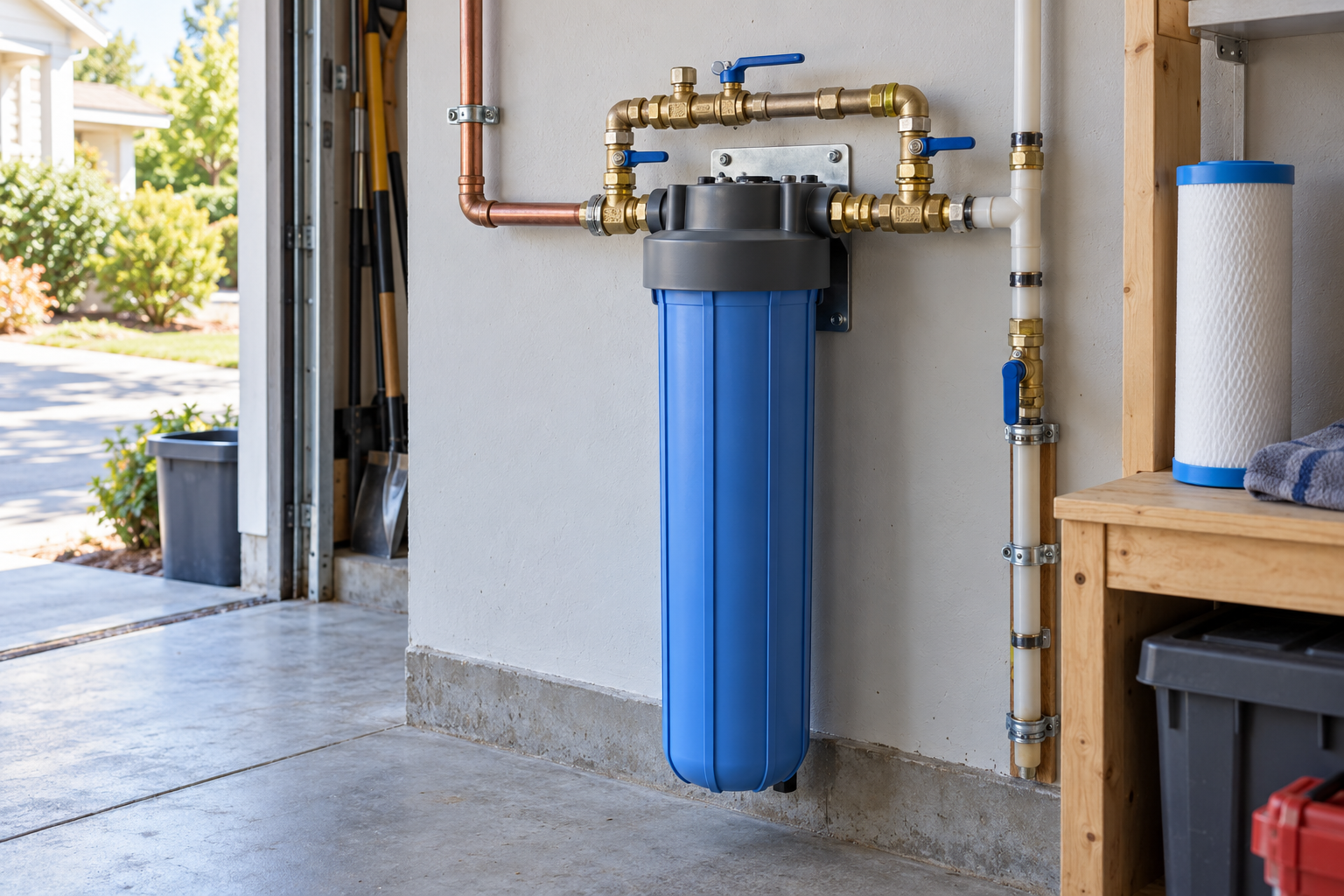
Common cartridge housings are often described by nominal length and diameter. Slim housings suit lower flows or point-of-use work, while larger-diameter “big blue” style housings offer more cartridge area and generally lower resistance for whole-house applications. Longer cartridges typically offer more area and capacity than shorter versions of the same design. Still, housing size alone does not guarantee performance; cartridges vary widely in media, micron rating, construction, and flow characteristics.
A fine sediment rating is not automatically better. Very fine cartridges can clog quickly when source water carries sand, rust, or silt. Staging a coarse washable separator or larger-micron prefilter ahead of a finer disposable cartridge may improve service life when the water test and equipment instructions support it. Use housings rated for the system pressure and temperature, install required brackets, and protect clear housings from light that could encourage growth.
Size Carbon and Other Media Systems Carefully
Carbon treatment needs enough media and contact time for the stated contaminant claim. A small cartridge may reduce chlorine at a modest flow but disappoint when several fixtures run. Large carbon tanks can offer lower restriction and more capacity, but they require appropriate control valves, drainage, backwashing flow, and maintenance. Verify independent certification for the reduction claim that matters to you rather than relying on broad “purifies everything” language.
Specialty media for iron, manganese, sulfur odor, scale, or other issues must match water chemistry, pH, oxidant conditions, and flow. Some systems require chemical feed, air injection, regeneration salt, or periodic backwash. Their drain discharge and electrical needs affect installation. When a treatment train includes a softener, carbon tank, sediment filter, and UV unit, calculate pressure loss and service requirements across the entire system, not one device at a time.
Match Port Size and Plumbing Layout
A filter’s connection should not create an unnecessary bottleneck. A home with a one-inch main should not casually be reduced through a small-port housing simply because adapters make it possible. The internal passages, bypass valve, elbows, and cartridge can all contribute restriction. Ask for a flow-versus-pressure-loss chart at the intended rate.
Installation also needs isolation valves, a bypass where appropriate, unions or other serviceable connections, pressure gauges, support, drainage, and enough clearance to remove a housing or tank. Do not hang a heavy water-filled housing from unsupported pipe. If changing the layout requires repiping, review the tradeoffs between PEX and copper and follow local code rather than building an improvised assembly.
Account for Capacity and Replacement Frequency
Capacity determines how often you service the system. A cartridge rated for a certain number of gallons may reach that figure quickly in a high-use household. Estimate daily use from a water bill, meter, or realistic household pattern, then compare it with rated capacity. Always obey time limits as well: some media should be replaced on schedule even when estimated gallons are low.
Larger is not always cheaper. A large specialty cartridge can cost more and may still fail early if heavy sediment is not addressed upstream. Conversely, repeatedly changing a small cartridge may cost more than installing a properly sized prefilter or tank. Compare annual consumable cost, pressure performance, sanitation steps, media disposal, and professional service—not just purchase price.
Avoid These Common Sizing Mistakes
The first mistake is buying by occupant count alone. Two homes with four residents can have very different peak demand because one has a single standard shower while the other has multiple high-flow fixtures. The second is selecting the smallest micron number without considering pressure and sediment load. The third is confusing a maximum hydraulic flow with certified treatment performance.
Also avoid assuming a whole-house carbon filter makes microbiologically unsafe well water potable. Carbon does not serve as a universal disinfectant, and exhausted or poorly maintained equipment can create problems. Do not conceal persistent leaks or corroded fittings during installation; a nearby water heater leaking from the top needs its own diagnosis. Finally, do not rely on thread tape to correct cracked housings, mismatched threads, or damaged valves; learn where plumbing tape does and does not stop leaks.
A Buyer’s Sizing Checklist
1. Obtain a relevant water test and identify treatment goals.
2. Measure or estimate simultaneous peak fixture demand.
3. Check incoming dynamic pressure while water is flowing.
4. Compare rated service flow, not marketing-only maximum flow.
5. Review pressure loss at both clean and loaded conditions.
6. Match port size to the main line and intended flow.
7. Confirm gallon capacity, time limit, and consumable cost.
8. Verify backwash flow, drain, power, and regeneration needs.
9. Look for applicable third-party certification.
10. Plan bypass, isolation, gauges, support, and service clearance.
Use this list to compare written specifications from several systems. If a seller cannot provide treatment performance or pressure-loss information, that uncertainty is itself useful purchasing information.
When to Escalate Beyond DIYfessional
Consult a qualified water-treatment professional when testing reveals a health-related contaminant, multiple treatment stages are required, or well chemistry makes equipment selection complex. A licensed plumber is appropriate when the main line must be altered, valves do not shut off, grounding or bonding may be affected, pressure exceeds equipment limits, or there is no safe drain and support arrangement.
Professional sizing is especially valuable for large homes, accessory units, fire-sprinkler interactions, commercial-style fixtures, low-producing wells, booster pumps, and systems requiring substantial backwash. Ask for the water analysis, design flow, pressure-loss assumptions, media quantity, maintenance schedule, warranty conditions, and expected consumable costs in writing.
Frequently Asked Questions
Is a 10-inch filter big enough for a whole house?
Sometimes for a small household or a limited prefilter role, but dimensions do not answer the question. Check cartridge service flow, pressure loss, contaminant capacity, and peak demand. Many homes benefit from a larger-diameter or longer housing when cartridge filtration is appropriate.
How many gallons per minute should I choose?
Choose a certified or documented service-flow rating at least equal to your realistic simultaneous demand, with reasonable margin. Measure high-flow fixtures and account for pressure loss through all treatment stages.
Does a larger pipe connection mean better filtration?
No. A larger port may reduce one source of restriction, but treatment depends on media, contact time, cartridge area, and water chemistry. Review the full pressure-loss and performance data.
Should irrigation run through the filter?
Usually there is little benefit in sending landscape irrigation through expensive whole-house media unless a specific water issue requires it. Routing depends on plumbing layout, code, and treatment goals; excluding irrigation can greatly reduce demand and media use.
Can I size the system without a water test?
You can estimate hydraulic flow, but you cannot responsibly select contaminant treatment without understanding the water. Testing prevents buying a large system that treats the wrong problem.
Why This Is Different in San Antonio
A filter here must handle both peak flow and a substantial mineral load. Edwards Aquifer hardness can consume sediment capacity indirectly as loosened scale reaches the housing, while carbon media still needs enough contact time to address chlorine, taste, and odor. A filter does not soften 21 gpg water unless it includes ion-exchange or another hardness-treatment stage.
SAWS publishes useful source and treatment data, but conditions inside a house vary with pipe age, heater sediment, and neighborhood pressure. In Helotes, private-well users need laboratory results before selecting media; municipal customers should still test at the tap if staining, odor, or repeated cartridge plugging is the concern. Keep irrigation and fire-sprinkler demand out of the filtered peak-flow calculation unless the system is specifically engineered for it.
Winter Storm Uri also exposed a practical design issue: outdoor housings and uninsulated garage piping can freeze. Use a bypass, isolation valves, pressure gauges before and after the media, and freeze protection so maintenance does not require shutting down the entire home.
What San Antonio Homeowners Pay (2026)
| Filter work | Typical homeowner range |
|---|---|
| Water test and flow/pressure assessment | $100–$350 |
| Large cartridge filter with bypass, installed | $600–$1,500 |
| Backwashing carbon or specialty media system | $2,000–$4,500 |
| Separate whole-home softener | $1,500–$4,000 |
| Licensed plumbing labor | $85–$150 per hour |
Prices depend on tested contaminants, media volume, service flow, drain access, and electrical work. Ask for the specified continuous flow rate and pressure drop in writing, not only a tank diameter.
When to Call a San Antonio Plumber
DIY measurement and cartridge replacement are reasonable when shutoffs work and the housing is accessible. Use a licensed plumber when the installation requires cutting the main, adding a code-compliant drain or backflow device, changing pipe size, or working near electrical equipment. A professional should also investigate pressure below 40 psi under load, unexplained iron or sulfur odor, bacteria in a well test, or a housing that repeatedly plugs in weeks.
Ask the installer to document the untreated and treated pressure, bypass operation, replacement interval, and where discharge water goes. For a Bexar County well, use a certified laboratory rather than choosing treatment from appearance alone.
San Antonio FAQ
Will a whole-house filter remove hard water?
Not unless hardness reduction is one of its stated functions. Sediment and carbon filters can improve particles, chlorine, taste, and odor but leave dissolved calcium and magnesium behind.
Is a 20-inch cartridge automatically large enough?
No. Check the manufacturer's flow curve at your measured peak demand and plan cartridge changes around actual pressure loss. A large-looking housing can still choke two simultaneous showers.
Should the filter serve outdoor faucets?
Usually not. Bypassing irrigation preserves media and flow, though a plumber may leave one treated hose bib for washing.