> San Antonio Local Insight: San Antonio's hard water from the Edwards Aquifer affects every plumbing system in your home. With 357 mg/L mineral content (21 grains per gallon), our water causes faster corrosion, heavier scale buildup, and more frequent repairs than most US cities. Understanding this local factor helps you make better decisions about maintenance, repair, and prevention.
Size the Unit From Grain Load and Peak Flow
“Family of four” is not enough information to size a softener. Start with measured hardness, average daily indoor use, and the number of fixtures that may run together. A unit must have enough efficient grain capacity between regenerations without becoming a bottleneck during showers, laundry, and dishwasher use.
In Alamo Heights, older galvanized or mixed-metal plumbing can already restrict flow, so installing a large-looking softener does not correct weak supply piping. Edwards Aquifer water around 357 mg/L, or 21 gpg, creates roughly 5,000 grains of daily load at 240 gallons per day before adding any iron adjustment. Many households therefore compare 40,000- to 48,000-grain class units, then verify usable capacity and service flow rather than relying on the box label.
A professionally installed system commonly falls around $1,800-$4,000 locally, with plumbing changes, drain routing, and valve quality driving the spread. Check SAWS usage history for a realistic demand estimate. DIY measurement and comparison are reasonable; cutting the main, creating a code-compliant drain connection, or correcting old pipe restrictions belongs with a licensed Bexar County plumber.
A homeowner in Alamo Heights should be especially careful because older galvanized and mixed-metal lines make small leaks more urgent than they look. If you are comparing advice from national repair guides, shorten the maintenance interval and inspect for white scale, crusted fittings, stiff shutoff valves, and early corrosion before assuming the part simply “got old.”
For budgeting, use local pricing instead of national averages: licensed plumber labor commonly runs $85-$150 per hour, with emergency visits costing more. If the issue appears after a summer high-use period or after a rare freeze like Winter Storm Uri, treat it as a local risk signal and document what you see before calling a licensed plumber in Bexar County.
For many four-person households, a nominal 32,000- to 48,000-grain water softener is a sensible starting range. It is not a universal answer. The correct size depends on how many gallons the household uses, the measured hardness of untreated water, any iron or manganese present, and the useful capacity delivered at an efficient salt setting.
Do not buy from household size alone. Two families of four can have very different needs if one uses 240 gallons a day at 8 grains per gallon while another uses 360 gallons at 20 grains per gallon. A short calculation, followed by a check of flow rate and local water conditions, produces a system that regenerates reliably without wasting salt or restricting pressure.
Start with hardness and daily water use
Test the cold, untreated water before any existing softener or filter. A laboratory or water-treatment professional is most useful for private wells because hardness may be accompanied by iron, manganese, sediment, low pH, bacteria, or other issues that a standard softener is not designed to solve. Municipal customers can start with a utility report, but an on-site hardness test is still helpful because source blending and units can vary.
Estimate daily use from recent water bills rather than relying only on a generic per-person allowance. Divide billed gallons by the number of service days, then consider whether outdoor irrigation bypasses the softener. If no bill is available, 60–75 gallons per person per day is a reasonable planning estimate, giving roughly 240–300 gallons for four people. Adjust for frequent laundry, large tubs, guests, or water-saving fixtures.
Calculate the household’s softening load
Multiply daily softened-water use by hardness in grains per gallon (gpg). A family using 280 gallons per day with 15 gpg hardness creates a daily load of 4,200 grains. Multiply that by the desired number of days between regenerations, then add a reserve so the resin is not exhausted before the next cycle. At seven days plus roughly one day of reserve, the example needs about 33,600 grains of usable capacity.
Iron can increase the effective load, but adjustment rules differ by equipment and water chemistry. Do not simply add a guessed number when a well test shows iron or manganese. Ask the equipment supplier how its resin, pretreatment, and programming handle the measured concentration. Significant iron, sediment, or sulfur odor may require pretreatment; oversizing a conventional softener does not make it a complete well-water treatment plant.
Quick sizing examples for a family of four
These examples assume all listed indoor water is softened and do not account for iron. They are planning figures, not substitutes for a water test and product-specific capacity data.
| Daily use | Hardness | Daily grain load | Approx. 8-day load | Practical nominal class to compare |
|---|---|---|---|---|
| 240 gal | 8 gpg | 1,920 | 15,360 | 24,000–32,000 grain |
| 280 gal | 15 gpg | 4,200 | 33,600 | 40,000–48,000 grain |
| 320 gal | 20 gpg | 6,400 | 51,200 | 64,000 grain |
| 360 gal | 25 gpg | 9,000 | 72,000 | 80,000 grain or twin alternating system |
Nominal labels are marketing shorthand. A “48,000-grain” unit may reach that figure only at a high salt dose, while its efficient programmed capacity is lower. Compare the manufacturer’s capacity at several salt settings, estimated gallons between regenerations, water used per cycle, and rated service flow—not just the largest number on the product page.
Nominal capacity versus efficient usable capacity
Ion-exchange resin can deliver more total capacity when regenerated with more salt, but the grains removed per pound of salt often decline at aggressive doses. In practical terms, selecting a little more resin and programming it at an efficient dose can use less salt than forcing a smaller system to its maximum advertised capacity. Product data should show capacity and salt dose together; a capacity claim without the corresponding pounds of salt is incomplete.
A correctly sized demand-initiated softener commonly regenerates about once a week, though a range of roughly every five to ten days may be reasonable. Regenerating every night suggests inadequate capacity, excessive load, a leak, or bad programming. Going many weeks between cycles is not automatically better either, especially with iron-bearing water or a system that needs periodic resin cleaning. Follow product guidance on maximum day override.
Check peak flow, not only grain capacity
A softener must pass enough water when several fixtures run at once. Morning demand might include two showers, a washing machine, and a faucet. If service flow exceeds what the resin tank and control valve can handle without excessive pressure drop, occupants may notice weak showers even though the grain calculation looks adequate. Review continuous and peak flow specifications and confirm the plumbing connection is not smaller than the home’s supply unnecessarily.
Large soaking tubs, body-spray showers, and multiple bathrooms raise peak demand. A larger resin tank or twin-tank system may be justified even when weekly grain load is modest. Conversely, buying an enormous single tank for a low-flow home can increase cost and create unnecessarily long intervals between regenerations. If supply piping is already restrictive, sizing the softener cannot correct it; decisions about PEX versus copper repiping belong in a separate plumbing evaluation.
Choose between common system configurations
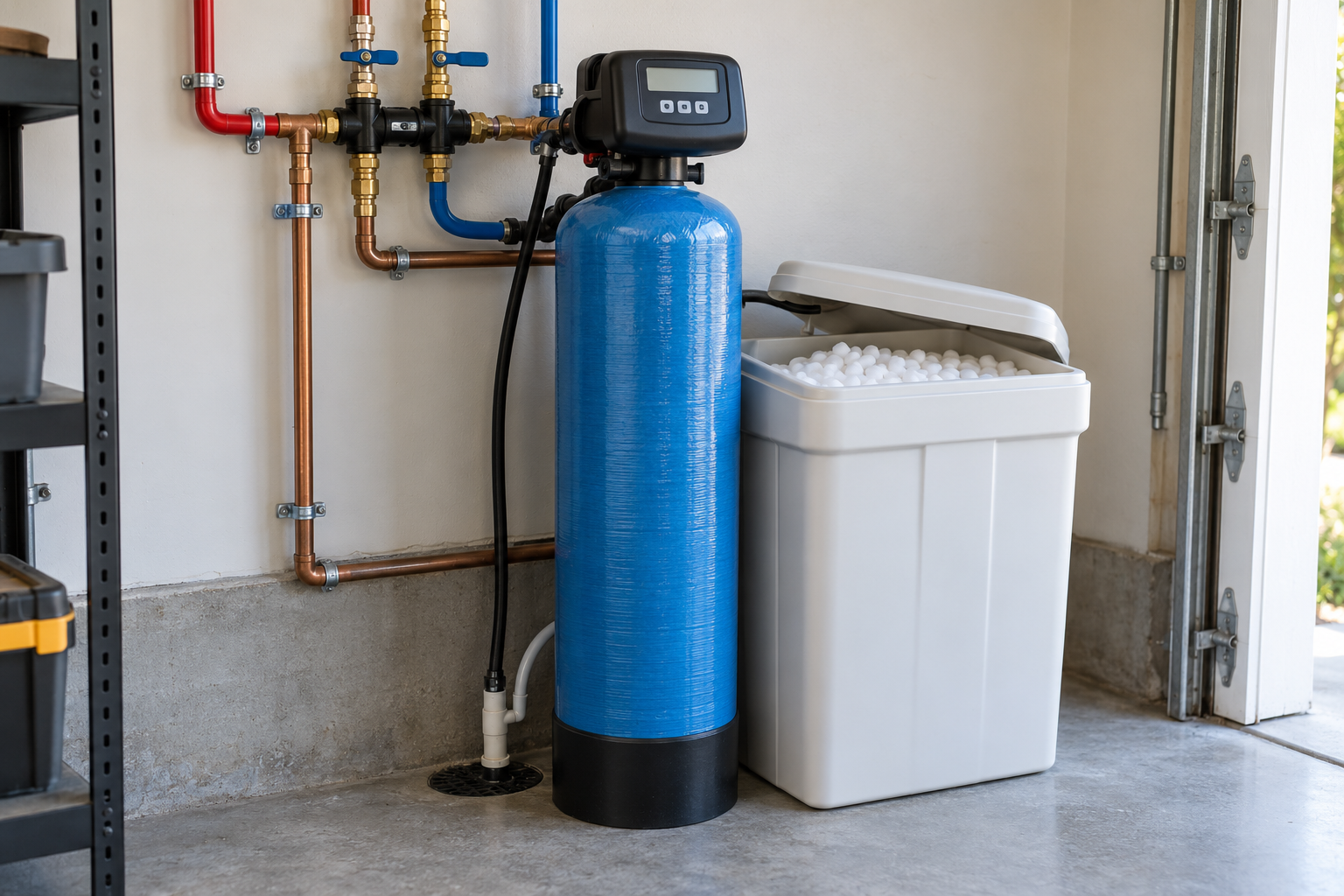
A single-tank demand-initiated softener is appropriate for many families. It meters usage, regenerates when calculated capacity is nearly depleted, and typically bypasses or provides hard water during regeneration. Scheduling that cycle overnight minimizes inconvenience. Look for accessible service parts, clear programming, a correctly sized brine tank, and published performance rather than extra display features.
A twin alternating system keeps one resin tank in service while the other regenerates. It is useful for very hard water, high continuous demand, or households that cannot tolerate a hard-water window. It costs more and needs more floor area. Cabinet-style units are compact but may be harder to service and hold less salt. Salt-free scale-control products are a different category: they may reduce scale behavior under certain conditions but do not remove hardness minerals or provide truly softened water.
Plan the installation and brine discharge safely
Measure the route, not just the equipment footprint. The site needs access to the main water line, a correctly trapped or air-gapped drain arrangement as required by code, a suitable electrical receptacle for powered controls, room to load salt, and protection from freezing. Keep required clearances from a water heater and do not place equipment where a leak would damage finished rooms without drainage or containment.
Brine discharge may be restricted for septic systems, dry wells, or local sewer rules. Confirm requirements before purchase. Never improvise a drain connection that could siphon sewage into the potable system. Shutoff and bypass valves should remain accessible. Water near electrical controls is a hazard; do not handle plugs while standing on a wet floor. A leak at adjacent equipment—such as a water heater leaking from the top—needs prompt diagnosis rather than being hidden behind a new softener.
Compare operating cost, not just purchase price
The total cost includes salt, regeneration water, electricity, periodic cleaning, replacement parts, and eventual resin or equipment replacement. Ask the seller to estimate annual salt and water use using your actual hardness and consumption, and request the settings behind that estimate. A low purchase price loses appeal if the unit regenerates inefficiently or proprietary parts are difficult to obtain.
Also consider warranty conditions, local service availability, and whether commissioning includes hardness testing and programming. Internet packages can be economical for an experienced installer, but plumbing adapters, drainage, a pressure-reducing valve, pretreatment, or code upgrades may change the final bill. Avoid purchasing before confirming the connection size and available space. A proper bypass assembly is valuable because it allows service without shutting off all household water.
Common sizing mistakes to avoid
The first mistake is choosing only by a chart that says “four people equals 32,000 grains.” That ignores a possible threefold difference in hardness. The second is treating advertised maximum capacity as efficient working capacity. The third is forgetting iron, which can foul resin and create much more maintenance than a hardness-only calculation predicts.
Other traps include softening outdoor irrigation, overlooking a running toilet, selecting a valve with inadequate flow, and placing the unit where salt cannot be loaded safely. Do not assume bigger is always safer. Extreme oversizing can mean stale brine, infrequent regeneration, a larger footprint, and unnecessary expense. Likewise, do not repair a leaking threaded connection by wrapping the outside; understanding whether plumbing tape stops leaks helps distinguish proper joint assembly from a temporary-looking but ineffective patch.
When professional sizing is the better choice
Professional help is wise for private wells, very hard water, detectable iron or manganese, sulfur odor, low water pressure, unusual pH, or high peak-flow fixtures. A qualified water-treatment specialist can test the source, calculate load, verify pressure and flow, identify pretreatment, and program reserve and regeneration correctly. A licensed plumber may be needed for the bypass, drain, backflow protection, electrical bonding considerations, or code compliance.
Stop DIY work if valves will not close, piping is corroded, there is active flooding, or electrical components are wet. Do not cut into a pressurized supply. Shut off water at a known, operable valve and relieve pressure according to safe procedures; if the shutoff is unreliable, call a plumber. Sizing is arithmetic, but safe installation depends on real site conditions and local rules.
Frequently asked questions
Is a 32,000-grain softener enough for four people?
It can be enough for moderate water use and mild-to-medium hardness. Calculate daily gallons multiplied by gpg, include reserve, and compare that load with efficient—not maximum—usable capacity. At high hardness, 32,000 nominal grains may regenerate too frequently.
Is a 48,000-grain unit too large for a family of four?
Not necessarily. It is often a practical class for medium-hard to hard water, particularly when operated at an efficient salt dose. Confirm the actual resin volume, flow rating, and programmed capacity.
How often should a correctly sized system regenerate?
Many demand-based household units regenerate about every five to ten days, with around weekly being a useful design target. Manufacturer guidance, iron content, and day-override settings can change that range.
Does a bigger softener increase water pressure?
No. An adequately sized valve and tank can reduce avoidable pressure loss, but a softener does not boost supply pressure. Restricted plumbing, clogged media, or a partially closed bypass requires separate diagnosis.
How much salt will a family of four use?
Usage depends on grain load and programmed efficiency, not family size alone. Ask for capacity at a stated salt dose, then track actual bags used. A sudden increase can signal higher consumption, a leak, or incorrect settings.
For most buyers, the best water softener size for a family of four emerges from three checks: measured hardness, realistic daily use, and adequate peak flow. Do that work before comparing brands, and a 32,000-, 48,000-, or 64,000-grain choice becomes a defensible calculation rather than a guess.
Why This Is Different in San Antonio
San Antonio's Edwards Aquifer supplies some of the hardest municipal water in the United States: about 357 mg/L, or 21 grains per gallon. That limestone-filtered groundwater carries calcium carbonate and magnesium into our fixtures, valves, drains, heaters, and supply lines. For water softener size for family of 4, that matters because mineral scale changes the maintenance schedule, failure signs, and realistic repair costs for local homeowners.
- Scale buildup makes small restrictions worse, especially at cartridges, aerators, shutoff valves, drains, and heater connections.
- Fixtures, pipes, and appliances in our area can wear out 30-50% faster than in soft-water cities when maintenance is delayed.
- SAWS publishes annual water quality reports, but the practical homeowner takeaway is simple: maintenance intervals here should be shorter than national advice suggests.
Homes in Alamo Heights are particularly affected because older 1920s-40s homes often still have galvanized or mixed-metal plumbing that reacts badly to mineral-heavy water. Unlike cities with naturally soft water, local homeowners should treat hard-water maintenance as normal prevention, not an upsell.
> "In my 20 years working in San Antonio, I would say most surprise plumbing failures I see start with homeowners following soft-water maintenance advice in a hard-water city." — Licensed local plumber
What San Antonio Homeowners Pay (2026)
| Service | Typical Cost in San Antonio |
|---|---|
| Emergency plumber call | $150–$350; after hours $250–$500 |
| Plumber hourly rate | $85–$150/hr |
| Water softener installation | $1,500–$4,000 |
Prices are based on local metro area ranges for 2026. Costs may vary by neighborhood, access, pipe material, after-hours timing, and whether the plumber finds hard-water damage beyond the visible problem.
When to Call a San Antonio Plumber
Call a licensed local plumber if the problem involves active leaking, a shutoff valve that will not close, sewer smell, recurring clogs, water near electrical components, a water heater leak, or any pipe inside a wall, ceiling, or slab. Locally, expect many licensed plumbers to charge roughly $85-$150 per hour, with emergency visits commonly around $150-$350 and after-hours calls closer to $250-$500.
When you call, ask three local questions:
1. Are you licensed and insured for work in Bexar County or the surrounding local metro?
2. Have you dealt with Edwards Aquifer hard-water scale on this type of repair?
3. Should I also check the water heater, shutoff valves, or water softener while you are there?
local plumbers see hard-water issues every week, so a good pro should be able to explain whether the failure is normal wear, mineral damage, freeze damage from a cold snap like Winter Storm Uri, or a sign of a larger plumbing system problem.
San Antonio FAQ
Is San Antonio water hard?
Yes. San Antonio water is very hard at about 357 mg/L, or 21 grains per gallon, because much of it comes from the Edwards Aquifer and passes through limestone. That mineral content is why scale shows up quickly on faucets, showerheads, valves, drains, and water heaters.
Do local homes need a water softener?
A water softener is recommended for many local homes, especially if you see white scale, repeated faucet or valve problems, short water-heater life, or cloudy spots on dishes. A typical whole-home water softener installation in San Antonio runs about $1,500-$4,000.