Quick answer: There is no honest single lifespan number for every San Antonio water heater. Tank design, installation, water chemistry, temperature, anode condition, sediment, maintenance, and location all matter. In very hard water, plan inspections earlier, keep records, and replace based on condition and risk—not a generic birthday.
A ten-year-old tank in a drained garage with a maintained anode presents a different risk from a seven-year-old tank in an interior closet with rumbling sediment and corrosion at the base. The useful question is not only “How old is it?” but “What evidence says it can continue operating safely?”
For national context, the U.S. Department of Energy says conventional storage heaters generally last 10–15 years, while most tankless units have a life expectancy exceeding 20 years with replaceable parts. Those are broad baselines, not promises for a specific installation or untreated hard-water service; see the DOE tankless water-heater guide.
Use this age-and-condition decision table
| Condition | Practical next step |
|---|---|
| Under 6 years, dry, quiet, stable hot-water output | Keep the model/serial record and follow manufacturer maintenance. |
| Any age with active tank leak or water at the base | Shut down safely and arrange replacement; a leaking tank is not a maintenance project. |
| 6–10 years with rumbling, reduced capacity, rusty fittings, or repeated service | Schedule an inspection and obtain a replacement plan before failure. |
| Over 10 years in an interior/attic/finished-space location | Treat damage exposure as part of the decision; price planned replacement and leak protection. |
| Unknown age or history | Read the serial label, locate the manual, inspect condition, and establish a baseline. |
Manufacturer warranties and expected service life are not the same thing. A warranty has terms and exclusions; it does not predict the exact failure date.
Why San Antonio water changes maintenance
SAWS explains that calcium carbonate from the Edwards and Trinity aquifers naturally makes local water hard. Check the current SAWS water-quality report and water-quality FAQ instead of relying on one citywide hardness number for every address.
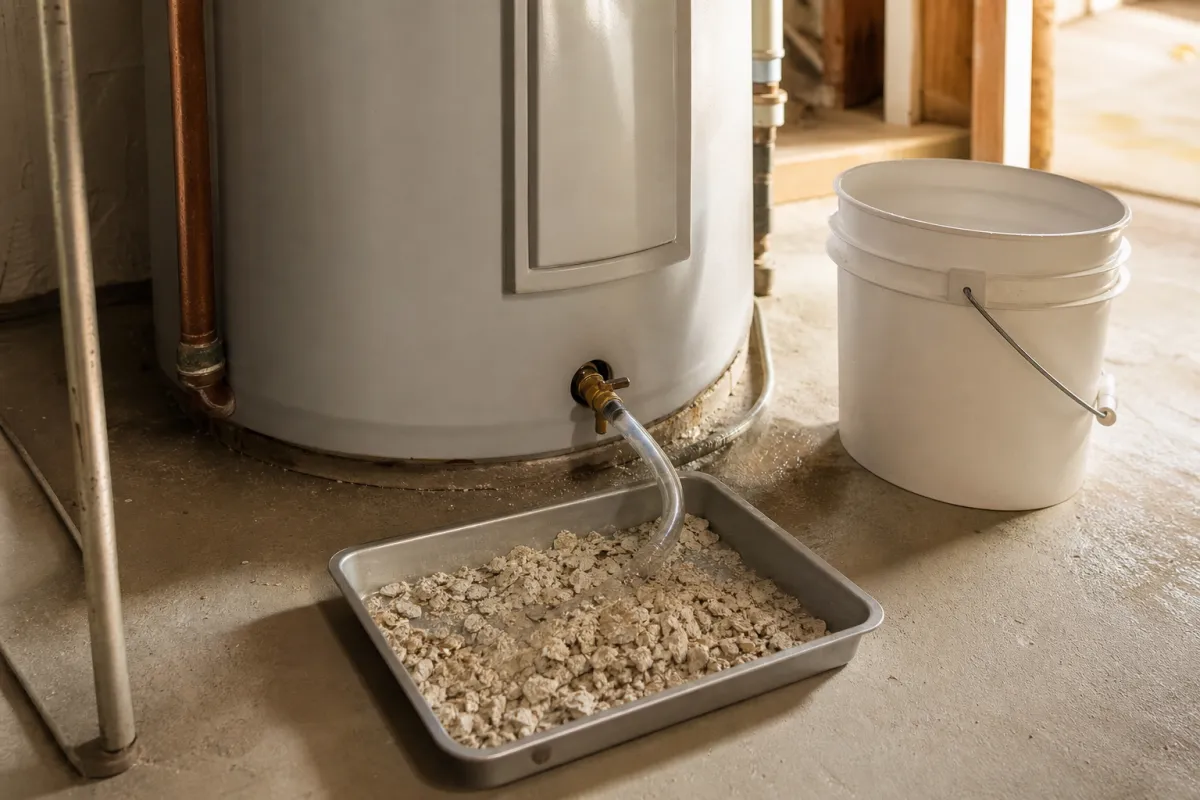
When hard water is heated, mineral scale and sediment can collect in the tank or on heating surfaces. In a gas tank, sediment can insulate the bottom of the tank and contribute to popping or rumbling. In an electric tank, deposits can accumulate around the lower element. In a tankless unit, scale can restrict the heat exchanger and flow passages.
That does not support a universal claim that hard water removes exactly two, four, or five years of life. It does support a shorter inspection rhythm and closer adherence to the model’s maintenance instructions.
The six checks that matter most
1. Tank or heat-exchanger leaks
Moisture from the tank body, welded seam, or heat exchanger is a replacement-level warning. First rule out condensation and a loose external fitting, but do not patch a leaking pressure vessel.
2. Temperature and pressure relief system
The relief valve and discharge pipe are safety components. Do not cap, plug, or reduce the discharge. If the valve drips, lifts repeatedly, or lacks a proper discharge path, have the system evaluated.
3. Anode condition on tank models
The sacrificial anode helps protect a steel tank from corrosion. Inspection interval and replacement method vary by manufacturer and model. Some installations have little ceiling clearance, and powered or segmented replacement options may require professional evaluation.
4. Sediment and drainability
A drain valve that will not flow can indicate sediment, but aggressive flushing of a neglected old tank can create a new leak or block the valve. Follow the manufacturer procedure and do not improvise with pressure, chemicals, or tools that the manual does not allow.
5. Combustion or electrical condition
Soot, flame abnormalities, venting concerns, scorching, tripped breakers, burned wiring, or melted insulation require qualified help. Routine water-side maintenance does not make gas or high-voltage work DIY-safe.
6. Location and damage exposure
A tank above finished space, in an interior closet, or near valuable flooring deserves a lower tolerance for uncertainty than one in a drained utility area. Check the drain pan, drain path, shutoff access, and whether a leak detector or automatic shutoff is appropriate.
Maintenance plan: follow the manual, then adjust from evidence
A useful plan has dates, observations, and the exact model instructions.
| Task | Baseline approach | Escalate when |
|---|---|---|
| Visual leak/corrosion check | Monthly glance and after nearby plumbing work | Moisture, rust streaks, bulging, or damaged insulation |
| Temperature check | Confirm safe, useful output; DOE commonly recommends about 120°F for many homes | Scald risk, bacterial-risk context, or appliance needs require professional advice |
| Flush/descale | Use the manufacturer’s procedure and interval | Heavy sediment, poor drain flow, or neglected history makes DIY uncertain |
| Anode inspection | Follow model manual; record condition | Access is poor or depletion is advanced |
| Vent/combustion review | Professional service for fuel-burning equipment | Soot, odor, rollout, vent damage, or alarm |
| Leak protection | Test detector/shutoff per manufacturer | Finished-space exposure or prior leak history |
The U.S. Department of Energy’s water-heater temperature guidance is a useful starting point for efficiency and temperature decisions. The appliance manual remains the controlling source for maintenance steps.
Should San Antonio tanks be flushed every six months?
Six months can be a reasonable local service interval for a high-sediment tank, but it is not a universal rule. Use three inputs:
1. the manufacturer’s instructions;
2. what previous flushes actually produced;
3. advice from a qualified technician who has inspected the system.
A newer, regularly maintained tank may tolerate routine flushing well. An old tank that has never been flushed can present different risks. Record the date, sediment amount, valve condition, and any change in noise or recovery.
Repair or replace?
Repair can make sense for a younger tank with an external component failure: thermostat, element, valve, igniter, or serviceable control. Replacement becomes more rational when the tank body leaks, corrosion is advanced, several systems are failing, parts are unavailable, or the installation itself is unsafe.
Build a replacement quote with separate lines for:
- exact heater model and capacity;
- removal and haul-away;
- code/safety corrections;
- venting, gas, or electrical scope;
- drain pan and discharge path;
- expansion control where required;
- permit/inspection responsibility;
- water treatment or isolation valves;
- labor and product warranty.
A planned replacement is easier to compare than an emergency replacement after water damage.
Tank versus tankless in hard water
Tankless equipment avoids storing a full tank of hot water, but it does not avoid scale. It requires correctly placed service valves and periodic descaling based on water quality and manufacturer instructions. Conversion can also trigger gas-line, venting, condensate, or electrical work.
Choose tankless for its operating characteristics and a maintainable installation—not as a promise that hard-water maintenance disappears. See the tankless brand and serviceability guide before requesting bids.
Stop-DIY conditions
Call a licensed plumber or qualified technician for:
- active tank leakage;
- gas odor, soot, venting damage, or combustion concerns;
- water near electrical components;
- repeated relief-valve discharge;
- a breaker that trips again after reset;
- severe corrosion, bulging, or a blocked drain valve;
- any job requiring gas-line, vent, circuit, or pressure-system modification.
If gas odor is present, leave the area and follow the gas utility’s emergency guidance. Do not operate switches or attempt a repair.
FAQ
How long should a water heater last in San Antonio?
Use age as one input, not a guarantee. Condition, maintenance, water quality, installation, and location risk matter more than a single citywide number.
Does a water softener guarantee longer life?
No. Treatment can reduce scale, but settings and maintenance matter, and softened water changes system chemistry. Size and maintain equipment correctly and continue heater inspections.
Is rumbling always a replacement sign?
No, but it often indicates sediment or boiling beneath deposits and deserves diagnosis. On an older unit, combine the noise with age, leak risk, recovery, and corrosion before spending on service.
What should I read next?
Compare tankless water-heater brands and local service factors, review faucet choices for hard water, or request a scoped local estimate.