> San Antonio Local Insight: San Antonio's hard water from the Edwards Aquifer affects every plumbing system in your home. With 357 mg/L mineral content (21 grains per gallon), our water causes faster corrosion, heavier scale buildup, and more frequent repairs than most US cities. Understanding this local factor helps you make better decisions about maintenance, repair, and prevention.
Replace the Cartridge When Capacity or Pressure Says It Is Done
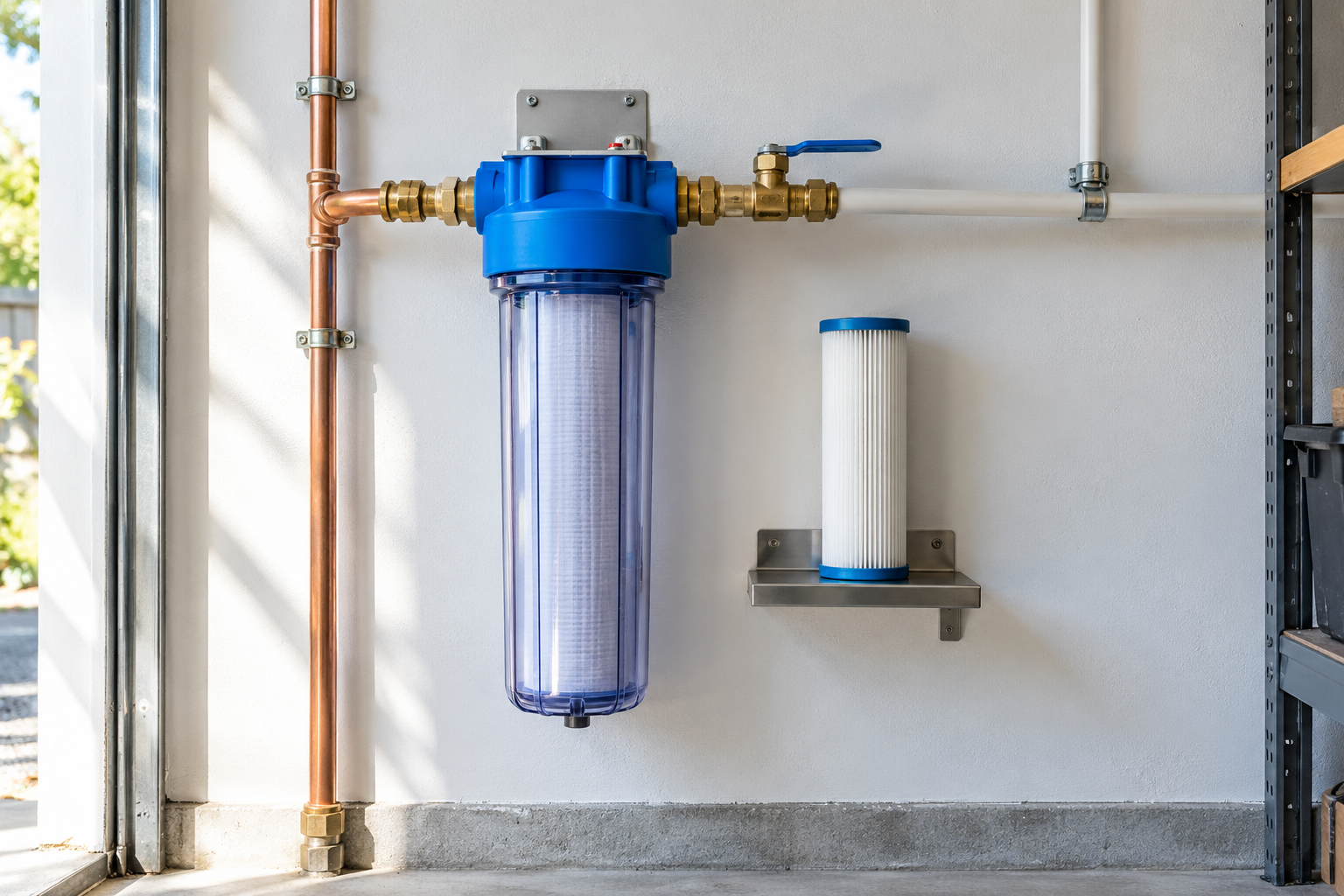
A whole-house filter interval begins with the media rating, but the pressure drop and captured sediment decide the real change date. Record pressure immediately after installing a clean cartridge, then compare it under the same flow conditions each month. A noticeable decline, dirty-water breakthrough, or the manufacturer's capacity limit is stronger evidence than an arbitrary reminder.
Stone Oak homes often have 1990s- and 2000s-era copper systems where scale at cartridges and fixture passages can mimic a supply problem. Edwards Aquifer water at about 357 mg/L, or 21 gpg, is hardness—not automatically sediment—so identify what the cartridge is designed to remove. A standard cartridge may cost $20-$80, while a plumber's filter service or diagnosis commonly starts around $125-$300 depending on housing condition and access.
Use SAWS notices to rule out temporary distribution work when sediment changes suddenly. Seasonal construction, main flushing, and freeze repairs after events such as Winter Storm Uri can shorten a cartridge cycle. Homeowners can change an accessible housing after shutting off water and relieving pressure; stop if the housing is cracked, the isolation valves will not close, or contamination requires certified treatment.
A homeowner in Stone Oak should be especially careful because 1990s and 2000s copper lines are a common place for pinhole leaks and scale-related fixture wear. If you are comparing advice from national repair guides, shorten the maintenance interval and inspect for white scale, crusted fittings, stiff shutoff valves, and early corrosion before assuming the part simply “got old.”
For budgeting, use local pricing instead of national averages: licensed plumber labor commonly runs $85-$150 per hour, with emergency visits costing more. If the issue appears after a summer high-use period or after a rare freeze like Winter Storm Uri, treat it as a local risk signal and document what you see before calling a licensed plumber in Bexar County.
A whole-house water filter should usually be changed according to the manufacturer’s rated capacity, but the calendar is only a starting point. Many sediment cartridges last about three to six months, while larger media tanks may serve for several years before their media needs replacement. Actual life depends on water use, contaminant load, filter size, and the pressure drop your household can tolerate.
The most reliable rule is to combine a maintenance schedule with evidence from the system. Note the installation date, check the cartridge at sensible intervals, and watch for lower pressure, altered taste or odor, visible sediment, and changes in water quality. Replace a filter sooner when those signs appear. A neglected filter can restrict flow and, depending on its design and condition, stop treating water effectively.
Start With the Filter Type, Not a Generic Schedule
“Whole-house filter” can describe several very different systems. A small spun-polypropylene sediment cartridge may need attention several times a year. A pleated cartridge can sometimes be cleaned if its manufacturer explicitly permits it. Carbon block cartridges have a finite adsorption capacity and should not be judged by appearance alone. Backwashing carbon, iron-removal, or catalytic media tanks follow service intervals based on gallons, water chemistry, and equipment settings rather than a simple monthly swap.
Read the label on the housing and the specification for the exact replacement element. Look for both a time interval and a rated gallon capacity. The first limit reached should generally trigger replacement. If the manual says six months or 50,000 gallons, for example, a high-use household may reach the gallon limit first. Keep in mind that broad online recommendations cannot override instructions for a particular model.
A Practical Replacement Range
The following ranges are useful for planning, but they are not guarantees. Unusually dirty well water, municipal main work, wildfire ash, flooding, or old supply pipes can shorten service life dramatically.
| Filter or treatment stage | Common planning range | Better signal to use |
|---|---|---|
| Fine sediment cartridge | 1–6 months | Pressure drop and visible loading |
| Pleated sediment cartridge | 3–9 months | Pressure drop; cleaning only if allowed |
| Carbon cartridge | 3–12 months | Rated gallons, time, taste or odor change |
| Specialty iron or manganese cartridge | 1–6 months | Water testing and breakthrough |
| Large backwashing media tank | Several years | Dealer testing, media condition, performance |
| UV prefilter | Often 3–6 months | Pressure drop and UV-system requirements |
A household using modest amounts of clean city water may land near the long end of a cartridge range. A busy household on a sediment-heavy well may land at the short end. When a system has several stages, each stage can have a different interval; replacing every component on the same arbitrary date may waste usable media or leave an exhausted stage in service.
What to Check First
Find the installation manual, model number, cartridge part number, and date of the last change. If there is no maintenance record, write the current date on the housing tag and begin one now. Confirm whether the treatment is intended for sediment, chlorine, lead, iron, sulfur odor, scale, microorganisms, or another issue. Different contaminants require different media, and an apparently clean cartridge may still be chemically exhausted.
Next, inspect any pressure gauges before and after the filter while water is flowing. A growing difference between the two readings is stronger evidence of clogging than a single static pressure reading. If there are no gauges, note whether several fixtures lose flow at once. One weak faucet may have a clogged aerator or local valve; reduced flow throughout the house points more strongly toward the main filter, pressure equipment, or supply.
Signs the Filter Needs an Early Change
A noticeable whole-house pressure reduction is the classic sign of a loaded sediment cartridge. Other clues include sediment returning to tubs or toilet tanks, chlorine taste or odor returning after a carbon stage, staining that reappears after iron treatment, or cloudy water that was previously clear. Do not wait for every symptom to appear. A treatment stage can reach capacity without changing the water’s appearance.
Pay attention after disturbances in the supply. Municipal flushing and water-main repairs can send rust and sediment toward homes. Well work can temporarily increase sand or silt. In those situations, check the first-stage filter soon afterward. If water suddenly smells like sewage, fuel, or chemicals, or if a boil-water advisory is issued, a routine cartridge change is not an adequate response. Stop using the water as directed by local authorities and obtain appropriate testing or professional guidance.
How Household Conditions Change the Interval
Water use matters because most filters are capacity-limited. More occupants, frequent laundry, large tubs, irrigation connected downstream of the filter, and leaks all push more gallons through the media. A vacation home may reach a time limit before a gallon limit, while a large family can do the opposite. Carbon media in particular should not remain indefinitely merely because the house was lightly occupied; follow storage, stagnation, and replacement directions from the manufacturer.
Water quality is equally important. A 5-micron cartridge facing heavy silt will load faster than one filtering already-clear municipal water. Finer filtration also creates more resistance and may clog sooner. If cartridges repeatedly fail far earlier than expected, do not simply buy them in bulk. Test the source water and investigate whether a spin-down separator, larger housing, staged filtration, well repair, or different micron sequence would address the cause more effectively.
A Safe Step-by-Step Replacement Routine
First, buy the exact approved replacement and any required food-grade lubricant or housing O-ring. Do not substitute petroleum jelly on seals unless the manufacturer permits it. Turn off equipment that depends on water flow if its manual requires shutdown, then close the main supply valve or the filter’s isolation valves. Open a cold faucet to relieve pressure and press the housing’s pressure-release button if provided. Never force a pressurized housing open.
Place a bucket beneath the unit, support the housing, and use the supplied wrench carefully. Remove the old cartridge without touching nearby electrical equipment with wet hands. Clean and sanitize the housing only with the method and concentration specified by the manufacturer. Inspect the O-ring for flattening, cuts, swelling, or grit; replace a damaged seal and seat it correctly. Install the new element in the right orientation, tighten the housing by hand as directed, and avoid over-tightening.
Restore water slowly while a nearby faucet remains partly open to purge air. Check the housing, pressure-relief button, bypass, drains, and unions for leaks. Some carbon cartridges require flushing for several minutes or a stated number of gallons. Follow that instruction before drinking the water, then recheck for leaks after the system has reached full pressure. If a connection continues to seep, shut the water off rather than assuming plumbing tape will stop the leak.
Mistakes That Shorten Filter Life or Create Risk
Do not choose a replacement solely because it physically fits the housing. Micron rating, material, flow capacity, certification, temperature rating, and contaminant claims all matter. An extremely fine cartridge can create disappointing pressure or clog rapidly when it is used as the first defense against heavy sediment. Conversely, a coarse filter will not reliably remove fine particles merely because the housing is labeled “whole house.”
Avoid bypassing an exhausted filter for extended use unless the system instructions and water conditions make that safe. A bypass restores flow but also sends untreated water downstream. Never reuse a disposable cartridge, pressure-wash it, or soak it in household chemicals. Do not open housings under pressure, and do not work in standing water near pumps, heaters, outlets, or electrical panels. A filter service is also a good time to scan nearby plumbing for corrosion; water at the top of a tank may require a different diagnosis, as explained in this guide to a water heater leaking from the top.
Build a Schedule You Can Trust
Record the date, meter reading if available, cartridge model, observed condition, and pressure readings at every change. Put the next inspection on a calendar earlier than the maximum replacement date. After two or three cycles, the record will reveal whether the household consistently gets two months, six months, or another interval. A simple tag attached to the housing helps anyone servicing the system avoid guessing.
A differential-pressure gauge or pair of gauges makes the schedule more useful. Record readings with a known flow, such as one bathtub faucet running, because static pressure does not reveal filter resistance well. If interval and pressure disagree, obey the manufacturer’s capacity limit while investigating. Changing a carbon element on time is important even when pressure remains normal because chemical adsorption can be exhausted before the cartridge looks clogged.
When Frequent Changes Point to a Bigger Problem
A cartridge that plugs every few days or weeks may be warning you about a failing well screen, deteriorating pipe, disturbed municipal supply, excessive iron, or a filter that is undersized for the flow. Sudden pressure changes can also come from a pressure tank, pressure regulator, partially closed valve, pump, or plumbing restriction. Replacing the cartridge may temporarily improve flow without correcting the underlying condition.
Call a licensed plumber or qualified water-treatment professional when housings are cracked, valves do not isolate the system, plumbing must be cut or repiped, leaks persist, or pressure is unsafe. For a well, use a laboratory appropriate to your area to test contaminants before selecting treatment. If an installation needs substantial pipe changes, compare material and installation implications rather than making an improvised connection; this overview of PEX versus copper repiping can help frame that conversation.
Quick Maintenance Checklist
- Identify the exact filter type, model, and contaminant purpose.
- Follow both the time limit and rated gallon capacity.
- Check pressure drop under flowing conditions.
- Watch for sediment, staining, taste, or odor breakthrough.
- Keep the correct cartridge and spare O-ring on hand.
- Isolate the water and relieve pressure before opening a housing.
- Clean, reassemble, flush, and leak-test exactly as directed.
- Record the date, readings, and next inspection.
- Investigate unusually short service life instead of repeatedly masking it.
Frequently Asked Questions
Can I wait until water pressure drops?
Not for every filter. Pressure drop is useful for sediment loading, but carbon and other treatment media can reach their contaminant capacity while flow still feels normal. Respect the manufacturer’s time and gallon limits as well as pressure observations.
Does a brown cartridge always need replacement?
Discoloration indicates captured material, but color alone does not measure remaining capacity. Replace it if the service limit or pressure threshold has been reached. If a new filter turns brown unusually quickly, test the water and investigate the source.
Should I change all stages at once?
Only when their service intervals happen to align or the manufacturer specifies it. A sediment prefilter may need several changes during the life of a carbon stage. Label each housing and track each element separately.
What happens if I install the wrong micron rating?
A much finer cartridge may restrict flow and clog early; a coarser one may allow unwanted particles downstream. Match the system design, required flow, and treatment goal rather than assuming the smallest micron number is automatically best.
Is filtered water automatically safe to drink?
No. Safety depends on the source, contaminants, filter claims, installation, and maintenance. Many whole-house filters improve sediment, taste, or odor without disinfecting water or removing every health-related contaminant. Use appropriate testing and treatment for the actual water supply.
Why This Is Different in San Antonio
San Antonio's Edwards Aquifer supplies some of the hardest municipal water in the United States: about 357 mg/L, or 21 grains per gallon. That limestone-filtered groundwater carries calcium carbonate and magnesium into our fixtures, valves, drains, heaters, and supply lines. For how often to change whole house water filter, that matters because mineral scale changes the maintenance schedule, failure signs, and realistic repair costs for local homeowners.
- Scale buildup makes small restrictions worse, especially at cartridges, aerators, shutoff valves, drains, and heater connections.
- Fixtures, pipes, and appliances in our area can wear out 30-50% faster than in soft-water cities when maintenance is delayed.
- SAWS publishes annual water quality reports, but the practical homeowner takeaway is simple: maintenance intervals here should be shorter than national advice suggests.
Homes in Stone Oak are particularly affected because many 1990s-2000s homes have copper lines where hard-water scale and pinhole leaks show up sooner than owners expect. Unlike cities with naturally soft water, local homeowners should treat hard-water maintenance as normal prevention, not an upsell.
> "In my 20 years working in San Antonio, I would say most surprise plumbing failures I see start with homeowners following soft-water maintenance advice in a hard-water city." — Licensed local plumber
What San Antonio Homeowners Pay (2026)
| Service | Typical Cost in San Antonio |
|---|---|
| Emergency plumber call | $150–$350; after hours $250–$500 |
| Plumber hourly rate | $85–$150/hr |
| Water softener installation | $1,500–$4,000 |
Prices are based on local metro area ranges for 2026. Costs may vary by neighborhood, access, pipe material, after-hours timing, and whether the plumber finds hard-water damage beyond the visible problem.
When to Call a San Antonio Plumber
Call a licensed local plumber if the problem involves active leaking, a shutoff valve that will not close, sewer smell, recurring clogs, water near electrical components, a water heater leak, or any pipe inside a wall, ceiling, or slab. Locally, expect many licensed plumbers to charge roughly $85-$150 per hour, with emergency visits commonly around $150-$350 and after-hours calls closer to $250-$500.
When you call, ask three local questions:
1. Are you licensed and insured for work in Bexar County or the surrounding local metro?
2. Have you dealt with Edwards Aquifer hard-water scale on this type of repair?
3. Should I also check the water heater, shutoff valves, or water softener while you are there?
local plumbers see hard-water issues every week, so a good pro should be able to explain whether the failure is normal wear, mineral damage, freeze damage from a cold snap like Winter Storm Uri, or a sign of a larger plumbing system problem.
San Antonio FAQ
Is San Antonio water hard?
Yes. San Antonio water is very hard at about 357 mg/L, or 21 grains per gallon, because much of it comes from the Edwards Aquifer and passes through limestone. That mineral content is why scale shows up quickly on faucets, showerheads, valves, drains, and water heaters.
Do local homes need a water softener?
A water softener is recommended for many local homes, especially if you see white scale, repeated faucet or valve problems, short water-heater life, or cloudy spots on dishes. A typical whole-home water softener installation in San Antonio runs about $1,500-$4,000.