> San Antonio Local Insight: San Antonio's hard water from the Edwards Aquifer affects every plumbing system in your home. With 357 mg/L mineral content (21 grains per gallon), our water causes faster corrosion, heavier scale buildup, and more frequent repairs than most US cities. Understanding this local factor helps you make better decisions about maintenance, repair, and prevention.
Resin Life Depends on Water Chemistry and Actual Performance
Resin is not a calendar-only maintenance item. Replace it when testing shows that the bed no longer exchanges hardness reliably after correct regeneration—not merely because the system reached an anniversary. In Westover Hills and Alamo Ranch, even newer PEX-heavy houses can show the first clues at shower glass, faucet cartridges, and the water heater.
Edwards Aquifer water is commonly about 357 mg/L, or 21 gpg. That heavy hardness makes correct capacity settings important, while disinfectant exposure, sediment, and iron determine how quickly resin degrades. Test untreated and softened water, confirm salt draw, and review regeneration history before ordering a rebed. A service diagnosis often runs about $125-$250, while professional rebedding commonly lands around $600-$1,200 depending on tank size, resin grade, and valve condition.
SAWS water-quality information can help establish the source-water baseline, but a sample at the home tells you what reaches the appliance. Homeowners can safely test hardness and inspect the brine cycle. Leave pressure-vessel opening, distributor repair, and electrical troubleshooting to a qualified technician.
A homeowner in Westover Hills and Alamo Ranch should be especially careful because newer PEX-heavy homes still get hard-water damage at fixtures, cartridges, and appliances. If you are comparing advice from national repair guides, shorten the maintenance interval and inspect for white scale, crusted fittings, stiff shutoff valves, and early corrosion before assuming the part simply “got old.”
For budgeting, use local pricing instead of national averages: licensed plumber labor commonly runs $85-$150 per hour, with emergency visits costing more. If the issue appears after a summer high-use period or after a rare freeze like Winter Storm Uri, treat it as a local risk signal and document what you see before calling a licensed plumber in Bexar County.
Water softener resin does not have a universal replacement date. In many homes, a properly sized system with suitable feed water can use the same resin for roughly a decade or longer, while chlorine, iron, sediment, hydraulic damage, or poor regeneration can shorten that service life. Age is useful context, but performance and water testing should drive the decision.
Do not replace resin simply because the calendar says so. First confirm that hard-water symptoms are not caused by an empty salt tank, salt bridge, clogged injector, incorrect settings, bypass position, or a failed control valve. Resin replacement is messy and involves a heavy pressure vessel; for many homeowners, diagnosis and rebedding are better handled by a water-treatment professional.
What softener resin does
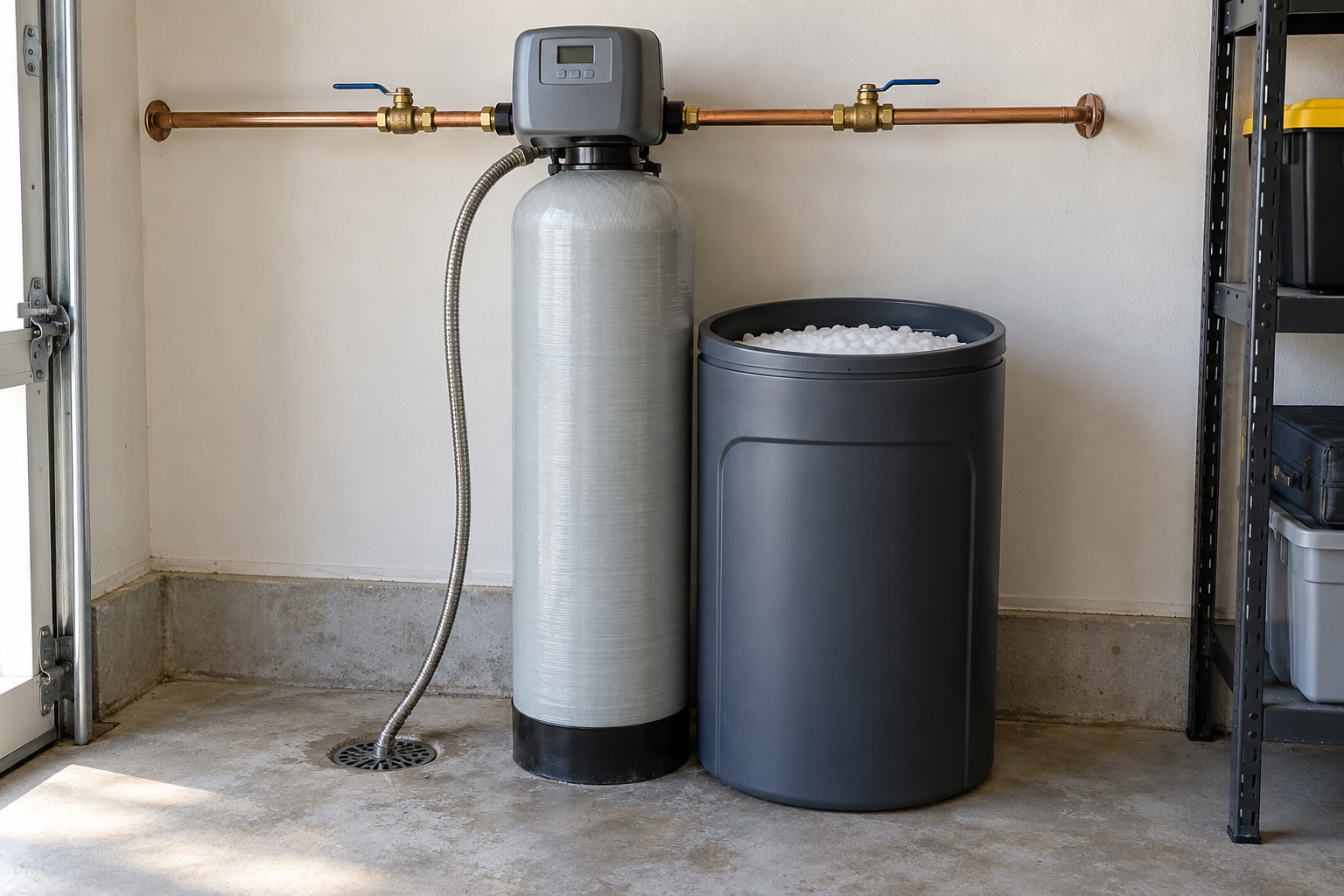
A conventional softener contains thousands of polymer beads charged with sodium or potassium ions. As hard water passes through the bed, calcium and magnesium attach to the resin and the exchange ions enter the water. Regeneration draws brine through the bed to release accumulated hardness and recharge the beads. The resin is reused through many cycles rather than consumed like a filter cartridge.
Eventually, beads can lose exchange capacity, become coated with contaminants, fracture, or allow water to channel through the bed. These failures may look similar from the faucet: scale returns, soap lathers poorly, water spots increase, or capacity between regenerations falls. Correct diagnosis matters because replacing otherwise healthy resin will not fix a clogged brine injector, incorrect hardness setting, or valve that is failing to complete regeneration.
Typical replacement timing is a range, not a rule
A planning range of about 8 to 15 years is common for standard residential cation resin, but actual life can fall outside it. Resin exposed to high disinfectant levels, frequent oxidation, iron, manganese, or heavy sediment may degrade sooner. A well-protected bed operating with correct salt dosage and flow may remain effective beyond the middle of that range.
Treat any advertised lifespan as an estimate under assumed conditions. Ask what resin type was installed, whether it is designed for chlorinated water, and whether the unit receives municipal or well water. Keep service records showing water hardness, regeneration frequency, salt use, and repairs. A ten-year-old system that consistently delivers soft water may need monitoring, not automatic rebedding; a much younger system with confirmed bead damage may need action now.
Signs that resin may be nearing the end
The strongest sign is a verified decline in softened-water quality even though salt, settings, brine draw, and regeneration are correct. Test raw water before the unit and treated water after it with a suitable hardness test. Repeated hardness leakage soon after a complete regeneration suggests reduced resin capacity, channeling, or an internal distribution problem.
Other warning signs include much more frequent regenerations for the same household demand, a persistent pressure drop across the softener, and resin beads appearing in faucet aerators. Escaped beads often look like tiny amber or golden granules. If you find them, place the unit in bypass according to its manual and arrange service; a failed distributor or damaged resin can send material into appliance valves and fixture cartridges.
| Symptom | Could be resin? | Check before replacing it |
|---|---|---|
| Hard water returns quickly | Yes | Salt level, settings, brine draw, water use |
| No salt is being consumed | Usually not the resin alone | Salt bridge, injector, control cycle |
| Low flow throughout house | Possibly | Prefilter, bypass, valve, pressure loss |
| Amber beads at faucets | Strong warning sign | Distributor and resin condition |
| Water feels different but tests soft | Uncertain | Test method and other water chemistry |
| Unit regenerates too often | Possibly | Leaks, meter, capacity setting, household demand |
Chlorine, iron, and sediment change the schedule
Oxidants used in municipal water can attack the cross-linked polymer over time. More oxidation-resistant resin may be appropriate where disinfectant exposure is significant, but selection should be based on actual water conditions and manufacturer guidance. Carbon pretreatment can reduce oxidants, yet it adds maintenance and can become its own flow restriction if neglected.
Iron and manganese can coat exchange sites, while sediment can accumulate in the bed or control valve. Some fouling can be treated with a cleaner specifically approved for the resin and equipment; physical damage cannot be cleaned away. Never improvise with household bleach, acids, or mixed chemicals. Wrong concentrations can damage seals, release fumes, or contaminate drinking-water plumbing. A water analysis is usually cheaper and safer than guessing at a chemical remedy.
Rule out salt and regeneration problems first
Check that the salt tank contains usable salt rather than a hard crust with an empty space below it. A salt bridge can make the tank appear full while preventing brine formation. Follow the manual for safe inspection, and do not strike the tank with metal tools that can puncture it. Look for an appropriate water level, but remember that designs differ: some tanks normally show little standing water.
Review the programmed hardness, household size or capacity, regeneration time, and meter operation. If the unit does not draw brine, the injector may be clogged or a valve part may have failed. A manual regeneration can confirm cycle behavior when the manufacturer recommends it, but repeated cycles waste water and salt. If the drain line is kinked, frozen, blocked, or installed incorrectly, correct it only within the equipment instructions and local plumbing requirements.
Test performance instead of relying on feel
“Slippery” softened water and soap behavior are subjective. Use a reliable hardness test on samples taken before and after the softener. Flush the sampling faucet long enough to clear standing water, and avoid a faucet that blends untreated and treated lines. Test soon after regeneration and again near the expected end of capacity. This pattern shows whether leakage is constant or develops as the bed exhausts.
A service professional can perform more controlled evaluation: verify flow and pressure, confirm brine concentration and draw, calculate expected capacity from resin volume, and inspect the control valve. If the system is causing weak fixtures, a pressure measurement on both sides under the same flow can separate a resin-bed restriction from a broader plumbing problem. Hot-water-only symptoms may instead require inspection of the heater and its valves; learn the warning signs of a water heater leaking from the top while checking that area.
Cleaning, rebedding, and replacement solve different problems
Cleaning is appropriate only for compatible, potentially reversible fouling. Use a product and procedure approved by the softener or resin manufacturer, and follow dosage, flushing, and drinking-water precautions exactly. Cleaning cannot restore beads that have oxidized into fragments, repair a broken distributor, or increase the service-flow capacity of an undersized control valve.
Rebedding means removing old media, inspecting internal distributors and the mineral tank, and loading the correct amount and type of new resin—often with a specified gravel underbed. Whole-unit replacement may make more sense when the valve is obsolete, the pressure vessel is damaged or beyond its rated service life, parts are unavailable, or the equipment is poorly sized. Compare total repair cost and expected service life rather than choosing resin replacement by default.
What resin replacement involves
The safe sequence generally includes bypassing and depressurizing the unit, disconnecting plumbing and power, separating the control head from the tank, removing wet resin, inspecting internal tubes and screens, and loading new media without allowing resin into the riser tube. Wet resin is heavy, spills easily, and must be disposed of according to local requirements. Reassembly requires clean seals, correct torque, controlled repressurization, and thorough flushing.
This is not a good project if shutoff valves do not hold, flexible connectors are deteriorated, the tank is cracked, or electrical equipment is exposed to water. Never loosen a control head while the vessel is pressurized. Do not tip or drag a connected tank. If piping must be modified, a plumber can advise whether a localized repair or a broader PEX-versus-copper repipe decision is appropriate and code-compliant.
How to extend the life of new resin
Set regeneration from measured hardness and iron levels rather than a guess. Keep the brine tank clean, use salt appropriate for the equipment, and address leaks such as running toilets that cause needless capacity use. Replace sediment prefilters on pressure-drop or manufacturer guidance, not only when they look dirty. Ensure the drain line remains secure, unobstructed, and properly air-gapped where required.
Retest raw and treated water periodically, especially after utility changes, well work, or a noticeable shift in taste, staining, scale, or salt consumption. Record the date and results. If oxidants or iron are significant, have a treatment professional design pretreatment rather than stacking generic filters. Every added housing, valve, and media bed affects flow and requires maintenance, so more equipment is not automatically better.
Common mistakes to avoid
Do not assume every hard-water symptom proves failed resin. Scale already inside a water heater or fixture can persist after softening is restored. Conversely, do not mask a leaking valve with thread tape; plumbing tape does not stop every leak, particularly on compression joints, cracked parts, or connections that seal with gaskets.
Avoid buying resin only by price or bag volume. Match the resin chemistry, cross-link level, bead form, food-contact or drinking-water certifications where applicable, and equipment specifications. Do not mix unknown old and new media unless the manufacturer allows it. Most importantly, never open a pressure vessel without isolating, depressurizing, and verifying zero pressure.
Safety boundaries before opening the system
Shut off the water supply and place the unit in bypass according to its manual before disconnecting anything, then open an approved nearby faucet to relieve trapped pressure. Verify that the vessel is fully depressurized; a closed valve does not prove zero pressure. Keep water away from the control transformer, receptacles, extension cords, and other electrical equipment. If the floor is flooded or water is near energized equipment, do not enter or touch the system—call qualified emergency help.
Wear eye protection and gloves appropriate to the approved cleaner or media being handled, and never mix treatment chemicals. Do not connect a softener drain to a sewage line without the code-required air gap, because a cross-connection can contaminate drinking water. Gas piping is not part of softener service; if work would disturb a nearby gas line or you smell gas, stop, leave the area, and contact the gas utility or emergency service. Hidden water damage, mold, cracked pressure vessels, and unreliable shutoffs also move the job beyond routine DIY.
When professional service is the better choice
Call a water-treatment professional when hardness tests remain high after verified regeneration, resin escapes into fixtures, pressure drops markedly across the bed, or water contains significant iron, manganese, sediment, or oxidants. Professional testing can prevent replacing good media while a ten-dollar setting or serviceable valve part remains the real cause.
Use a licensed plumber for leaking or seized shutoffs, corroded piping, unreliable bypass assemblies, or code-related drain and connection work. Stop immediately if water reaches receptacles, cords, or control electronics. Isolate water and power only when safe and accessible, keep clear of flooded electrical areas, and obtain qualified assistance.
Frequently asked questions
Can water softener resin last 20 years?
It can in favorable conditions, but age alone does not prove that it still has its original capacity. Test treated hardness and review regeneration behavior, pressure loss, water chemistry, and component condition.
Does resin need replacement if the water is still soft?
Usually not solely because of age. Continue appropriate maintenance and periodic testing. Replacement becomes reasonable when performance decline or physical damage is confirmed.
Can I add new resin on top of old resin?
That is generally not a sound shortcut. It leaves fouled or fragmented media in place and may create the wrong bed depth. Follow the equipment manufacturer’s rebedding specification.
Will resin cleaner make old resin new again?
No. An approved cleaner may remove certain deposits, but it cannot reverse oxidation, fractured beads, lost cross-link integrity, or broken internal distributors.
Is replacing resin cheaper than replacing the softener?
Often, if the pressure vessel and control valve are in good condition and parts remain available. For an old, undersized, or obsolete unit, whole-system replacement may provide better value and reliability.
Why This Is Different in San Antonio
San Antonio's Edwards Aquifer supplies some of the hardest municipal water in the United States: about 357 mg/L, or 21 grains per gallon. That limestone-filtered groundwater carries calcium carbonate and magnesium into our fixtures, valves, drains, heaters, and supply lines. For how often should you replace water softener resin, that matters because mineral scale changes the maintenance schedule, failure signs, and realistic repair costs for local homeowners.
- Scale buildup makes small restrictions worse, especially at cartridges, aerators, shutoff valves, drains, and heater connections.
- Fixtures, pipes, and appliances in our area can wear out 30-50% faster than in soft-water cities when maintenance is delayed.
- SAWS publishes annual water quality reports, but the practical homeowner takeaway is simple: maintenance intervals here should be shorter than national advice suggests.
Homes in Westover Hills and Alamo Ranch are particularly affected because newer PEX-heavy construction still sees fixture wear from 21 gpg hard water. Unlike cities with naturally soft water, local homeowners should treat hard-water maintenance as normal prevention, not an upsell.
> "In my 20 years working in San Antonio, I would say most surprise plumbing failures I see start with homeowners following soft-water maintenance advice in a hard-water city." — Licensed local plumber
What San Antonio Homeowners Pay (2026)
| Service | Typical Cost in San Antonio |
|---|---|
| Emergency plumber call | $150–$350; after hours $250–$500 |
| Plumber hourly rate | $85–$150/hr |
| Water softener installation | $1,500–$4,000 |
Prices are based on local metro area ranges for 2026. Costs may vary by neighborhood, access, pipe material, after-hours timing, and whether the plumber finds hard-water damage beyond the visible problem.
When to Call a San Antonio Plumber
Call a licensed local plumber if the problem involves active leaking, a shutoff valve that will not close, sewer smell, recurring clogs, water near electrical components, a water heater leak, or any pipe inside a wall, ceiling, or slab. Locally, expect many licensed plumbers to charge roughly $85-$150 per hour, with emergency visits commonly around $150-$350 and after-hours calls closer to $250-$500.
When you call, ask three local questions:
1. Are you licensed and insured for work in Bexar County or the surrounding local metro?
2. Have you dealt with Edwards Aquifer hard-water scale on this type of repair?
3. Should I also check the water heater, shutoff valves, or water softener while you are there?
local plumbers see hard-water issues every week, so a good pro should be able to explain whether the failure is normal wear, mineral damage, freeze damage from a cold snap like Winter Storm Uri, or a sign of a larger plumbing system problem.
San Antonio FAQ
Is San Antonio water hard?
Yes. San Antonio water is very hard at about 357 mg/L, or 21 grains per gallon, because much of it comes from the Edwards Aquifer and passes through limestone. That mineral content is why scale shows up quickly on faucets, showerheads, valves, drains, and water heaters.
Do local homes need a water softener?
A water softener is recommended for many local homes, especially if you see white scale, repeated faucet or valve problems, short water-heater life, or cloudy spots on dishes. A typical whole-home water softener installation in San Antonio runs about $1,500-$4,000.