> San Antonio Local Insight: Fixture and faucet leaks in San Antonio happen faster because hard water minerals (21 gpg from Edwards Aquifer) grind down valve seats, corrode cartridges, and prevent proper sealing. A faucet that lasts 15 years in soft-water cities often starts leaking within 5–8 years in San Antonio without a water softener.
Local San Antonio Field Notes Before You Start
Leak tape is frequently misunderstood in Alamo Heights homes where galvanized, copper, brass, and modern supply lines may meet within one remodel. PTFE tape belongs on compatible tapered pipe threads before assembly; wrapping it around the outside of a wet compression joint does not seal the mating surfaces. Self-fusing silicone tape can slow a tiny leak on a clean, depressurized pipe, but it is temporary containment—not a hidden-wall repair.
Hard water from the Edwards Aquifer, about 357 mg/L or 21 gpg, can leave crust that looks solid while the metal beneath is thin. Never scrape aggressively or tighten through heavy corrosion. A roll of tape costs about $5–$20, a proper exposed fitting repair often runs $175–$450, and emergency or after-hours work can reach $250–$500 before parts. The cheap choice is only cheaper when the fitting is structurally sound.
After Winter Storm Uri or another Bexar County freeze, tape should not be used to return a split pipe to normal pressure. Isolate the line, photograph the damage, and arrange a permanent repair. If a concealed leak affects usage, retain the invoice and meter evidence for any applicable SAWS leak-adjustment request.
First Identify What Kind of Tape You Have
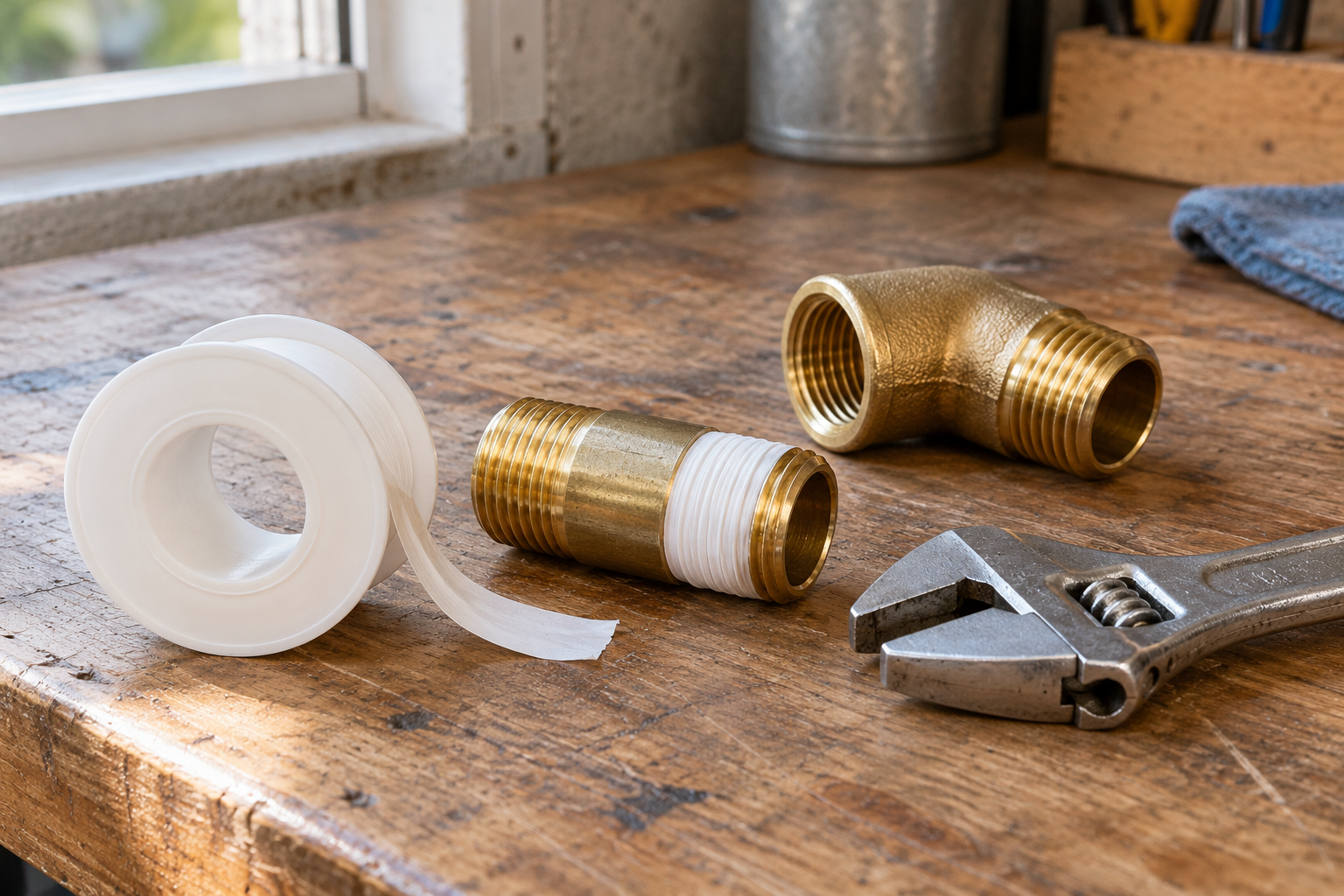
White or colored PTFE tape is thin, nonadhesive film sold on a small spool. It fills microscopic gaps between tapered pipe threads during assembly. It belongs on appropriate male threads, applied in the direction that keeps it from unraveling as the fitting is tightened. It does not seal compression fittings, flare fittings, unions, push-to-connect ends, or the exterior of a cracked pipe. Some gas applications require specifically approved tape and professional, code-compliant work.
Self-fusing silicone tape is thicker and bonds to itself when stretched, creating a compressive sleeve without adhesive. It needs clean access and enough sound pipe on both sides of the defect. Fiberglass and resin repair wraps cure into a rigid shell and have specific surface, temperature, pressure, and potable-water limitations. Read the package rather than choosing by color alone; “waterproof” does not automatically mean approved for a pressurized drinking-water line.

Find the Actual Source Before Wrapping Anything
Water travels along pipe, framing, and insulation, so the wettest point may not be the failure. Dry the area, place paper towels at likely joints, and briefly restore pressure only if there is no electrical or flooding hazard. Watch where the first bead appears. A leak at a valve stem, supply connector, compression nut, soldered joint, drain slip joint, or cracked pipe calls for a different repair.
Check above and behind the visible spot. A bathtub faucet leaking, appliance hose, or water heater leaking from top can send water down another line and make an intact pipe look guilty. If moisture comes from inside a wall, ceiling, slab, or insulated cavity, stop destructive investigation unless you understand the hidden utilities and building risks. Professional leak detection is cheaper than opening the wrong surface.
Safety Comes Before a Temporary Patch
Turn off water and verify that pressure has fallen before touching the pipe. Hot-water lines can burn, and a weakened pipe can split further when moved. Do not work in standing water near energized equipment. If water has reached outlets, hardwired appliances, or a service panel, stay out of the area and call qualified help. Wastewater requires contamination precautions, while a gas odor requires evacuation and an emergency call from outside—not tape.
Never apply ordinary plumbing tape to a fuel-gas leak. Do not cover a bulging, deeply pitted, crumbling, or longitudinally split pipe. Avoid repairs on fire-sprinkler systems, boiler safety components, refrigerant lines, and other regulated systems. If the shutoff will not close, the leak is causing structural saturation, or the pipe could fail suddenly, call an emergency plumber and keep people away from the area.
When PTFE Thread-Seal Tape Is Appropriate
PTFE tape is useful when an accessible threaded fitting is being disassembled and reassembled and the threads are designed to seal with thread compound. Shut off and drain the line, support nearby pipe, and inspect both fittings. Cracked, cross-threaded, flattened, or heavily corroded threads need replacement. Remove old tape without pushing fragments into the piping, clean the threads, and follow the fitting and tape manufacturers' directions.
Apply a suitable PTFE thread-seal tape to the male threads in the tightening direction, usually beginning one or two threads back from the end so fragments do not enter the system. Use the specified number of wraps and avoid excessive buildup, which can crack a female fitting. Tighten with appropriate backup support, restore pressure slowly, and inspect while dry. If seepage continues, shut down and correct the fitting rather than adding tape externally.
PTFE tape should not be used merely because a joint has threads visible. Supply hoses often seal with rubber washers; compression fittings seal at a ferrule; flare fittings seal metal-to-metal; unions have dedicated sealing faces. Adding tape to the wrong surface can prevent correct seating and create a leak. When uncertain, identify the fitting type or ask a plumber.
How Self-Fusing Tape Can Limit a Small Leak
Self-fusing silicone tape works best on a small pinhole or minor weep in a straight, accessible, relatively smooth pipe. Shut off and drain the line completely. Clean away oil and loose corrosion without grinding through weakened material, then dry the pipe. Start several inches before the defect, stretch the tape as directed, overlap each pass substantially, and continue several inches beyond it. Multiple tight layers create compression.
Restore pressure gradually while watching from a safe position. If the wrap swells, shifts, sprays, or remains wet, shut the water off. Even a successful wrap should stay visible and be checked frequently until replacement. Product pressure ratings are laboratory-dependent and do not account for jagged corrosion, water hammer, poor wrapping, heat cycling, or movement. Do not bury it in a wall or rely on it while the home is vacant.

Other Repair Wraps, Clamps, and Their Limits
A purpose-made repair clamp uses a rubber gasket and rigid band to compress over a small defect. On a round, sound pipe of the correct diameter, it is often more predictable than flexible tape. It still requires enough intact material to carry the clamping force. Severe corrosion can collapse under the clamp or begin leaking at its edge. Follow material, pressure, and temperature ratings exactly.
Epoxy putties and fiberglass wraps require careful surface preparation and curing. Some are not approved for potable water, hot lines, or continuous pressure. Chemical compatibility also matters. These products may be useful for emergency stabilization or certain noncritical services, but they can complicate later soldering or joining and hide the extent of deterioration. A proper pipe leak repair usually removes the damaged section and uses an approved coupling or rerouted line.
| Leak or fitting type | Is tape suitable? | Better response |
|---|---|---|
| Seeping tapered threaded water fitting | PTFE during correct reassembly | Inspect threads and reinstall |
| Small pinhole on sound exposed pipe | Silicone tape may be temporary | Replace damaged section |
| Compression or flare fitting | PTFE usually does not belong on sealing face | Remake or replace fitting |
| Long split or widespread corrosion | No | Shut off and replace pipe |
| Concealed leak in wall or slab | No external wrap without access and diagnosis | Locate and professionally repair |
| Gas, sprinkler, boiler, or contaminated line | Do not improvise | Qualified emergency service |
Step-by-Step Homeowner Decision Process
First, control the water and protect electricity. Second, locate the first point of leakage rather than following drips. Third, identify the pipe material, fitting type, temperature, and service. Fourth, inspect the surrounding pipe: a single clean pinhole differs from a long field of green crust, rust flakes, deformation, or freeze damage. Fifth, decide whether you are assembling a threaded fitting or temporarily wrapping a straight pipe.
If the defect is accessible, low-risk, and small, follow a product explicitly rated for that material and use. Keep the repair visible, label the shutoff, and arrange permanent work. If the pipe is concealed, hot enough to burn, near electricity, contaminated, structurally compromised, or on a regulated system, stop. Repeated patches are evidence that the line needs broader evaluation, not that it needs stronger tape.
Why Tape Repairs Fail
Tape frequently fails because it is applied while water is flowing or the surface is wet, dirty, jagged, or oily. Insufficient stretch and overlap prevent self-fusing tape from forming compression. Wrapping directly over active corrosion leaves weak metal beneath the patch. Pressure surges and temperature cycling then move the pipe until the leak escapes at an edge.
Misdiagnosis is equally common. External PTFE tape cannot seal a crack, and tape around a joint cannot correct damaged threads, a failed washer, or a misaligned compression ferrule. A leak may also be running from a fitting above the wrapped location. Finally, a temporary patch may “work” so well that it is forgotten until hidden water damage appears. Set a prompt repair date instead of treating silence as proof of permanence.
Tools and Materials Worth Having
Useful basics include a flashlight, towels, a bucket, adjustable wrenches sized for the fitting, a second wrench for backup support, and a noncontact moisture meter for comparison. A self-fusing silicone repair tape can be part of an emergency kit, provided its limitations are understood. Keep the main shutoff accessible and test it periodically without forcing a seized valve.
For cleanup, use a wet/dry vacuum only on clean water and only from a dry, electrically safe location. Avoid aggressive wire wheels or torches on an unknown line. Do not begin cutting until you know the pipe's service and have a plan for joining the material correctly. Permanent repair may require pipe cutters, deburring tools, approved couplings, permits, and skills beyond a reasonable emergency patch.
Cost and Time Expectations
A roll of tape is inexpensive and application may take minutes after shutdown and preparation. That does not make it the least expensive long-term choice. A failed patch can damage drywall, flooring, cabinets, insulation, and framing. The proper comparison is between timely pipe replacement and the potential cost of another uncontrolled release.
A simple exposed fitting or short pipe section may be repaired during a routine service visit. Concealed lines, corroded systems, difficult shutoffs, and restoration work take longer and cost more. Emergency rates differ from scheduled work. Ask whether an estimate covers opening and closing surfaces, permits, pressure testing, drying, and finish repair. Obtain options when repeated leaks suggest rerouting or repiping.
Preventing the Next Leak
Inspect visible connections and appliance hoses periodically, and investigate green staining, rust, mineral tracks, pressure changes, or unexplained water use. Have high water pressure corrected with appropriate regulating and thermal-expansion equipment. Secure pipes that knock or rub against framing, and protect vulnerable lines from freezing. Replace aging connectors before they fail rather than wrapping them after they split.
Know the location of the main shutoff and fixture valves. Consider a leak sensor or automatic shutoff in high-risk areas, especially for vacant homes. After any repair, dry the surroundings, record what failed, and monitor the meter and materials for recurrence. When several pinholes appear in the same material, request an assessment of water chemistry, pressure, grounding concerns, and overall pipe condition.
When to Call a Plumber
Call immediately for uncontrolled water, electrical exposure, sewage, gas odor, a failed main shutoff, or a pipe that is splitting or collapsing. Professional help is also appropriate for concealed piping, repeated failures, extensive corrosion, frozen-pipe damage, code-controlled systems, and any repair requiring soldering or joining in a hazardous location. Stop DIY work when uncertainty itself creates risk.
For a nonemergency, take clear photos after shutting off water and tell the plumber the pipe material, approximate diameter, location, and whether the leak changes with fixture use. Mention any temporary products already applied. A plumber can remove the damaged section, inspect adjacent material, test the repair, and advise whether the failure is isolated or part of a larger pattern.
Frequently Asked Questions
Does plumbing leak tape permanently stop a leak?
Usually not when wrapped around a damaged pipe. Self-fusing tape and repair wraps are generally temporary stabilization. PTFE tape can be part of a permanent threaded-joint assembly when used on the correct fitting. The distinction is explained further in does plumbing tape stop leaks.
Can I apply tape while water is running?
No. Pressure pushes water beneath the wrap and prevents reliable preparation. Shut off and drain the line first. If the water cannot be controlled, call emergency service rather than wrestling with a pressurized failure.
Which direction should PTFE tape be wrapped?
Apply it in the direction that prevents unraveling as the male fitting is tightened, following the product and fitting instructions. Keep tape back from the first thread and do not use excessive layers. Confirm that the threaded connection actually seals at its threads.
Is silicone repair tape safe for drinking-water pipes?
Only if the specific product is explicitly rated for the material, temperature, pressure, and potable-water application involved. Even then, external wrapping is generally a temporary measure for a damaged pressurized pipe. Check the label and local requirements.
What should I avoid doing?
Do not tape gas leaks, energized wet areas, sewage lines without precautions, fire systems, badly corroded pipe, or concealed defects and call the job finished. Do not add external PTFE tape to a leaking pipe or stack products without diagnosing the source. Shut down and replace compromised components.
Why This Is Different in San Antonio
San Antonio's Edwards Aquifer supplies some of the hardest municipal water in the United States: about 357 mg/L, or 21 grains per gallon. That limestone-filtered groundwater carries calcium carbonate and magnesium into our fixtures, valves, drains, heaters, and supply lines. For plumbing leak tape, that matters because mineral deposits grind down seals, cartridges, fill valves, supply stops, spray arms, and small water passages faster than many generic guides assume.
- Scale buildup makes small restrictions worse, especially at cartridges, aerators, shutoff valves, drains, and heater connections.
- Fixtures, pipes, and appliances in our area can wear out 30-50% faster than in soft-water cities when maintenance is delayed.
- SAWS publishes annual water quality reports, but the practical homeowner takeaway is simple: maintenance intervals here should be shorter than national advice suggests.
Homes in Alamo Heights are particularly affected because older 1920s-40s homes often still have galvanized or mixed-metal plumbing that reacts badly to mineral-heavy water. Unlike cities with naturally soft water, local homeowners should treat hard-water maintenance as normal prevention, not an upsell.
> "When I see early leaks in San Antonio, I always look for hard-water scale, corrosion, and older neighborhood pipe materials before blaming one bad fixture." — Licensed local plumber
What San Antonio Homeowners Pay (2026)
| Service | Typical Cost in San Antonio |
|---|---|
| Emergency plumber call | $150–$350; after hours $250–$500 |
| Faucet replacement labor | $150–$300 |
| Plumber hourly rate | $85–$150/hr |
Prices are based on local metro area ranges for 2026. Costs may vary by neighborhood, access, pipe material, after-hours timing, and whether the plumber finds hard-water damage beyond the visible problem.
When to Call a San Antonio Plumber
Call a licensed local plumber if the problem involves active leaking, a shutoff valve that will not close, sewer smell, recurring clogs, water near electrical components, a water heater leak, or any pipe inside a wall, ceiling, or slab. Locally, expect many licensed plumbers to charge roughly $85-$150 per hour, with emergency visits commonly around $150-$350 and after-hours calls closer to $250-$500.
When you call, ask three local questions:
1. Are you licensed and insured for work in Bexar County or the surrounding local metro?
2. Have you dealt with Edwards Aquifer hard-water scale on this type of repair?
3. Should I also check the water heater, shutoff valves, or water softener while you are there?
local plumbers see hard-water issues every week, so a good pro should be able to explain whether the failure is normal wear, mineral damage, freeze damage from a cold snap like Winter Storm Uri, or a sign of a larger plumbing system problem.
San Antonio FAQ
Is local water hard?
Yes. San Antonio water is very hard at about 357 mg/L, or 21 grains per gallon, because much of it comes from the Edwards Aquifer and passes through limestone. That mineral content is why scale shows up quickly on faucets, showerheads, valves, drains, and water heaters.
Do local homes need a water softener?
A water softener is recommended for many local homes, especially if you see white scale, repeated faucet or valve problems, short water-heater life, or cloudy spots on dishes. A typical whole-home water softener installation in San Antonio runs about $1,500-$4,000.