> San Antonio Local Insight: Fixture and faucet leaks in San Antonio happen faster because hard water minerals (21 gpg from Edwards Aquifer) grind down valve seats, corrode cartridges, and prevent proper sealing. A faucet that lasts 15 years in soft-water cities often starts leaking within 5–8 years in San Antonio without a water softener.
Local San Antonio Field Notes Before You Start
A suspected slab leak is not a faucet problem, even though the first clue may be weak pressure or an unexplained SAWS bill. In New Braunfels and Boerne as well as Bexar County, expansive soils and long hot periods can move around foundation penetrations; freeze stress from events like Winter Storm Uri adds another failure history. Edwards Aquifer water—about 357 mg/L or 21 gpg—also leaves scale that can complicate valves and aging hot-water lines, but hardness alone does not prove where a pipe failed.
Do not authorize floor demolition from a warm tile or damp odor alone. With every fixture and irrigation zone off, photograph the meter, wait 15–30 minutes, and compare the reading. A professional diagnosis may cost about $250–$600; electronic location plus an under-slab repair often totals $2,000–$6,000, while rerouting can be higher but avoid cutting finished floors. Ask for the test findings and the proposed route in writing.
Your safe DIY role is to stop active loss, move belongings, and record moisture—not to drill the slab or energize equipment near wet flooring. If the meter moves, hot-water equipment cycles unexpectedly, or flooring begins to lift, close the supply when practical and call a licensed plumber experienced with local foundations.
Common Signs of a Leak Beneath the Foundation
An unexpectedly high water bill is often the first clue. Compare usage with the same season if possible, then make sure irrigation, toilets, faucets, water softeners, and outdoor taps are not responsible. Other supply-line clues include a water meter that moves while every fixture is off, reduced pressure throughout the house, a persistent hiss near the floor, or a hot patch caused by a leaking hot-water line.
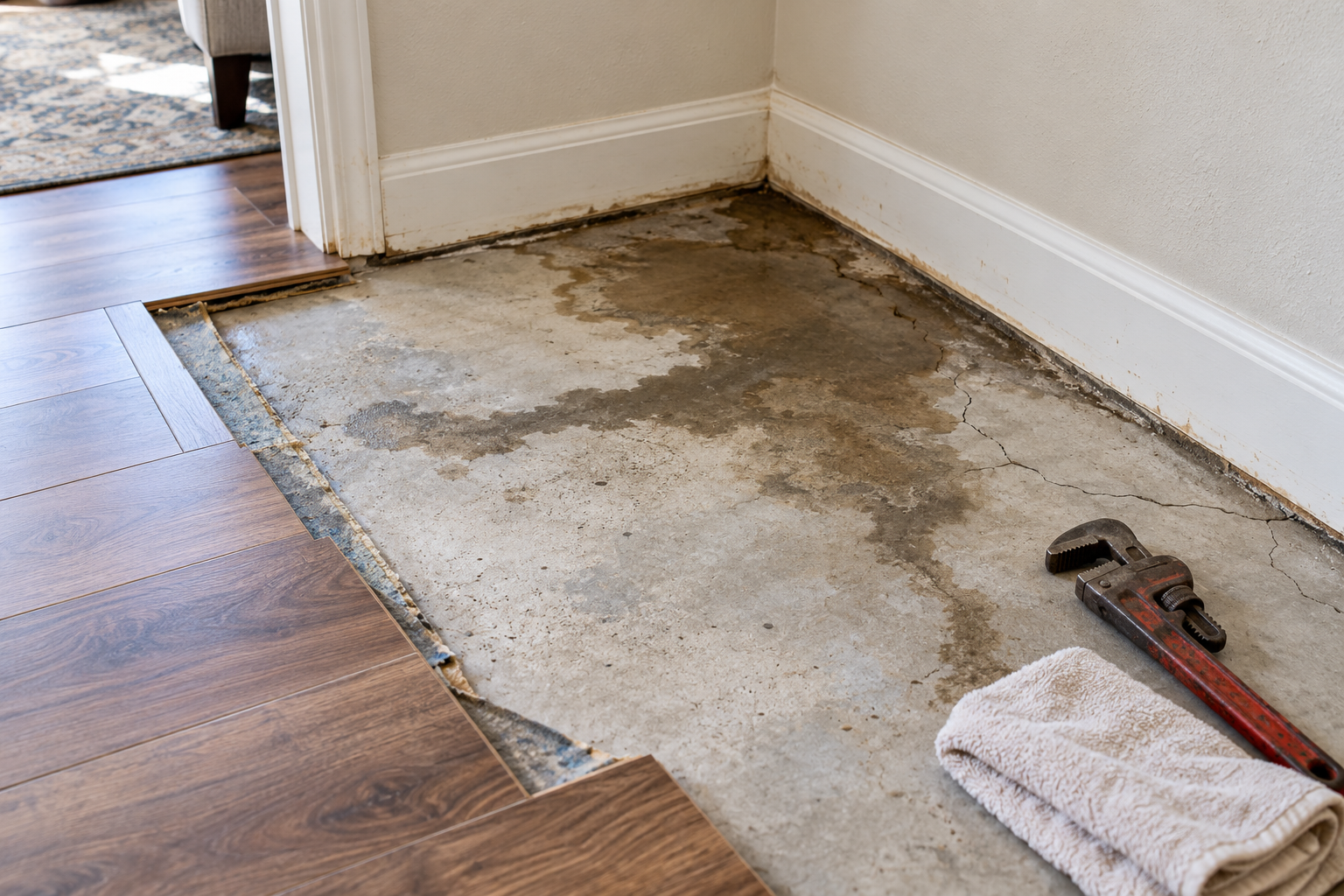
Physical damage may appear later. Look for damp carpet, darkened grout, lifted resilient flooring, swollen baseboards, musty odors, or moisture returning after it has been dried. Drain-line leaks can be less obvious because they occur mainly when a fixture is used. They may produce odors, pests, localized dampness, or soil movement rather than constant meter activity. Foundation cracks have many possible causes, so a crack alone is not proof of a slab leak.

Why Slab Leaks Happen
Pipes beneath slabs can fail because of corrosion, abrasion, installation defects, soil movement, freezing in vulnerable transitions, or long-term stress at joints. Copper tubing may develop pinholes in aggressive water conditions, while older steel lines can corrode internally and externally. A pipe that rests against concrete, gravel, or another hard surface can wear as it expands and contracts during normal hot- and cold-water cycles.
Excessive water pressure accelerates stress on valves, connectors, and weak pipe walls. Ground settlement can bend or pull piping, while poor original workmanship may leave kinked tubing or weak joints. Drain lines have a different set of risks, including separated fittings, root intrusion outside the footprint, improper slope, and deterioration. The visible symptom rarely identifies the exact cause; detection and inspection are needed before choosing a repair.
Safety Steps Before You Investigate
Treat active flooding as urgent. Shut off the main water supply, but do not enter standing water if it may contact electrical equipment. If water is near a service panel, hardwired appliance, outlet, or energized equipment, stay clear and call the utility or an appropriate professional. If you smell gas, leave the building without operating switches and contact the gas emergency service from outside. A sewer odor or wastewater backup also calls for professional cleanup precautions.
Move undamaged belongings out of the wet area and document visible damage for insurance purposes. Do not use bleach indiscriminately or aim household fans into contaminated wastewater. If the leak is modest and clean water only, towels and a wet/dry vacuum connected in a dry, protected location may limit spread. The shutoff stops a pressurized supply leak, but it will not repair damage or necessarily stop a leaking drain when fixtures are used.
Safe Homeowner Checks
Start by turning off faucets, ice makers, dishwashers, washing machines, irrigation, and any appliance that consumes water. Verify that toilets are not refilling. Record the water-meter reading or photograph it, wait 30 to 60 minutes without using water, and check again. Some meters have a small flow indicator that reveals low continuous use. Meter movement confirms consumption downstream of the meter, not the location.
Next, close fixture isolation valves where practical and repeat the test. Check exposed piping, toilet tanks, hose bibs, the water heater, and appliance connections. A water heater leaking from top or a silent toilet can imitate the billing pattern of a concealed leak. Observe whether a suspicious floor area warms when the water heater is operating or whether dampness appears only after a tub, shower, or sink drains.
Keep a simple timeline: meter readings, which fixtures were used, pressure changes, sounds, temperatures, and where moisture appeared. A pinless moisture meter can compare areas, but readings are affected by flooring and materials. Do not drill test holes into a slab; post-tension cables, electrical conduits, hydronic lines, and plumbing may be hidden inside it.
How Professionals Locate the Leak
A plumber or leak-detection specialist typically confirms that leakage exists before locating it. Methods can include pressure testing separate hot and cold lines, acoustic listening, thermal imaging, tracer gas, and inspection of accessible manifolds or pipe routes. Drain problems may require camera inspection, isolation tests, or other diagnostic work. No single method is perfect, and results are strongest when several clues agree.
Ask the provider to explain the likely pipe route, confidence in the location, and whether the diagnosis distinguishes a supply leak from drainage or exterior water. A written detection report can help when comparing repair proposals or filing an insurance claim. Detection has a cost, but it can prevent opening a floor in the wrong room and provides information needed to compare spot repair, rerouting, or repiping.

Repair Options and Their Tradeoffs
A spot repair opens the slab at the confirmed failure and replaces a short pipe section. It can be sensible for an isolated, accessible defect in otherwise sound piping. The drawbacks are disruption, dust, flooring replacement, and the possibility that another weak section will fail later. Cutting or coring must account for structural reinforcement and post-tension systems, so this is not suitable for improvised DIY work.
Rerouting abandons the leaking run and installs a new route through walls, ceilings, attics, or another approved path. It avoids opening the slab but may require drywall repairs and protection against freezing or heat. Repiping replaces multiple vulnerable lines and costs more initially, yet it may be economical when testing shows widespread deterioration or repeated leaks. Some specialized contractors offer lining in suitable situations, although eligibility depends on pipe material, condition, diameter, codes, and potable-water approvals.
For a drain leak, repair may involve excavation, a localized replacement, rerouting, or an approved trenchless method. The correct choice depends on access, pipe condition, structural considerations, and local code. Ask each bidder what is included: detection, permits, concrete work, flooring, wall repair, drying, mold remediation, and warranty. A low plumbing quote can exclude most restoration work.
What You Can—and Cannot—Do Yourself
Reasonable homeowner actions include shutting off water, testing the meter, checking visible fixtures, replacing a clearly failed exposed supply connector, and arranging drying. If an exposed threaded joint is the true source, proper pipe leak repair may be manageable after the line is depressurized. These tasks do not include excavating a slab or applying tape to an unseen pressurized pipe.
Do not pour sealants into potable-water lines, inject chemicals under flooring, or keep restoring pressure to “see how bad it is.” Avoid jackhammers, rotary hammers, and saws until hidden utilities and structural systems are located. A temporary clamp belongs only on an accessible compatible pipe and must not conceal ongoing corrosion. Repairs under a foundation often require permits, approved materials, pressure testing, and inspection.
Cost, Timing, and Insurance Questions
Costs vary widely because detection, plumbing repair, structural access, drying, and finish restoration are separate components. A well-located spot repair may take a day or two for plumbing work, while rerouting or repiping can take longer. Concrete curing, cabinetry, specialty flooring, and moisture remediation can extend the overall project. Emergency and after-hours response also changes pricing.
Request itemized estimates and clarify who coordinates each trade. Ask whether the quoted route meets code, how the abandoned line will be isolated, what testing follows repair, and what surfaces will remain unfinished. Home insurance may cover sudden resulting water damage while excluding the failed pipe, gradual seepage, or foundation access; policies differ. Notify the insurer promptly when damage is substantial, preserve photos and invoices, and avoid assuming coverage before reviewing the policy.
| Situation | Best immediate action | Typical next step |
|---|---|---|
| Meter moves with all water off | Close main valve if leakage is significant | Pressure test and leak detection |
| Warm floor with no visible source | Limit hot-water use | Test the hot-water lines |
| Dampness only after a fixture drains | Stop using that fixture | Drain inspection and isolation testing |
| Water near electrical equipment | Keep out of the area | Emergency electrical and plumbing help |
| Repeated concealed leaks | Document repair history | Compare reroute or repipe proposals |
Preventing Another Concealed Leak
Have unusually high pressure measured and corrected with properly maintained pressure-regulating and expansion-control equipment where required. Monitor water bills, inspect appliance hoses and water-heater connections, and respond to recurring pressure loss or running-water sounds. A whole-home leak monitor with automatic shutoff may reduce damage, especially in a frequently vacant property, but it requires correct installation and periodic testing.
Protect piping at vulnerable exterior transitions and address frozen water pipes before thawing creates hidden leakage. Keep records of pipe material, prior failures, and repair routes. During remodeling, photograph open walls and floors before closure. Prevention cannot eliminate every below-slab failure, but early detection, moderate pressure, and informed repair choices can substantially limit damage.
When to Call a Licensed Plumber
Call promptly when the meter confirms unexplained continuous use, moisture returns after drying, pressure falls across the home, flooring lifts, or a hot spot persists. Seek urgent assistance for uncontrolled flow, contaminated water, sewage, gas odor, electrical exposure, or signs of significant structural movement. A plumber should also take over when diagnosis requires pressure testing or when repair affects concealed, structural, or permitted work.
Get a second opinion when a proposal recommends major demolition without showing how the leak was isolated and located. For repeated failures, ask for a whole-system assessment rather than another automatic patch. The goal is not simply to stop today's water; it is to select a repair that fits the pipe condition, building structure, restoration burden, and likelihood of recurrence.
Frequently Asked Questions
Can a slab leak stop on its own?
A pressurized leak may seem to slow as minerals collect or conditions change, but that is not a dependable repair. Water can continue moving into soil or building materials without a visible puddle. Confirm the system with meter and pressure testing rather than assuming the problem has ended.
How urgent is a suspected slab leak?
Active flow, electrical exposure, major pressure loss, or spreading water is an emergency. Subtle meter movement without visible damage still deserves prompt scheduling because concealed moisture and erosion can worsen. Limit use and arrange detection rather than waiting for a larger symptom.
Will homeowners insurance pay for it?
Coverage depends on the policy and cause. Some policies cover sudden resulting damage or necessary access while excluding the worn pipe or long-term leakage. Document the discovery, prevent further damage when safe, and ask the insurer for a coverage determination.
Can leak-detection equipment find the exact spot?
It can often narrow the location substantially, but construction, depth, background noise, and pipe material affect accuracy. Ask how the conclusion was reached and whether more than one diagnostic method supports it before authorizing destructive access.
Should I repair one spot or repipe?
One isolated defect in otherwise sound piping may justify a spot repair. Multiple failures, widespread corrosion, inaccessible routes, or poor original installation may favor rerouting or repiping. Compare lifetime disruption and restoration costs, not only the first invoice.
Why This Is Different in San Antonio
San Antonio's Edwards Aquifer supplies some of the hardest municipal water in the United States: about 357 mg/L, or 21 grains per gallon. That limestone-filtered groundwater carries calcium carbonate and magnesium into our fixtures, valves, drains, heaters, and supply lines. For slab leak, that matters because scale, corrosion, and age-related pipe weakness combine with slab foundations and older neighborhood plumbing materials.
- Scale buildup makes small restrictions worse, especially at cartridges, aerators, shutoff valves, drains, and heater connections.
- Fixtures, pipes, and appliances in our area can wear out 30-50% faster than in soft-water cities when maintenance is delayed.
- SAWS publishes annual water quality reports, but the practical homeowner takeaway is simple: maintenance intervals here should be shorter than national advice suggests.
Homes in New Braunfels and Boerne are particularly affected because nearby Hill Country water systems are also very hard and create similar maintenance pressure. Unlike cities with naturally soft water, local homeowners should treat hard-water maintenance as normal prevention, not an upsell.
> "When I see early leaks in San Antonio, I always look for hard-water scale, corrosion, and older neighborhood pipe materials before blaming one bad fixture." — Licensed local plumber
What San Antonio Homeowners Pay (2026)
| Service | Typical Cost in San Antonio |
|---|---|
| Slab leak detection | $250–$500 |
| Slab leak repair | $2,000–$5,000 |
| Emergency plumber call | $150–$350; after hours $250–$500 |
Prices are based on local metro area ranges for 2026. Costs may vary by neighborhood, access, pipe material, after-hours timing, and whether the plumber finds hard-water damage beyond the visible problem.
When to Call a San Antonio Plumber
Call a licensed local plumber if the problem involves active leaking, a shutoff valve that will not close, sewer smell, recurring clogs, water near electrical components, a water heater leak, or any pipe inside a wall, ceiling, or slab. Locally, expect many licensed plumbers to charge roughly $85-$150 per hour, with emergency visits commonly around $150-$350 and after-hours calls closer to $250-$500.
When you call, ask three local questions:
1. Are you licensed and insured for work in Bexar County or the surrounding local metro?
2. Have you dealt with Edwards Aquifer hard-water scale on this type of repair?
3. Should I also check the water heater, shutoff valves, or water softener while you are there?
local plumbers see hard-water issues every week, so a good pro should be able to explain whether the failure is normal wear, mineral damage, freeze damage from a cold snap like Winter Storm Uri, or a sign of a larger plumbing system problem.
San Antonio FAQ
Is local water hard?
Yes. San Antonio water is very hard at about 357 mg/L, or 21 grains per gallon, because much of it comes from the Edwards Aquifer and passes through limestone. That mineral content is why scale shows up quickly on faucets, showerheads, valves, drains, and water heaters.
Do local homes need a water softener?
A water softener is recommended for many local homes, especially if you see white scale, repeated faucet or valve problems, short water-heater life, or cloudy spots on dishes. A typical whole-home water softener installation in San Antonio runs about $1,500-$4,000.