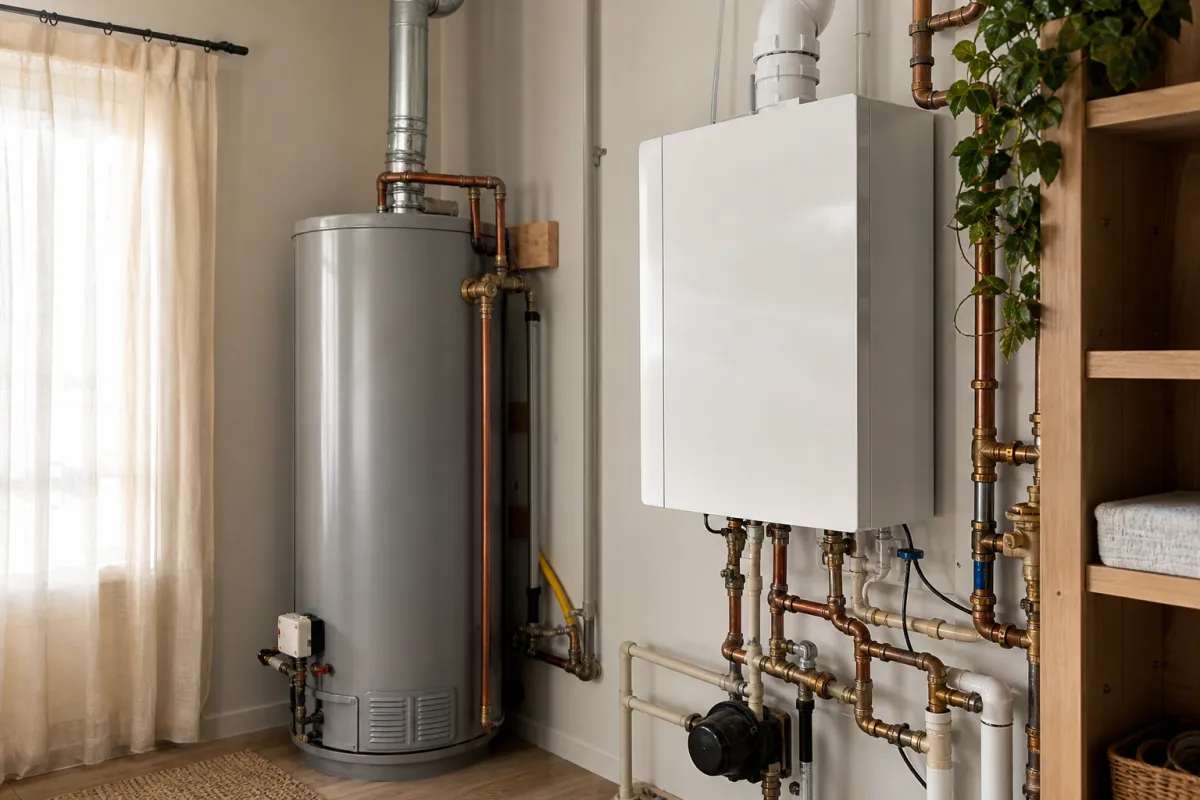
> San Antonio Local Insight: San Antonio's extremely hard water from the Edwards Aquifer (357 mg/L, 21 gpg) shortens water heater lifespan by 2–4 years. Sediment buildup forces heating elements to overwork, causes popping/rumbling noises, and leads to premature tank failure. local plumbers recommend flushing every 6 months — double the national frequency.
Local San Antonio Field Notes Before You Start
Before following any generic plumbing checklist, adjust it for our Edwards Aquifer water. At roughly 357 mg/L, or 21 grains per gallon, the calcium carbonate and magnesium in the water can turn a small maintenance issue into repeat wear on valves, seals, drains, heaters, and appliance connections. That means the useful question is not just capacity or fuel type; it is how the unit will handle sediment, descaling, anode wear, and the six-month maintenance rhythm our water demands.
A homeowner in Westover Hills and Alamo Ranch should be especially careful because newer PEX-heavy homes still get hard-water damage at fixtures, cartridges, and appliances. If you are comparing advice from national repair guides, shorten the maintenance interval and inspect for white scale, crusted fittings, stiff shutoff valves, and early corrosion before assuming the part simply “got old.”
For budgeting, use local pricing instead of national averages: tank water-heater replacement runs about $1,200-$2,800 installed, while tankless replacement usually lands around $2,500-$5,500. If the issue appears after a summer high-use period or after a rare freeze like Winter Storm Uri, treat it as a local risk signal and document what you see before calling a licensed plumber in Bexar County.
A family of four should size a tankless heater by simultaneous flow and required temperature rise, not by household size alone. Two showers at 2.0 gallons per minute plus a kitchen faucet at 1.0 GPM create a 5.0 GPM peak. The selected unit must deliver that flow while raising incoming water to the desired setpoint; the glossy maximum-GPM number on a product page often assumes warmer inlet water than a winter morning provides.
Start with a fixture-by-fixture peak-demand worksheet. A family that staggers showers may be comfortable near 5 GPM, while two showers plus laundry can require 7–9 GPM. Decide which uses truly overlap before paying for excess capacity. In Westover Hills or Alamo Ranch, also verify gas-meter capacity, line diameter, vent termination, condensate drainage, and the electrical circuit used by controls and freeze protection.
Hard-water serviceability belongs in the sizing decision. Isolation valves and flush ports make descaling practical, and a unit that operates at its limit is less forgiving when scale begins restricting the heat exchanger. The goal is stable outlet temperature during the real morning rush, with enough margin for seasonal inlet-water changes.
Why Tankless Water Heater Size Matters
Choosing the right tankless water heater size for a family of four is not just about convenience; it directly impacts your household’s comfort and energy efficiency. A unit that is too small may struggle to meet your family's hot water demands, leading to cold showers and frustration. Conversely, an oversized unit can lead to unnecessary energy consumption and higher utility bills. Therefore, understanding your family's hot water needs and how they align with the specifications of tankless models is essential for a seamless experience.
Quick Answer
For a family of four, a tankless water heater with a flow rate of 7 to 10 gallons per minute (GPM) is typically recommended. This range accommodates simultaneous demands, such as showering while running the dishwasher or washing machine. However, specific requirements can vary based on your household’s hot water usage patterns, the incoming water temperature, and the desired output temperature.
What to Check First
Before diving into the specifics of tankless water heater sizes, there are a few preliminary checks you should conduct to better understand your household’s needs.
Assess Your Hot Water Usage
Start by evaluating your family's hot water consumption. Take note of how many showers are taken daily, the frequency of laundry loads, and dishwasher usage. Here’s a rough estimate of GPM for common household appliances:
- Showers: 2.5 GPM per shower
- Dishwasher: 1.5 to 2 GPM
- Washing Machine: 2 to 3 GPM
For a family of four, you might have two showers running simultaneously, which already accounts for 5 GPM. If you add in other appliances, you could easily exceed the lower end of the recommended flow rate.
Determine Incoming Water Temperature
The temperature of the water entering your home can significantly affect how well a tankless water heater performs. In colder climates, incoming water temperatures can drop to 40°F or lower. If you want to heat water to a comfortable 120°F, you need to account for this temperature rise in your calculations.
The formula to determine the required GPM based on temperature rise is:
\[
\text{GPM} = \frac{\text{Desired Output Temperature} - \text{Incoming Water Temperature}}{2}
\]
For example, if your incoming water temperature is 40°F and you want it to reach 120°F:
\[
\text{GPM} = \frac{120 - 40}{2} = 40
\]
This means you would need a heater capable of delivering a flow rate that can achieve this temperature increase.
Size the Unit from Real Simultaneous Demand
Once you've assessed your hot water usage and incoming water temperature, you can begin to explore your options for tankless water heaters.
1. Calculate Your Required Flow Rate
As previously mentioned, add up the GPM for all fixtures that you might use simultaneously. A family of four may need anywhere from 7 to 10 GPM depending on their usage habits.
2. Choose Between Whole-House vs. Point-of-Use Units
You can opt for a whole-house tankless water heater or multiple point-of-use units. A whole-house unit is designed to supply hot water to multiple fixtures at once and is often more economical for larger families. However, if your household has specific hot water needs (like a bathroom far from the main unit), point-of-use heaters can be a convenient solution.
3. Select a Unit with Adequate Temperature Rise
Make sure to select a unit that can achieve the necessary temperature rise based on your incoming water temperature. Many manufacturers provide charts that outline the flow rates and temperature rises for their models, making it easier to choose the right one.
4. Consider Energy Efficiency Ratings
Look for energy-efficient models that carry an Energy Star rating. These units not only save on energy bills but also qualify for various rebates and incentives, which can offset initial costs.
Mistakes to Avoid
When selecting a tankless water heater, there are common pitfalls that homeowners often encounter. Avoid these mistakes to ensure a smooth installation and effective operation:
1. Underestimating Hot Water Needs
One of the most frequent mistakes is underestimating the household's hot water demand. Families often assume they will not use multiple fixtures simultaneously, only to find out later that they do. It's crucial to consider peak usage times and plan accordingly.
2. Ignoring Temperature Requirements
Many homeowners forget to factor in the temperature rise needed for their specific conditions. This oversight can lead to purchasing a unit that is insufficient for their needs, resulting in cold showers and disappointment.
3. Skipping Professional Consultation
While DIY projects can be rewarding, sizing and installing a tankless water heater can be complex. Skipping professional consultation can lead to sizing errors or improper installation, which can cause safety hazards and inefficiencies.
When to Escalate Beyond DIY
While many homeowners may feel confident in handling home improvement tasks, certain aspects of tankless water heater installation require professional expertise. Here are some scenarios where it’s wise to call in a licensed plumber or HVAC technician:
1. Electrical and Gas Connections
If your tankless water heater requires electrical or gas connections, it’s best to hire a professional. Improper wiring or gas line installation can pose serious safety risks, including fire hazards or gas leaks.
2. Complex Installations
If you’re considering multiple units or a whole-house system that requires extensive plumbing adjustments, a professional can help ensure everything is configured correctly and meets Bexar County and municipal requirements.
3. Troubleshooting Performance Issues
If you notice that your tankless water heater isn’t performing as expected, a professional can diagnose issues related to flow rate, temperature rise, or maintenance needs.
Frequently Asked Questions
1. How much does a tankless water heater cost?
The cost of a tankless water heater varies widely based on brand, size, and features. Expect to pay between $1,000 and $3,000 for a unit, plus installation costs.
2. Can I install a tankless water heater myself?
While it’s possible to install a tankless water heater as a DIY project, it’s recommended to hire a professional for electrical and gas connections to ensure safety and compliance with local codes.
3. How long do tankless water heaters last?
With proper maintenance, a tankless water heater can last 15 to 20 years, significantly longer than traditional tank models.
4. What maintenance is required for a tankless water heater?
Regular maintenance includes descaling the unit to remove mineral buildup, checking the filters, and ensuring that all connections are secure. It’s advisable to have a professional perform maintenance annually.
5. Are there any rebates available for tankless water heaters?
Many utility companies and local governments offer rebates for energy-efficient appliances, including tankless water heaters. Check with your local provider for available incentives.
Quick Reference Table
| Factor | Recommendation |
|---|---|
| Flow Rate for Family of Four | 7 - 10 GPM |
| Desired Output Temperature | 120°F |
| Incoming Water Temperature | Varies; calculate based on location |
| Installation Type | Whole-house or point-of-use |
| Maintenance Frequency | Annually |
Conclusion
Choosing the right tankless water heater size for a family of four involves understanding your household's hot water needs, evaluating the incoming water temperature, and selecting a unit that can efficiently meet those demands. By following this guide, you can make an informed decision that ensures comfort and efficiency for your family.
Why This Is Different in San Antonio
Water supplied from the Edwards Aquifer is commonly measured near 357 mg/L, or 21 grains per gallon—extremely hard by ordinary household standards. That matters to this job because flow capacity, temperature rise, and heat-exchanger restriction. SAWS water-quality reporting is the right source for current systemwide data, while visible scale at a specific home shows what its equipment is actually experiencing.
In Westover Hills and Alamo Ranch, age, construction type, and access can change the repair plan as much as the failed part. Bexar County homeowners should photograph corrosion or leaks, note error codes and service dates, and ask whether the quote addresses the cause as well as the symptom. After a severe freeze or prolonged outage, inspect exposed lines before assuming the appliance itself is the only problem.
What San Antonio Homeowners Pay (2026)
| Service or equipment | Typical 2026 range |
|---|---|
| Gas tankless replacement | $2,500–$5,500 installed |
| Gas-line, vent, or condensate upgrades | $500–$2,500 depending on access |
| Annual inspection and descaling | $200–$450 |
| Whole-home water softener | $1,500–$4,000 installed |
These are planning ranges, not bids. Access, permits, fuel or electrical upgrades, equipment efficiency, warranty terms, and after-hours timing can move the final price. Ask for a written scope that separates equipment, labor, code-related upgrades, and optional water treatment.
When to Call a San Antonio Plumber
Call a licensed plumber when there is an active leak, a valve will not close, water is near electrical equipment, gas odor is present, a breaker trips repeatedly, or the repair requires opening a fuel, vent, or pressurized-water connection. Shut off the relevant utility only if you can do so safely. For gas odor, leave the building and contact the gas utility or emergency services from outside.
For non-emergency work, give the plumber the model number, symptoms, error codes, maintenance history, and photos. Ask whether the proposed repair accounts for hard-water scale and whether the contractor is licensed and insured for the work. A clear diagnosis is more valuable than replacing parts until the symptom disappears.
San Antonio FAQ
Is the local water hard enough to change maintenance intervals?
Yes. At roughly 357 mg/L / 21 gpg, mineral accumulation can be much faster than national maintenance examples imply. Follow the appliance manual first, then shorten inspection or descaling intervals when scale returns before the next planned service.
Does every home need a water softener?
No single answer fits every household. Treatment is worth evaluating when scale returns quickly, valves bind, appliance heat exchangers need frequent service, or water-heater life has been short. Test the water, compare maintenance costs, and make sure any treatment system is sized and maintained correctly.
What can a homeowner safely do before the appointment?
Document the symptom, clear access, stop using leaking or overheating equipment, and locate the correct shutoff. Do not bypass safeties, open gas components, work live electrical circuits, or force a corroded valve. Those boundaries protect both the home and the technician who follows.