> San Antonio Local Insight: San Antonio's extremely hard water from the Edwards Aquifer (357 mg/L, 21 gpg) shortens water heater lifespan by 2–4 years. Sediment buildup forces heating elements to overwork, causes popping/rumbling noises, and leads to premature tank failure. Local plumbers recommend flushing every 6 months — double the national frequency.
Local San Antonio Field Notes Before You Start
The useful cost question is not simply “repair or replace?” but “what failed, how old is the tank, and what else is scale hiding?” Homeowners toward New Braunfels and Boerne see the same Hill Country mineral pressure on tanks and tankless heat exchangers. Record the model, serial number, fuel type, tank size, leak location, and error code before requesting estimates. A straightforward element, thermostat, or valve repair often runs $200–$650. A conventional replacement commonly reaches $1,200–$2,800 installed, while access changes, venting, electrical work, or a tankless conversion can push the total higher. Never approve a replacement quote that omits disposal, connections, safety upgrades, and warranty terms.
The quick answer on repair costs
For many conventional tank heaters, a straightforward repair often falls in the low hundreds of dollars, while difficult electrical, gas-control, venting, or tank-related problems can cost considerably more. A service fee may cover diagnosis but not parts or labor. Emergency timing, permit requirements, uncommon parts, and poor access can all raise the final invoice.
The most useful question is not “What is the average water heater repair cost?” but “What failed on this specific unit, what else is affected, and how much useful life remains?” Replacing an inexpensive thermostat on an otherwise sound middle-aged heater is different from installing major controls on a corroded tank near the end of its expected service life.
What changes the final price
Labor is only one part of the bill. The model and fuel type determine which components are available and how difficult they are to test. Electric resistance heaters commonly involve thermostats, heating elements, wiring, or breakers. Gas models add burners, ignition components, gas valves, combustion air, and venting. Heat-pump and tankless systems use more specialized sensors, controls, and diagnostic procedures.
Access also matters. A heater in an open garage is usually easier to service than one in a tight attic, finished closet, or drain-pan installation with little working room. Costs can also include draining the tank, correcting shutoff valves or connectors, adding required safety components, protecting finished surfaces, hauling debris, and repairing water damage. Ask which items are included before comparing bids.
| Symptom or finding | Possible issue | Sensible next step |
|---|---|---|
| No hot water on an electric unit | Breaker, thermostat, element, or wiring | Check breaker once; arrange electrical diagnosis if it trips again |
| Water is lukewarm or runs out quickly | Failed element, thermostat setting, sediment, or demand issue | Compare symptoms with unit size and age |
| Gas unit will not heat | Ignition, thermocouple, gas control, supply, or venting | Avoid dismantling gas components; call a qualified technician |
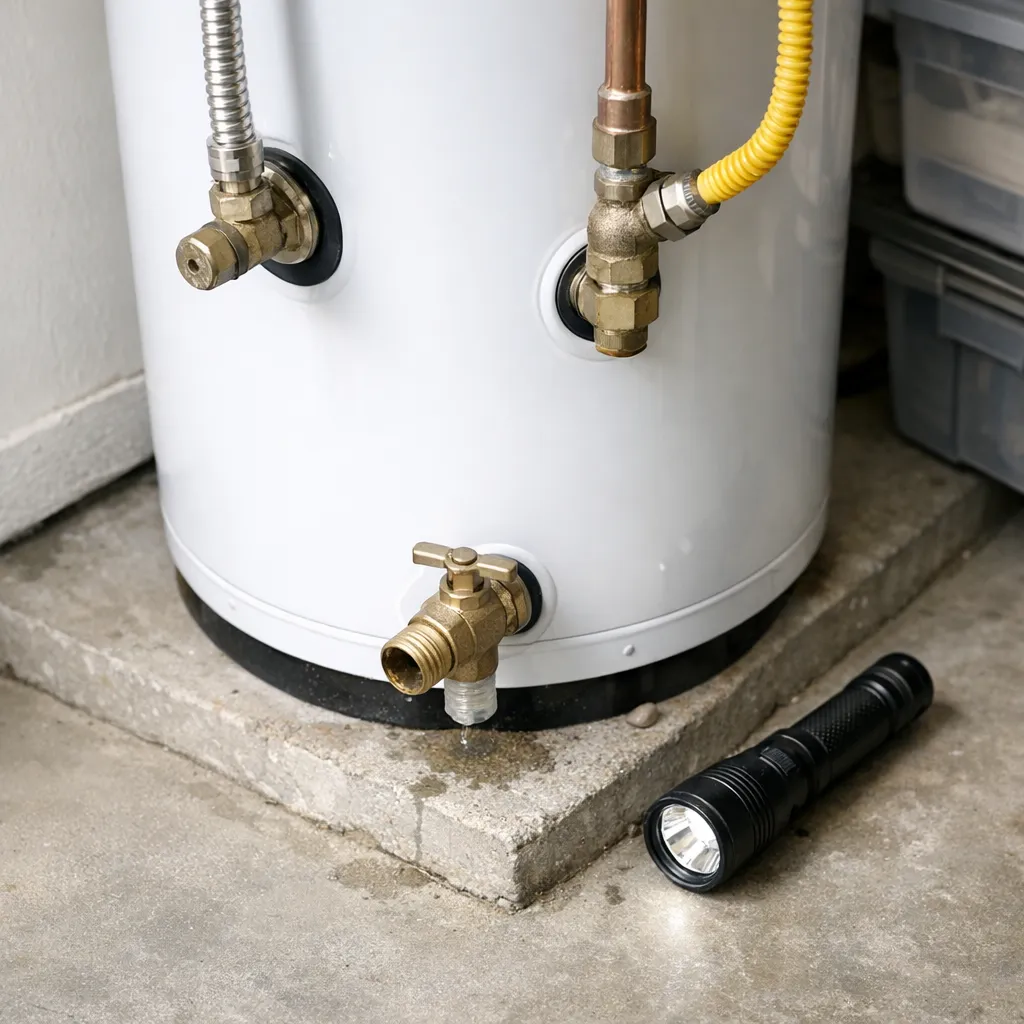
| Water around fittings | Loose or failed connector, valve, or pipe joint | Shut water if active; dry and trace the source |
| Water from the tank body | Internal corrosion or tank failure | Shut off supply and plan replacement |
| Rumbling or popping | Mineral scale or sediment | Have condition and remaining life assessed |
Safe checks before calling for service
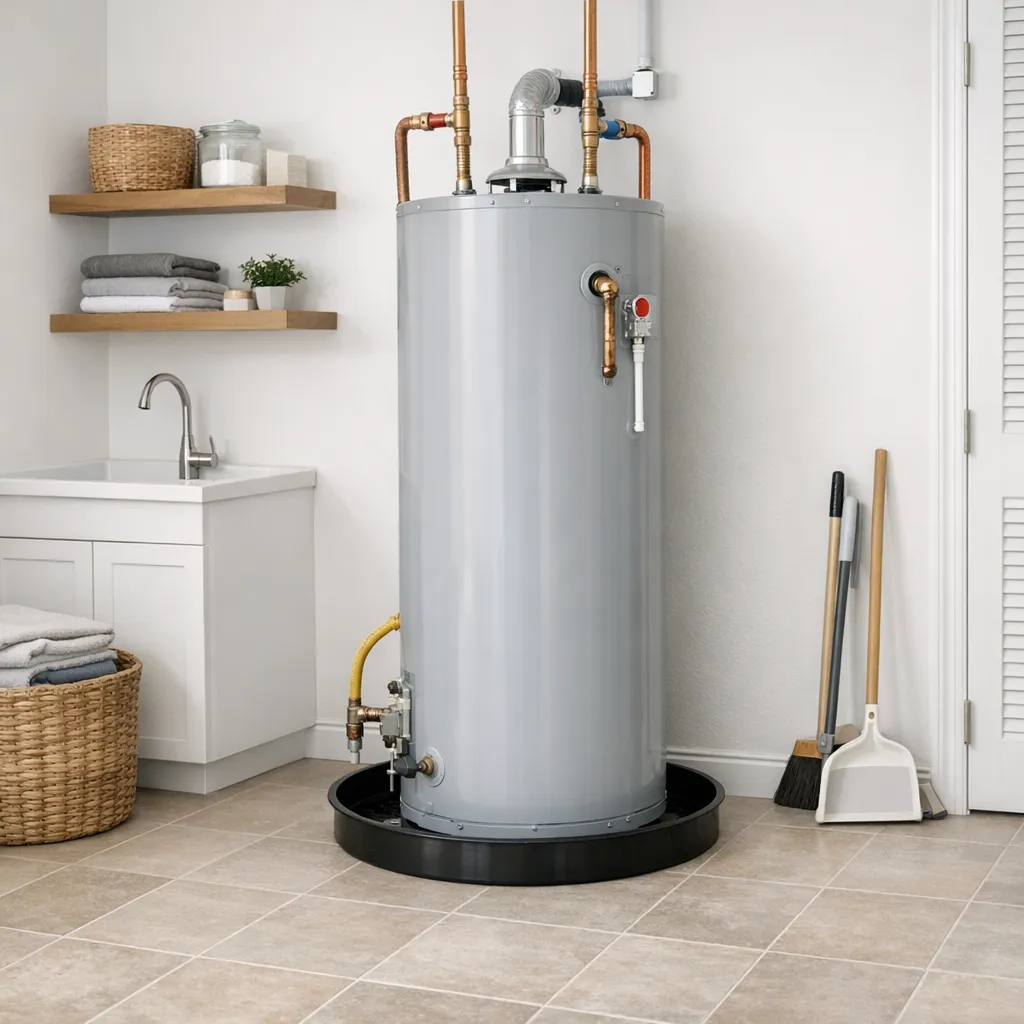
Start without removing covers. Look for the model and serial number, installation date if marked, active fault codes, puddles, corrosion trails, soot, scorched insulation, loose vent sections, or moisture above the tank. Photograph the whole installation and close-ups of the suspected source. Dry a small wet area only if you can do so without approaching energized equipment; then observe where fresh water first appears.
For an electric heater, check the dedicated breaker. If it has tripped, reset it only once. A breaker that trips again indicates a fault that needs diagnosis; repeated resetting can worsen damage. For a gas heater, confirm only that other gas appliances operate and that the control display shows no obvious warning. Do not loosen gas fittings, bypass safety controls, or attempt combustion adjustments.
Common repairs and what you are paying for
Heating elements and thermostats are common electric-heater repairs. The part itself may be relatively affordable, but proper service involves isolating power, testing circuits, draining enough water when necessary, installing the correct component, checking for leaks, and confirming safe operation. If wiring or the electrical panel is damaged, an electrician may also be needed.
On gas models, ignition assemblies, flame sensors, thermocouples, gas controls, burners, and venting faults require combustion expertise. The diagnosis should distinguish a dirty or failed component from inadequate combustion air, a supply problem, or unsafe draft. Paying for correct testing is preferable to swapping parts until the heater happens to run.
Valve and plumbing repairs can include inlet shutoffs, flexible connectors, dielectric connections, drain valves, and temperature-and-pressure relief components. A relief valve should never be capped or plugged. If it discharges, a professional must determine whether the valve is faulty or responding to excessive temperature, pressure, or thermal expansion.
When a leak changes the decision
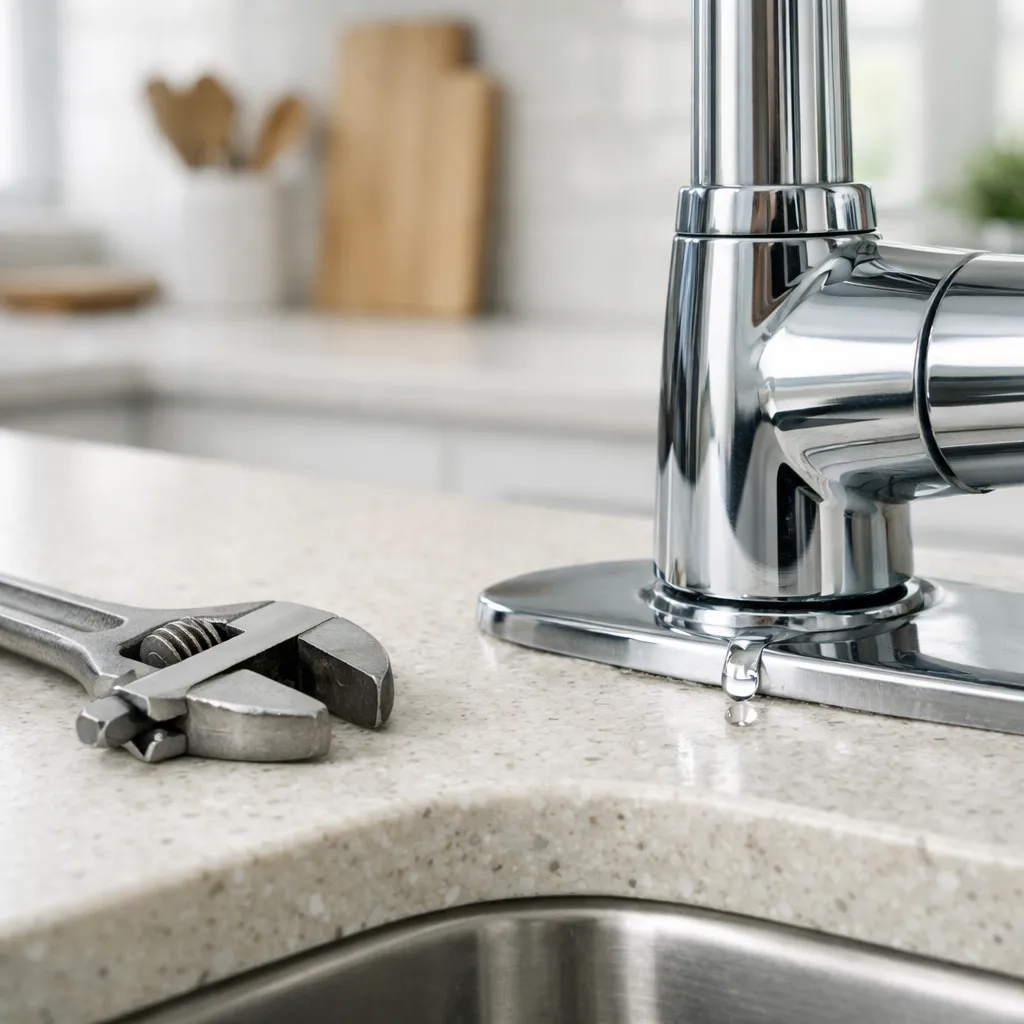
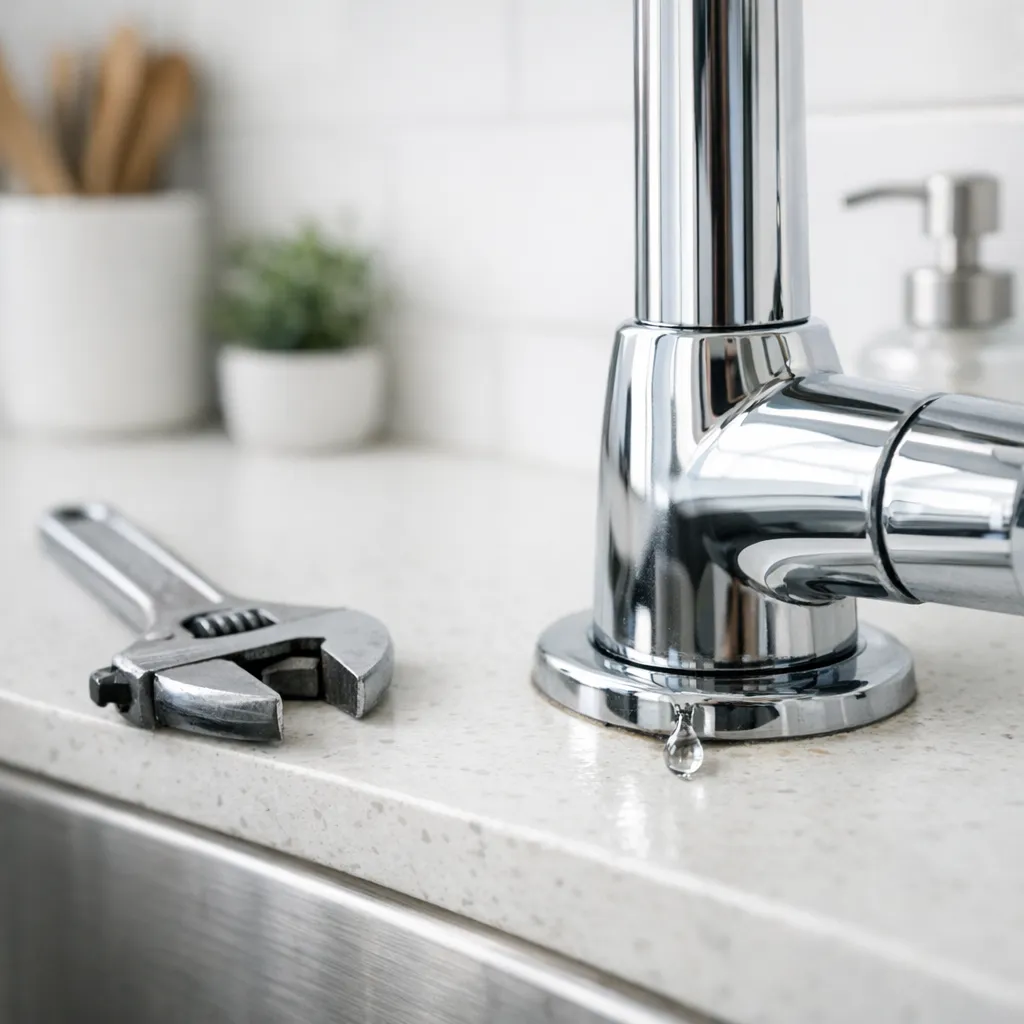
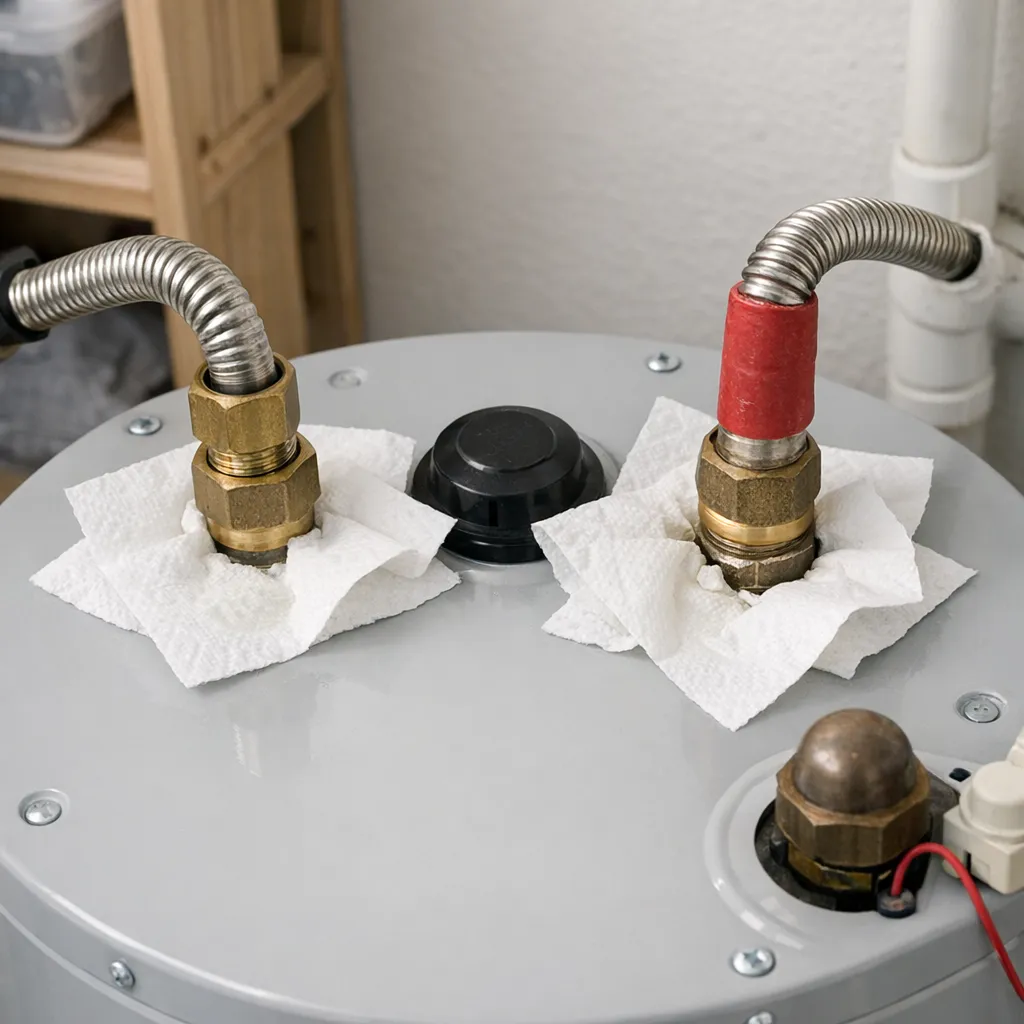
Not every puddle means the tank has failed. Condensation, a leaking pipe joint, a worn connector, a dripping relief discharge line, or water from equipment above the heater can mimic a tank leak. Trace the highest wet point. Water originating at a replaceable fitting may permit a practical repair, provided corrosion has not spread into the tank connection.
Water emerging through the tank jacket, around the lower seam, or from extensive corrosion generally points toward internal failure. A steel storage tank is not a homeowner-repairable pressure vessel. Shut off the cold-water supply; for an electric unit, switch off the breaker, and for a gas unit use the manufacturer-approved control position only if it is safe to reach. Arrange replacement and address standing water promptly.
Repair versus replacement
Age is a useful clue, not an automatic verdict. Review the manufacturer’s warranty, maintenance history, water quality, visible corrosion, and previous repairs. A newer unit with one failed serviceable part is usually a stronger repair candidate. An older tank with rust, repeated failures, poor efficiency, or inadequate capacity may turn an expensive repair into money that delays an inevitable replacement.
Ask for two numbers when the decision is close: the complete repair price and a comparable replacement price that includes required code upgrades, permits, disposal, connectors, drain pan, expansion control, venting, and electrical or gas work. A cheap replacement estimate that excludes those items is not comparable. Also consider disruption: an unreliable heater above finished space carries more water-damage risk than one in a garage with a safe drain.
How to read and compare estimates
A useful estimate identifies the diagnosed failure, proposed parts, labor, warranties, exclusions, and any work that may be added after opening the system. It should state whether the diagnostic fee is credited toward repair and whether permits or additional trades are expected. For a proprietary control, ask about availability and return delays.
Be cautious when a diagnosis is made solely by phone, when the estimate labels everything “repair” without naming components, or when someone pressures you to approve immediate replacement despite no active hazard. Conversely, do not treat careful diagnostic labor as unnecessary. Electrical measurements, combustion tests, pressure checks, and leak tracing are what separate a durable correction from guesswork.
Hidden costs homeowners overlook
The heater may not be the only damaged item. Slow leaks can affect subflooring, drywall, insulation, cabinets, and nearby electrical equipment. Mold remediation is not automatically required after every leak, but wet porous materials should be dried quickly and evaluated when water has remained for an unknown period. Document damage before cleanup if an insurance claim may be appropriate.
Code corrections can also appear during replacement or substantial repair. Depending on the location and jurisdiction, these may involve seismic restraints, drain pans, discharge piping, expansion tanks, combustion air, vent connectors, bollards, disconnects, or dedicated circuits. These are not interchangeable upsells; ask the installer which requirements apply locally and why.
Ways to control cost without cutting safety
Give the contractor useful information before arrival: fuel type, tank capacity, model number, age, fault code, photos, and a precise symptom timeline. Clear safe access to the heater, but do not remove protective panels. If the situation is not urgent, schedule during normal business hours and request an itemized written estimate before authorizing work.
After repair, follow manufacturer maintenance guidance. Periodic inspection, appropriate flushing where recommended, anode evaluation on applicable tanks, water-pressure control, and prompt attention to small leaks can protect the system. Never test a relief valve or drain a tank unless you understand the burn risk, discharge route, and manufacturer instructions; hot water can cause severe injury.
When to stop DIY work
Stop immediately if water is near wiring, the breaker will not remain set, insulation is scorched, gas odor is present, a vent is disconnected, soot appears, or a relief valve is releasing very hot water. Gas controls, line-voltage circuits, combustion systems, pressure vessels, and relief devices are not appropriate places for improvisation.
Also call a professional when the source cannot be identified, shutoff valves do not work, the heater is in a difficult location, or draining could damage finished areas. If gas odor is strong, do not operate switches or create sparks; leave the area and follow the gas utility’s emergency instructions from a safe location.
Frequently asked questions
Is a service-call fee part of the repair cost?
Sometimes. Some companies charge diagnosis separately and credit all or part of it if you approve the repair. Ask before the visit and confirm after-hours pricing.
Is it worth repairing an older water heater?
It can be if the tank is sound and the repair is minor. Repeated failures, corrosion, poor capacity, expired warranty, and a repair approaching a substantial share of replacement cost favor replacement.
Can I replace a heating element myself?
It requires line-voltage safety, correct testing, tank draining, proper part selection, and leak-free reassembly. If you are not trained and equipped for those tasks, hire a qualified professional.
Does homeowner insurance cover a failed water heater?
Policies vary. They may cover sudden resulting water damage while excluding the worn appliance or gradual leakage. Contact your insurer and preserve photos and invoices.
Why do two repair estimates differ so much?
They may include different parts, warranties, access assumptions, code corrections, or diagnostic depth. Compare scopes line by line rather than only totals.
A practical decision checklist
First make the installation safe, then record the model, age, symptoms, and leak location. Obtain a specific diagnosis and complete written price. Compare that repair with an all-in replacement suited to the home, not a bare equipment price. Factor in warranty, remaining service life, efficiency, reliability, and potential water damage.
A fair water heater repair cost is one tied to a defensible diagnosis and a clear scope. The lowest number is not a bargain if it omits the reason for failure, and the highest is not automatically more complete. Good documentation and targeted questions let you approve necessary work without paying for guesswork.
Why This Is Different in San Antonio
At roughly 357 mg/L, or 21 gpg, Edwards Aquifer water builds sediment faster than national soft-water examples assume. That changes the economics: replacing one failed element may be sensible on a sound midlife tank, while spending repeatedly on an old scaled tank is not. SAWS water-quality data provides the local baseline, and a Bexar County estimate should explain whether flushing, anode condition, expansion control, or descaling affects the recommendation.
What San Antonio Homeowners Pay (2026)
| Water-heater work | Typical 2026 range |
|---|---|
| Diagnosis/service visit | $85–$200 |
| Element, thermostat, igniter, or valve | $200–$650 |
| Tank water-heater replacement | $1,200–$2,800 |
| Tankless replacement or major conversion | $2,500–$5,500+ |
Request an itemized installed price covering labor, disposal, connectors, pan and drain work, venting or electrical changes, warranty, and permits when applicable.
When to Call a San Antonio Plumber
Professional service is warranted for gas odor, combustion or venting trouble, live electrical testing, relief-valve discharge, a leaking tank shell, or any repair requiring pressure-system changes. Safe homeowner checks are limited to reading labels and error codes, observing the leak, checking accessible breakers once, and documenting hot-water performance.
San Antonio FAQ
Is a service-call fee usually applied to the repair?
Sometimes, but not universally. Ask before booking and compare the complete repair total rather than the diagnostic fee alone.
When is replacement financially stronger?
Replacement usually wins when the tank leaks, is near the end of its expected life, has recurring scale-related failures, or when repair approaches a substantial share of an installed replacement.