> San Antonio Local Insight: San Antonio's hard water from the Edwards Aquifer affects every plumbing system in your home. With 357 mg/L mineral content (21 grains per gallon), our water causes faster corrosion, heavier scale buildup, and more frequent repairs than most US cities. Understanding this local factor helps you make better decisions about maintenance, repair, and prevention.
Verify the Result Before Running Another Cycle
A control display that reaches “service” proves the timer advanced, not that the resin received brine. In Stone Oak, begin with a $10–$25 hardness test at an untreated outdoor tap and a cold softened tap. Then check the bypass position, salt condition, and whether the brine level changed during regeneration.
Do not run repeated cycles back-to-back without finding the fault; that wastes water and can overfill a restricted drain system. Keep hands away from moving valve parts, unplug before exterior inspection, and never loosen a pressurized fitting. With Edwards Aquifer water near 357 mg/L (21 gpg), undersized capacity or a stale hardness setting can make a technically successful cycle look ineffective within days.
A completed regeneration does not guarantee that a water softener actually recharged its resin. The control can advance through every stage while a salt bridge prevents brine formation, a clogged injector prevents brine draw, a restricted drain weakens the rinse, or a bypass valve sends untreated water around the system.
Begin by confirming that the water is truly hard, then check power, bypass position, salt condition, and brine-tank behavior. One carefully observed manual regeneration can reveal much more than repeated cycles. Stop if the unit leaks, the brine tank approaches overflow, the drain backs up, or electrical equipment is wet.
Confirm the problem with a hardness test
Soap feel, spots, and existing scale are imperfect measures. Softened water often feels slick because soap rinses differently, while water temperature, detergents, and expectations can alter perception. Old mineral deposits remain on shower glass and fixtures after the softener starts working again. Use a fresh hardness strip or drop-test kit on cold water from a fixture known to be downstream of the unit.
For comparison, test untreated water at an outdoor tap or another point that bypasses the softener, if your plumbing provides one. If both samples are equally hard, the softener is not treating the flow. If the softened sample is substantially lower but not zero, settings, capacity, iron compensation, or blending may need attention. Test cold water first because a tank water heater may retain previously hard water for many hours.
Quick-reference symptom checklist
Observe what the equipment does before changing settings.
| Symptom after regeneration | Most useful first check | What it may indicate |
|---|---|---|
| Salt never decreases | Surface crust and brine draw | Salt bridge or blocked injector |
| Brine tank remains very full | Drain, injector, float, and tubing | Failure to draw brine or refill control problem |
| No drain flow during cycle | Drain hose and control movement | Obstruction, motor, piston, or programming fault |
| Drain runs continuously | Control valve position | Stuck piston, worn seal, or interrupted cycle |
| Display resets or clock is wrong | Outlet, transformer, outage history | Power interruption or control problem |
| Cold water is soft but hot is hard | Water-heater turnover | Stored hard water, not necessarily softener failure |
| Hardness returns quickly | Capacity and water use | Undersizing, meter issue, resin fouling, or leak |
Write down the current time, hardness setting, remaining-capacity display, and any error code. If possible, note when each regeneration stage begins and whether water flows to the drain. These observations make a service call faster and prevent the common mistake of treating a programming problem as a salt problem.
Verify power, time, and regeneration settings
A softener needs continuous power for its meter, clock, motor, and scheduled cycles. Confirm that the display is active and the transformer is firmly connected to a dry outlet. Check the breaker and GFCI once if necessary. If the outlet trips again or there is heat, discoloration, buzzing, or a burning odor, unplug the unit only if it is safe to do so and call an electrician or service technician.
Review the clock and regeneration time after an outage. A unit may appear to have regenerated because it was scheduled, yet a reset clock can delay the cycle. Check the programmed hardness and capacity against the manual and a current water test. Well water containing iron may require a manufacturer-approved hardness allowance. Do not inflate the number arbitrarily: excessive settings waste salt and water without correcting a mechanical failure.
Make sure the bypass valve is in service
A bypass valve lets the home receive water while the softener is isolated. It can be left partly or fully in bypass after maintenance, plumbing work, or a leak. Inspect the labels or manual and place all handles or knobs in the service position. Designs differ, so do not force a seized valve or rely on a generic internet diagram.
Also check for an unintended cross-connection. A mixing valve, incorrectly tied pipe, or untreated line feeding part of the house can make one area test hard while others are soft. Test several cold fixtures. If the unit’s outlet sample is soft but a distant fixture is hard, the issue is likely in the plumbing rather than regeneration. A plumber can trace mixed lines without dismantling the softener.
Inspect salt condition and brine formation
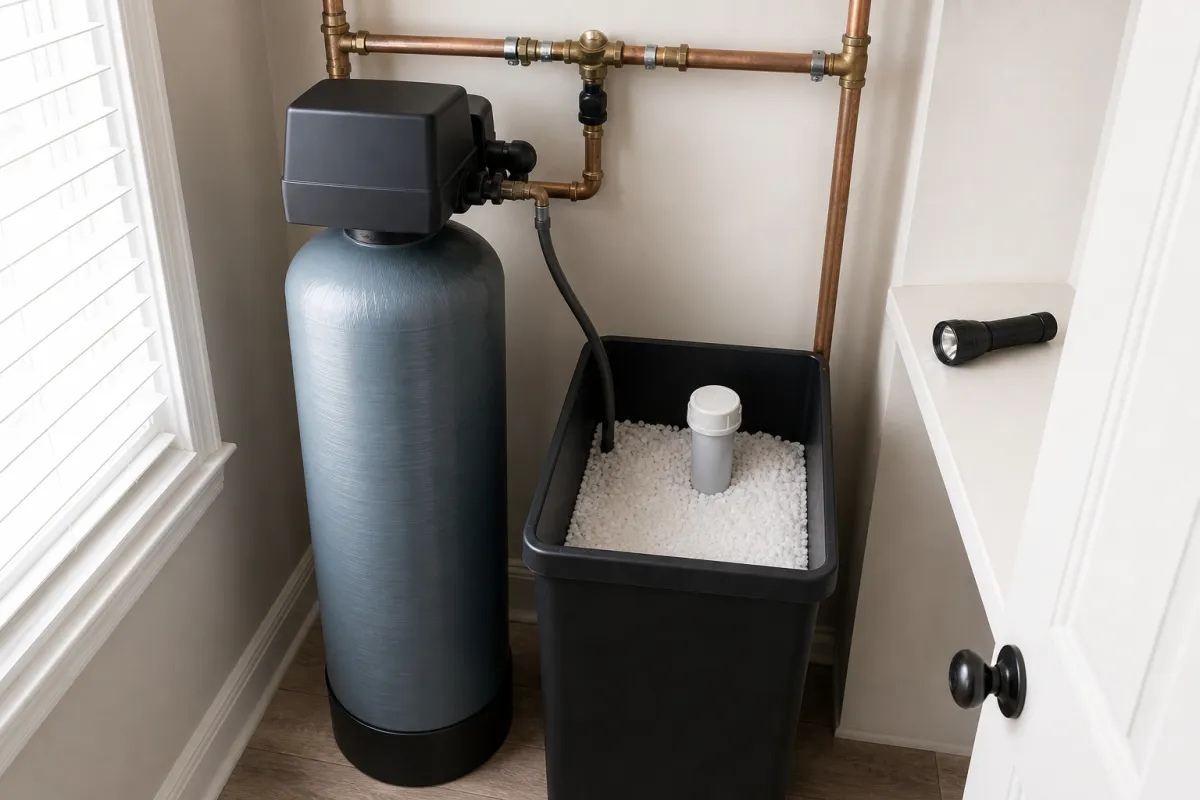
A brine tank that looks full can conceal a salt bridge: a hard shelf of salt suspended above an empty cavity. Press gently on the salt with a clean wooden handle, avoiding the brine well and float. A hollow feel suggests bridging. Break the crust carefully and remove large chunks without striking the plastic tank. Keep the salt level within the manufacturer’s recommended range rather than filling to the lid.
Mushy, compacted salt at the bottom can also prevent reliable brine formation. In that case, removing old material and cleaning the tank may be necessary. Use only an approved salt type. Do not add hot water, acids, detergents, or improvised chemicals. A normal visible water level varies by design, but salt should have access to water so concentrated brine can form before the next cycle.
Determine whether the unit draws brine
During brine draw, the water level in many conventional brine tanks should fall. Mark the starting level with removable tape, initiate a manual cycle as directed by the manufacturer, and observe from outside the tank. You should also hear or see flow at the drain during appropriate stages. Keep the drain connection secure and preserve its required air gap to protect against contamination.
If the level does not fall, possible causes include a clogged injector or venturi, kinked brine line, air leak at a fitting, stuck float, blocked drain, or worn valve components. Some injectors can be cleaned by a homeowner, but only with the water shut off, pressure safely relieved, and model-specific instructions. If those conditions are unclear, leave the control head intact. Opening a pressurized valve can release water suddenly and cause extensive damage.
Check the drain path and rinse stage
Regeneration depends on adequate drain flow to backwash the resin, pull brine, and rinse hardness minerals away. Inspect the accessible drain hose for kinks, crushing, freezing, or a raised route that exceeds the manufacturer’s limits. The termination should not be submerged in a drain or sealed into waste plumbing. A proper air gap reduces the risk of sewage being siphoned into the water-treatment system.
Weak or absent drain flow may result from blockage, low supply pressure, a fouled injector, or a valve that did not shift stages. Continuous flow after the cycle should have ended can indicate a stuck piston, worn seals, or a control interrupted in mid-cycle. Do not clamp or cap a flowing hose. Put the unit in bypass if the manual permits and arrange service, especially if the drain is backing up or water cannot be contained.
Consider resin fouling, age, and water chemistry
Even a perfect brine cycle cannot fully restore resin that is coated with iron, manganese, sediment, or organic material. Private-well conditions can change over time, so an old analysis may no longer describe the incoming water. Compare hardness, iron, pH, and other relevant results with the softener’s specifications. For difficult well water, our overview of the best water softener for well water with iron explains why pretreatment or a specialized system may be necessary.
Use resin cleaner only when it is approved for the specific unit and contaminant. Never mix treatment chemicals, and do not use a softener to make microbiologically unsafe water potable. Resin can also lose useful capacity with age or chemical damage. A technician can perform hardness checks before and after the mineral tank, evaluate flow and pressure drop, and determine whether cleaning, rebedding, or replacement makes economic sense.
Review capacity, meter operation, and household demand
If the water is soft immediately after regeneration but becomes hard much sooner than expected, the unit may be exhausting its capacity. Causes include increased occupancy, laundry volume, a leaking toilet, an outdoor tap connected to softened water, or hardness higher than the programmed value. Check for silent toilet leaks and compare recent consumption with the system’s rated usable capacity.
A demand-initiated softener also relies on a turbine or flow meter. If the display never records water use, it may not know when to regenerate. Conversely, a unit that is too small may cycle excessively even with correct metering. Before replacing it, have the raw hardness, peak flow needs, resin volume, and realistic salt dose reviewed. Our guide to water softener installation cost can help frame the full cost of resizing rather than focusing only on the control head.
Flush stored hard water and isolate fixture issues
After a successful repair and regeneration, open a cold softened-water fixture and allow enough flow to replace water in the nearby branch line. There is no need to waste large amounts of water; test periodically until the result stabilizes. Hot water may remain hard until the water heater turns over through ordinary use. Do not drain a water heater solely for this diagnosis unless you understand the burn, electrical, gas, and sediment risks and follow its manufacturer’s procedure.
If only one faucet fails the hardness test, clean its aerator and inspect any local cartridge or point-of-use device. White debris can be old scale released after plumbing changes. If hot-water problems include poor heating, leakage, unusual noises, or discolored water, treat that as a separate appliance issue and consult a hot water heater repair guide or qualified technician.
Common troubleshooting mistakes
Repeated manual regenerations are rarely the best first response. They consume salt and water while doing nothing for a blocked injector, failed motor, closed bypass, or drain restriction. Run one observed cycle, record the evidence, and correct the identified cause. Do not reset error codes before noting them, and avoid changing multiple settings at once because that obscures which adjustment mattered.
Never disable the brine float, remove the drain air gap, or loosen valve parts under pressure. Do not assume that all water-quality complaints are hardness: odor, unsafe bacteria, nitrate, arsenic, and many other contaminants require specific testing and treatment. A water softener vs. water conditioner comparison can also clarify whether your equipment is designed to remove hardness or merely reduce scale behavior.
When professional service is needed
Arrange service when the brine level will not drop, the tank overfills, drain flow is absent or continuous, the motor stalls, an error returns, or the plumbing leaks. Professional help is also appropriate when the valve must be disassembled, the mineral tank needs rebedding, the unit cannot be isolated, or water pressure must be diagnosed. Provide the technician with test results, settings, model information, and your notes from the cycle.
Call urgently for uncontrolled leakage, a wet electrical connection, sewage backup near the drain, or suspected contaminated drinking water. Put the softener in bypass and shut off water only if you know the correct valves and can do so safely. A precise diagnosis is usually cheaper than replacing parts by trial and error.
Frequently asked questions
How soon should water be soft after regeneration?
Cold water downstream should test softer once the cycle completes and the branch line is flushed. Hot water can take longer because the heater stores water from before regeneration.
Why did the cycle finish if no brine was used?
The timer can advance mechanically or electronically even when a salt bridge, clogged injector, air leak, or drain restriction prevents actual brine draw. Control movement alone is not proof of successful recharge.
Can I regenerate twice in a row?
Some manufacturers recommend two cycles after certain repairs or prolonged depletion, but it should not be the default. Identify brine and drain problems first, then follow the manual to avoid needless water and salt use.
How much water should be in the brine tank?
There is no universal level. Pre-fill and post-fill designs look different, and salt can hide the water. Use the manual and focus on whether the level changes appropriately during a cycle.
Does old resin mean I need a whole new softener?
Not always. Resin can sometimes be cleaned or replaced while the tank and control remain serviceable. Compare valve condition, parts availability, labor, efficiency, and correct system sizing before deciding.
Why This Is Different in San Antonio
A regeneration must restore enough capacity for unusually hard Edwards Aquifer water—about 357 mg/L, or 21 gpg—and the home’s actual demand. Large Stone Oak households, irrigation cross-connections, and 1990s-era plumbing can complicate the diagnosis. Confirm that the softener is not bypassed, compare meter gallons with real use, and remember that scale loosened from a heater may persist after the cold supply tests soft. SAWS reports are useful context, but a tap test tells you what reaches this house today.
What San Antonio Homeowners Pay (2026)
| Post-regeneration repair | Typical local range |
|---|---|
| Hardness test and diagnosis | $95–$185 |
| Brine injector/drain service | $175–$400 |
| Meter or control repair | $350–$900 |
| Resin rebedding | $700–$1,500 |
Bexar County quotes vary with valve brand, resin volume, access, and parts availability. San Antonio homeowners should require test results before approving resin replacement.
When to Call a San Antonio Plumber
Call if the unit never draws brine, sends water to drain continuously, overflows, leaks at the valve, or delivers hard water after one correctly observed cycle. A licensed pro should document inlet hardness, softened hardness, brine draw, flow to drain, and programmed capacity—not simply recommend a new unit.
San Antonio FAQ
Can I regenerate twice in one day?
Only when the manual permits it and you know the first cycle completed correctly. Repetition will not clear a blocked injector.
Could Winter Storm Uri damage explain the problem?
Freeze damage is possible where a unit or drain line was exposed, but a new symptom years later still needs present-day pressure, leak, and brine-draw testing.