> San Antonio Local Insight: Hard water mineral deposits (21 gpg from Edwards Aquifer) affect toilet components, garbage disposals, and fixtures throughout local homes. Scale buildup causes premature wear, reduces performance, and creates problems that soft-water cities rarely see. Regular descaling maintenance is essential for San Antonio plumbing.
Local San Antonio Field Notes Before You Start
Before following any generic plumbing checklist, adjust it for our Edwards Aquifer water. At roughly 357 mg/L, or 21 grains per gallon, the calcium carbonate and magnesium in the water can turn a small maintenance issue into repeat wear on valves, seals, drains, heaters, and appliance connections. That means a clog should be treated as hair, grease, food waste, and mineral scale working together, not as a simple one-cause blockage.
A homeowner in Stone Oak should be especially careful because 1990s and 2000s copper lines are a common place for pinhole leaks and scale-related fixture wear. If you are comparing advice from national repair guides, shorten the maintenance interval and inspect for white scale, crusted fittings, stiff shutoff valves, and early corrosion before assuming the part simply “got old.”
For budgeting, use local pricing instead of national averages: drain cleaning usually runs $150-$350, and a sewer camera inspection is commonly $200-$400. If the issue appears after a summer high-use period or after a rare freeze like Winter Storm Uri, treat it as a local risk signal and document what you see before calling a licensed plumber in Bexar County.
A disposal that hums without turning is receiving power, but the grinding assembly is not rotating. Most often, food debris or a small utensil has jammed the plate; sometimes the motor has overheated or seized. The sound is useful diagnostic information, but leaving the switch on can burn out the motor in seconds.
Treat the repair as both an electrical and plumbing task. Switch the disposal off, unplug it or open the correct breaker, and verify it cannot start before reaching near the sink opening. In a Stone Oak kitchen, hard-water scale may roughen drain surfaces and help grease or food debris hold on, but scale alone rarely causes the motor to hum—the immediate problem is still a jam or failed motor.
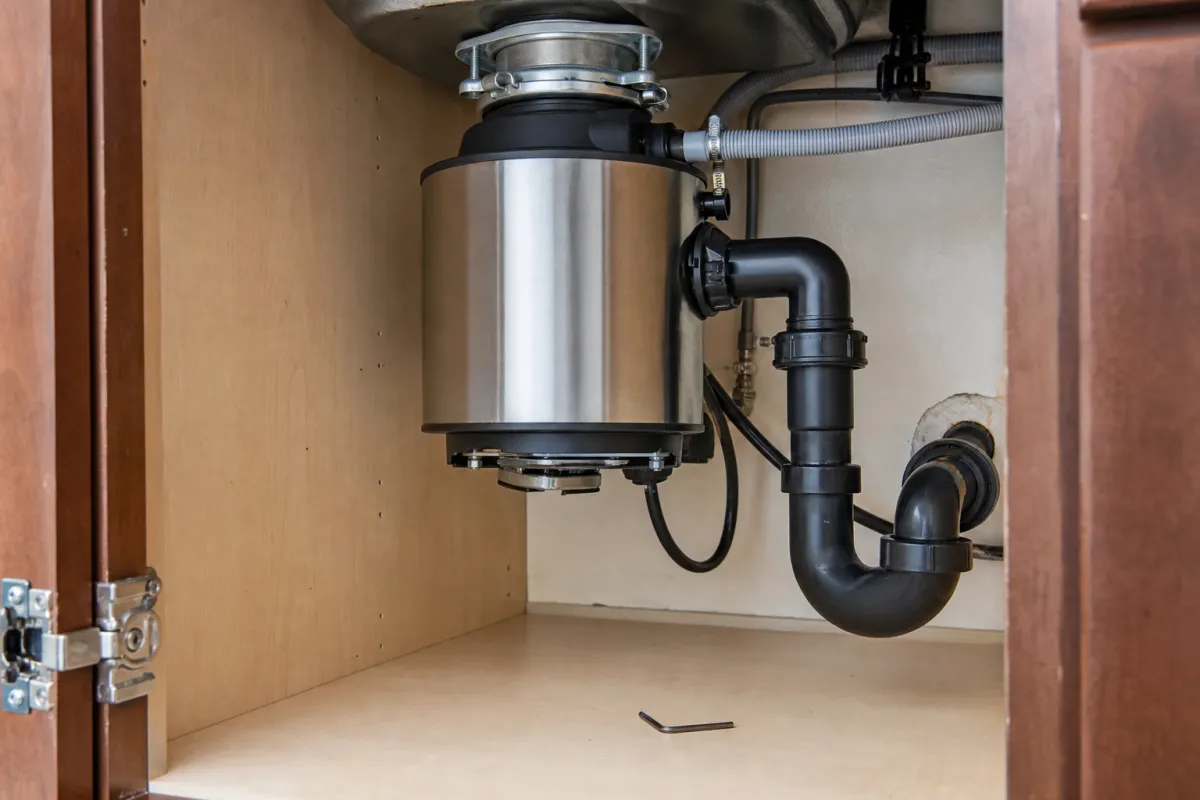
A reset button and manufacturer-supplied hex wrench are reasonable DIY tools. Hands inside the chamber, drain chemicals, improvised leverage, and repeated switch flips are not. If the sink is leaking, the breaker trips, or the unit will not rotate freely after the obstruction is removed, stop and arrange a repair.
Quick answer: what that humming sound usually means
When a disposal works normally, you hear a short startup sound, then grinding, then quiet. When it only hums, the motor windings are energized but the rotor is not turning. Common reasons include:
- A utensil, bone fragment, fruit pit, glass, or fibrous food locked against the impellers
- A seized flywheel after long idle periods or hard mineral buildup
- A failed start capacitor or worn bearings that leave the motor stalled under load
- A partial electrical problem that still delivers enough power for a hum but not a clean start (less common than jams)
The good news: if the unit hums and the reset button has not tripped yet, many units can still be freed with the manufacturer’s hex wrench under the sink. The bad news: if you leave a humming motor powered for more than a few seconds, heat builds fast and you can burn out a motor that was otherwise salvageable.
Immediate rule: flip the wall switch off as soon as you hear a continuous hum with no grind. Do not hold the switch on while you poke around.
Safety first: water, power, and when to stop
Treat the disposal as both a wet electrical appliance and a sharp mechanical device.
1. Power off at the wall switch before any hand or tool work under the sink.
2. Confirm the circuit if the switch is unreliable—use the breaker labeled for the disposal or kitchen if you need a hard off.
3. Never put bare hands into the disposal chamber, even with power off. Use tongs or needle-nose pliers from above if you must retrieve an object.
4. Do not pour drain cleaners into a humming or jammed disposal. Caustic products can splash back, damage seals, and make later repairs more dangerous.
5. Watch for water under the sink. A humming unit that also leaks may have a cracked housing or failed seal—not just a jam.
6. Stop DIY if you smell burning plastic, see scorch marks on the cord or outlet, or the breaker trips repeatedly.
If anyone in the home is not comfortable working under a sink with electrical connections nearby, skip to the pro section. The cost of a service call is usually lower than replacing a motor you burned out by forcing power against a jam.
What to check first (in a safe order)
Work top-down and power-aware. This sequence solves most “humming, not grinding” complaints without guesswork.
1. Confirm it is truly humming, not dead
Press the wall switch once. Listen for:
- Steady hum, no grind → jam or seized flywheel (continue)
- Nothing at all → check GFCI outlets, breaker, cord plug under the sink, and the red reset button on the unit bottom
- Click then silence → thermal overload may have already tripped; wait 10–15 minutes, then try reset
- Grind with loud metal screech → stop; object may still be present
2. Look in the chamber with a flashlight (power off)
With the switch off, shine a light into the splash guard opening. Common culprits: spoon handles, bottle caps, fruit pits, corn cobs, potato peels in a packed mass, shrimp shells, or glass shards. If you see something reachable with tongs, remove it carefully. Do not force brittle objects that could shatter deeper into the unit.
3. Try the reset button (only after cooling)
Most disposals have a red or black reset button on the bottom of the housing. If it has popped out, press it firmly until it clicks in. If it will not stay in, the motor may still be hot or damaged—wait longer, or the unit may need replacement.
4. Use the hex wrench port under the unit
This is the step that fixes a large share of humming disposals. On the very bottom center of many units (InSinkErator-style and similar) there is a hex-shaped recess. Insert the disposal wrench (often included when the unit was installed; a standard hex key of the correct size can work if it fits fully).
- Power remains off
- Turn the wrench back and forth firmly to rock the flywheel free
- You may feel resistance, then a sudden free spin
- Once it turns freely both directions, remove the wrench
5. Flush and test briefly
Restore power only after the chamber looks clear and the flywheel turns freely by wrench. Run cold water, flip the switch for one second. If it spins normally, keep water running 15–30 seconds. If it hums again, power off immediately and reassess.
Step-by-step: free a jammed disposal without damaging it
Use this as a practical procedure when the unit hums and nothing obvious is sitting in the chamber.
1. Kill power at the switch (and breaker if you prefer a hard lockout).
2. Bail standing water from the sink if the drain is full so debris does not hide underwater.
3. Inspect and extract reachable objects with tongs.
4. Hex-wrench the flywheel from below until it rotates freely.
5. Press the reset if it is out.
6. Optional wooden dowel method (power still off): some manufacturers allow careful leverage from above with a wooden spoon handle against the impellers—not metal pry bars that scar the chamber. Only if the manual allows it.
7. Cold water on, short test burst.
8. If successful, grind a small amount of ice cubes with cold water to help scour soft residue, then flush. Skip ice if the unit still feels weak or noisy.
What about baking soda, vinegar, or ice?
Ice and cold water can help after a jam is freed. Baking soda and vinegar are mild deodorizers, not jam removers. They will not free a locked flywheel and should not replace mechanical freeing. Avoid chemical drain openers entirely for this symptom.
Common causes ranked by how often they show up
| Cause | Typical clues | Homeowner fix? |
|---|---|---|
| Foreign object jam | Hum + recent dropped utensil/pits | Often yes (tongs + wrench) |
| Fibrous food pack | Celery, corn husks, onion skins | Sometimes; prevention matters |
| Seized flywheel after idle | Hum after long non-use | Often wrench + reset |
| Overheated motor / tripped reset | Worked, then stopped; button out | Reset after cool-down |
| Failed motor / bearings | Hum, free spin by wrench fails, burn smell | Usually replace |
| Wiring / switch / GFCI issues | Intermittent power, dead outlets | Electrical check |
| Grease solidified mass | Slow drain + hum under load | Clear carefully; change habits |
Grease is especially common in homes that rinse pans “just a little.” Grease cools in the chamber and trap, binds soft debris, and loads the motor. Even if you free today’s jam, ongoing grease disposal will bring the problem back.
Mistakes that make a humming disposal worse
- Holding the switch on while it hums. Motors overheat quickly under locked-rotor conditions.
- Hands in the chamber with power available. Always lock out power; still never use bare hands.
- Metal tools prying from above that chip the grinding ring or crack the housing.
- Chemical drain cleaners that damage rubber splash guards and seals.
- Running hot water with grease thinking it “melts away.” Grease often re-solidifies farther down the line.
- Assuming every hum is a cheap fix. Units over 10–15 years with repeated jams may be at end of life; repeated resets can be a false economy.
- Ignoring a leak while chasing the hum. Water and live connections under the sink are a bad combination.
How to test after you free the jam
A good recovery test is short and controlled:
1. Cold water running before the switch.
2. One-second start to confirm spin.
3. If normal, run 20–30 seconds with water only.
4. Small soft food test (optional), never bones or fibrous masses on the first test.
5. Listen for new rattles that suggest a remaining fragment.
If the unit starts, then stalls again under light load, something is still obstructing the plate or the motor is weak. Power off and re-inspect rather than forcing longer runs.
Prevention habits that actually reduce humming jams
- Run a strong stream of cold water before, during, and after grinding.
- Feed food gradually; do not dump a full plate at once.
- Keep out: grease, oil, coffee grounds in bulk, eggshells in excess, pasta/rice in bulk, fibrous peels, expandable foods, non-foods.
- If you must dispose of small soft scraps, alternate with cold water flushes.
- Monthly: optional ice cube grind + cold flush if the manufacturer supports it; wipe the splash guard.
- Teach everyone in the home that utensils do not “rest” on the splash guard.
None of these habits eliminate every jam, but they cut the odds of a locked flywheel dramatically.
Choosing the Right Trade for a Disposal Failure
Call for help when any of the following is true:
- The flywheel will not free with the hex wrench and no object is visible
- The reset button will not stay engaged
- You smell burning, see discoloration on wiring, or breakers trip
- Water is leaking from the disposal body, dishwasher inlet, or drain connections
- The unit is hardwired and you are not qualified to disconnect it safely
- Multiple kitchen circuits or GFCI outlets are misbehaving
- The disposal is old, repeatedly jamming, and replacement is likely more rational than repair
A licensed plumber can pull the unit, clear the trap, check the drain line, and advise on replacement sizing. An electrician is the right call for switch, outlet, or wiring faults. If sewage smell or backup appears in other fixtures, treat it as a drain system issue, not only a disposal jam.
Replacement vs repair: practical framing
There is no universal year when every disposal “must” die, but repeated motor overloads, chronic leaks at the body, and inability to free the flywheel are common replacement triggers. When replacing:
- Match horsepower to household use (light vs heavy cooking)
- Confirm sink flange compatibility and dishwasher takeoff needs
- Plan for new discharge tubing and a solid electrical connection
- Do not reuse badly corroded plumbing fittings just to save a few dollars
Get written estimates if a contractor proposes full kitchen drain rework beyond the disposal itself—sometimes it is necessary, sometimes it is upselling.
FAQ
Why does my garbage disposal hum but not turn?
Power is reaching the motor, but the grinding plate cannot rotate. Most often a jam or seized flywheel is holding it. Less often, the motor itself has failed.
Is it safe to keep flipping the switch when it only hums?
No. Each attempt under a locked rotor heats the motor. Switch off, free the jam, reset, then test briefly with water running.
Where is the reset button on a garbage disposal?
Usually on the bottom of the unit, facing the cabinet floor—a small red button on many models. Press only after the unit has cooled and power is off at the switch during inspection.
Can I use a drill on the hex port?
Some people use a hex bit in a drill on low torque, but hand wrenching gives better feel and less risk of damage. If you use power tools, keep torque low and stop as soon as the flywheel frees.
What if water is standing in both sink basins?
The disposal jam may be paired with a clogged trap or branch line. Freeing the disposal may not clear the standing water. You may need to clear the P-trap or call a plumber if plunging and trap cleaning fail. Avoid chemical cleaners in a disposal-equipped sink when possible.
Will a humming disposal fix itself?
Unlikely. Heat may trip the overload and silence the hum, but the underlying jam remains. Address the cause rather than waiting.
Why This Is Different in San Antonio
Water supplied from the Edwards Aquifer is commonly measured near 357 mg/L, or 21 grains per gallon—extremely hard by ordinary household standards. That matters to this job because drain friction, splash-guard buildup, and recurring kitchen clogs. SAWS water-quality reporting is the right source for current systemwide data, while visible scale at a specific home shows what its equipment is actually experiencing.
In Stone Oak, age, construction type, and access can change the repair plan as much as the failed part. Bexar County homeowners should photograph corrosion or leaks, note error codes and service dates, and ask whether the quote addresses the cause as well as the symptom. After a severe freeze or prolonged outage, inspect exposed lines before assuming the appliance itself is the only problem.
What San Antonio Homeowners Pay (2026)
| Service | Typical 2026 range |
|---|---|
| Disposal jam or drain service | $150–$350 |
| Standard disposal replacement | $300–$750 installed |
| Electrical diagnosis or switch/GFCI repair | $175–$600 |
| After-hours plumbing visit | $250–$500 |
These are planning ranges, not bids. Access, permits, fuel or electrical upgrades, equipment efficiency, warranty terms, and after-hours timing can move the final price. Ask for a written scope that separates equipment, labor, code-related upgrades, and optional water treatment.
When to Call a San Antonio Plumber
Call a licensed plumber when there is an active leak, a valve will not close, water is near electrical equipment, gas odor is present, a breaker trips repeatedly, or the repair requires opening a fuel, vent, or pressurized-water connection. Shut off the relevant utility only if you can do so safely. For gas odor, leave the building and contact the gas utility or emergency services from outside.
For non-emergency work, give the plumber the model number, symptoms, error codes, maintenance history, and photos. Ask whether the proposed repair accounts for hard-water scale and whether the contractor is licensed and insured for the work. A clear diagnosis is more valuable than replacing parts until the symptom disappears.
San Antonio FAQ
Is the local water hard enough to change maintenance intervals?
Yes. At roughly 357 mg/L / 21 gpg, mineral accumulation can be much faster than national maintenance examples imply. Follow the appliance manual first, then shorten inspection or descaling intervals when scale returns before the next planned service.
Does every home need a water softener?
No single answer fits every household. Treatment is worth evaluating when scale returns quickly, valves bind, appliance heat exchangers need frequent service, or water-heater life has been short. Test the water, compare maintenance costs, and make sure any treatment system is sized and maintained correctly.
What can a homeowner safely do before the appointment?
Document the symptom, clear access, stop using leaking or overheating equipment, and locate the correct shutoff. Do not bypass safeties, open gas components, work live electrical circuits, or force a corroded valve. Those boundaries protect both the home and the technician who follows.