> San Antonio Local Insight: Drain and sink clogs in San Antonio are different from other cities. Edwards Aquifer hard water (357 mg/L) deposits white calcium scale inside pipes that traps hair, grease, and soap more aggressively. Standard drain cleaners often fail because they dissolve organic matter but not mineral buildup. local homes need descaling-specific methods.
For a San Antonio homeowner in Alamo Heights, the safe first decision is whether caustic liquid remains—not which tool to try next. A straightforward mechanical clearing may cost $150–$300, while chemical handling, a long branch restriction, or after-hours access can move the bill higher.
When Drano doesn’t work in a kitchen sink, do not pour in more product or add another cleaner. The drain may contain a dense grease plug, food debris, an object, a disposal obstruction, or a problem farther down the branch line—conditions a chemical cleaner may not solve. More chemicals increase the risk to your eyes, skin, pipes, and anyone who later opens the drain.
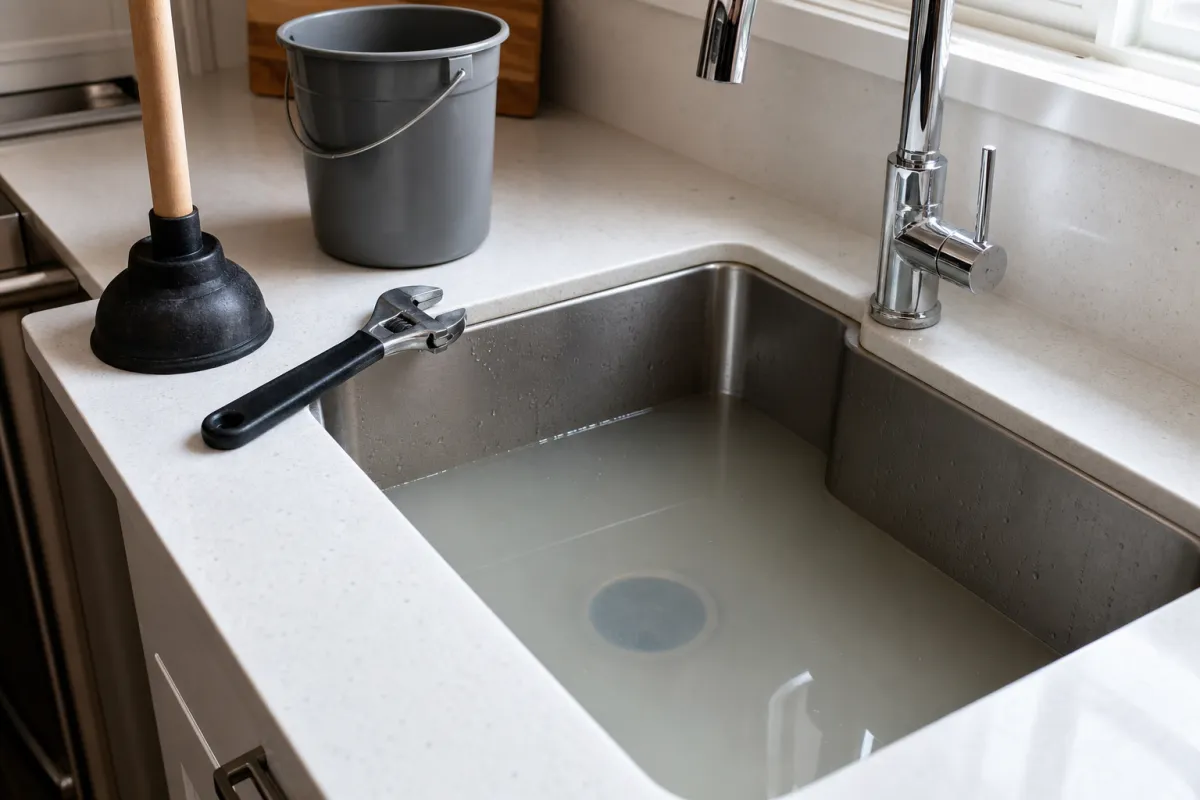
Treat the sink as if caustic liquid remains inside it. Stop running water, keep others away, ventilate the room, and read the product label. The safest next move depends on whether the basin is still holding liquid, whether a garbage disposal is installed, and whether other fixtures are affected.
First, control the chemical hazard
Commercial drain openers may contain sodium hydroxide, oxidizers, or other corrosive ingredients. Even when the visible liquid looks like ordinary dirty water, it may burn skin and eyes. Do not plunge a chemically treated sink because the plunger can spray contaminated water. Do not put your face over the drain, reach into a disposal, or loosen a trap full of unknown liquid.
Never mix the product with bleach, ammonia, acids, vinegar, another drain opener, or a homemade remedy. Mixing cleaners can release toxic gas, generate heat, or cause violent splashing. Keep the container or take a photo of its label so a plumber or poison-control specialist knows what was used. If exposure occurs, follow the label’s first-aid directions and contact local poison control or emergency services as appropriate.
Why chemical cleaner often fails in a kitchen sink
Kitchen clogs are frequently made of cooled fats, starch paste, fibrous food, coffee grounds, and soap residue. A chemical may cut a narrow passage without removing the larger deposit, so drainage improves briefly and then slows again. If the product cannot reach the blockage because standing water dilutes it, or if the obstruction is a utensil or other solid object, adding more will not address the cause.
The restriction may also sit beyond the trap in a long horizontal branch. In that case, liquid cleaner can remain pooled in the piping. A blocked plumbing vent, incorrectly sloped drain, collapsed line, or full main drain is not chemically fixable. Likewise, a jammed garbage disposal needs safe mechanical diagnosis rather than another dose of drain opener.
| Situation | Do now | Do not do |
|---|---|---|
| Chemical water standing in basin | Isolate area, ventilate, check label, call a plumber | Plunge, scoop by hand, or add products |
| Sink drains but remains slow | Avoid further chemicals; arrange mechanical cleaning | Assume the clog is gone |
| Disposal hums or trips | Cut power at breaker | Reach inside or repeatedly reset it |
| Other fixtures back up | Stop unnecessary water use; call promptly | Keep testing with more water |
| Cleaner contacted skin or eyes | Rinse as label directs and seek expert guidance | Neutralize it with another chemical |
Determine whether the issue is local or larger
Observe without adding water. Did only the kitchen sink slow down, or did a nearby dishwasher, laundry drain, toilet, or tub also react? A single affected sink often points to its trap, disposal, or branch. Multiple fixtures gurgling or backing up can indicate a larger branch or main-line obstruction. In a multifamily building, contact management because shared drainage may be involved.
Also note how the failure began. A sudden stop after food preparation may indicate an object or food mass. Gradual slowing suggests accumulated grease and residue. A sink that fills when the dishwasher discharges may have a restricted disposal outlet or shared drain. Sewer odor, water rising in another fixture, or wastewater at a floor drain moves the problem beyond routine DIY.
If chemical remains, choose professional removal
Opening a trap after drain cleaner has failed is much riskier than opening an untreated drain. The curved pipe can hold concentrated corrosive liquid under slight pressure, and slip nuts may release it unpredictably. A plumber can arrive with splash protection, chemical-resistant equipment, containment, and a plan for lawful disposal. Tell the dispatcher which product, approximate amount, and time of use.
Do not attempt to “neutralize” the cleaner. Neutralization can be exothermic and may aerosolize or splash the chemical. Do not use a wet/dry vacuum unless its manufacturer explicitly approves the exact chemical and application; many do not, and the exhaust can spread fumes. If the product label provides a specific flushing instruction and the drain still passes water, follow only that instruction—never improvise or exceed it.
Check the garbage disposal without touching the chamber
If the treated sink has a disposal, avoid all inspection until chemical liquid has safely drained or been professionally removed. After the chemical hazard is resolved, switch the disposal off and cut power at the breaker. Confirm it cannot start. Use a flashlight from above; never insert a hand, even when power appears off. An object may be removed only with suitable long-handled tongs when it is clearly visible and safely reachable.
A humming motor often means the grinding mechanism is jammed. Many units can be turned with the manufacturer’s wrench from below, followed by a reset after the obstruction is cleared, but follow the specific manual. A silent unit may have lost power; repeated breaker trips, a burning smell, heat, leaking housing, or damaged cable requires an appliance technician, electrician, or plumber. Water near electrical components is a stop-work condition.
Use mechanical cleaning only after the chemical is gone
For an untreated sink, removing and cleaning the P-trap is often a sensible first mechanical step. After chemical use, however, wait until the system has been made safe according to the label or by a professional. Then wear eye protection and appropriate gloves, place a wide bucket below, and loosen slip nuts slowly. Replace cracked washers and avoid overtightening plastic fittings.
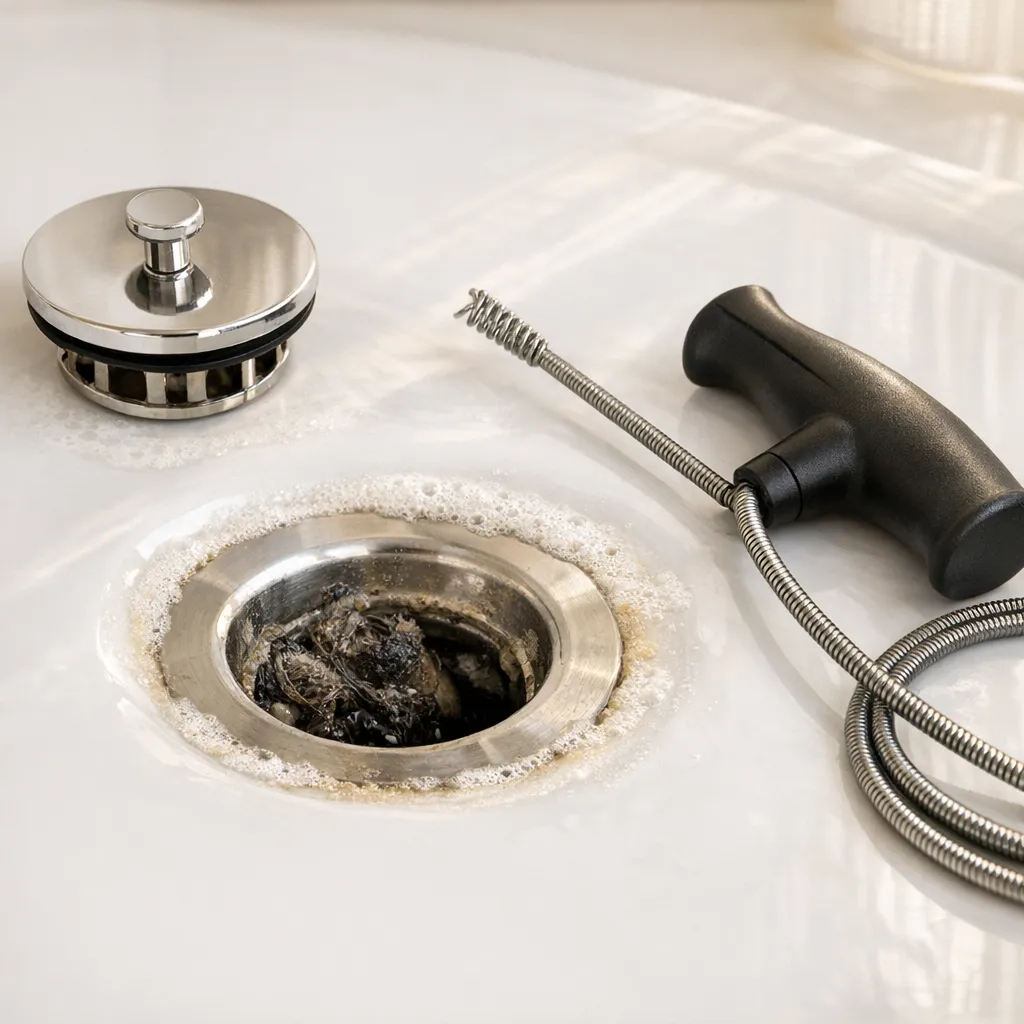
If the trap is clear, a manual hand auger can address residue in the wall arm or branch. Feed it gently, rotate as instructed, and withdraw debris rather than forcing the cable. Powered drain machines can twist, damage piping, or injure an inexperienced operator. Hydro-jetting also requires diagnosis; excessive pressure can harm weak or incorrectly assembled lines. The goal is to remove the obstruction, not merely punch a temporary hole through it.
Know when a plunger is—and is not—appropriate
A sink plunger can work on an ordinary untreated local clog. Seal the second bowl of a double sink, cover an overflow if present, add enough clean water to cover the cup, and make controlled strokes. The seal directs pressure toward the obstruction. Afterward, test with a small amount of water rather than immediately filling the basin.
A plunger is not appropriate when Drano or another corrosive product may remain. Splashing can cause serious injury, and pressure can force chemical water through a loose joint. It is also the wrong tool when the disposal is mechanically jammed, several fixtures are backed up, or old corroded piping may separate. In those cases, isolate the area and use professional service.
Avoid popular remedies that create new risks
Boiling water is often recommended for grease, but it is not universally safe. Very hot water can stress some sink materials and plastic piping, and melted grease may solidify farther down a cooler branch. Baking soda and vinegar create visible foam but usually cannot remove a dense food-and-grease plug. After a commercial opener, adding either is unsafe because the remaining ingredients are uncertain.
Do not force a coat hanger into the drain; it can scratch finishes, puncture a disposal splash guard, compact debris, or become stuck. Avoid removing glued pipe, cutting into a wall, or dismantling hardwired equipment without the appropriate skills. Accordion-style replacement drains are also a poor shortcut because their ridges collect debris and may not meet local requirements.
Decide when to call a plumber
Call a plumber now if caustic liquid stands in the sink, you cannot identify what products were mixed, multiple fixtures are affected, wastewater is rising, or sewer odor is strong. Professional help is also the right choice for recurring clogs, inaccessible piping, leaking or corroded joints, a disposal with electrical symptoms, and any suspected vent or main-line issue.
Before work begins, describe the exact symptoms and chemical history. Ask whether the service includes trap clearing, branch-line cabling, camera inspection, cleanup, and reassembly testing. Camera work may be useful for recurrent or distant obstructions but is not automatically necessary for every simple trap clog. A clear scope helps prevent surprise charges while allowing the technician to stop if damaged piping appears.
Prevent the next kitchen sink blockage
Keep fats, oils, and grease out of the drain. Pour cooled grease into a disposable container, scrape plates, and use a basket strainer. Even with a disposal, avoid large loads of pasta, rice, peels, fibrous vegetables, coffee grounds, and eggshells. Feed suitable scraps gradually with the water flow and run time specified by the manufacturer.
Clean strainers and disposal splash guards routinely, and inspect beneath the sink for moisture or poorly aligned pipes. If drainage begins slowing, address it before the basin stops completely. Mechanical removal at an early stage is usually more predictable than repeated chemical treatment. Keep the drain-cleaner label available until the issue is fully resolved, then store chemicals locked away from children and away from incompatible products.
A safe step-by-step decision checklist
1. Stop adding water and products.
2. Keep people and animals away from the sink and ventilate the room.
3. Identify the product, amount, and time used without handling contaminated liquid.
4. If exposure occurred, use the label’s first-aid instructions and obtain expert medical guidance.
5. If chemical liquid remains, call a plumber and disclose it before arrival.
6. If several fixtures react, limit household water use and report a probable branch or main issue.
7. After the chemical hazard is resolved, use inspection and mechanical cleaning rather than another chemical dose.
8. Test the repaired drain gradually and check every joint for leakage.
This sequence prioritizes safety while preserving useful diagnostic information. It also protects the next person who works on the drain; undisclosed chemical cleaner is a serious occupational hazard.
Frequently asked questions
Can I use another brand if Drano didn’t work?
No. Different products may contain incompatible ingredients, and the first product may remain trapped. Adding another cleaner can create heat, gas, or splashing without removing the obstruction.
How long should I wait before calling a plumber?
If corrosive liquid is standing, call promptly rather than waiting for an uncertain reaction. If the sink drained but remains slow, stop using chemicals and schedule mechanical diagnosis. Mention the product and time used when booking.
Can I remove the P-trap myself after using drain cleaner?
Not while chemical may remain. The trap can release concentrated liquid onto your face, arms, or cabinet. Follow the label and use a professional equipped for containment when there is uncertainty.
Why did the drain improve and clog again?
The cleaner may have opened only a small channel through a larger grease-and-food deposit. The remaining material catches more debris. Complete mechanical removal and correction of any slope or disposal issue are more durable.
Is a failed drain cleaner bad for pipes?
One correctly used product does not prove pipe damage, but prolonged chemical contact, repeated dosing, heat, and incompatible products can harm some materials or joints. A plumber can inspect vulnerable or leaking sections after the blockage is cleared.
Why This Is Different in San Antonio
The first complication is chemistry. Edwards Aquifer water averages about 357 mg/L, or 21 gpg, so calcium scale gives grease and starch a rough surface to grip. A cleaner may tunnel through the organic material while leaving the mineral-backed restriction in place. That is why a sink may drain for a day and then stop again.
In older Alamo Heights kitchens, mixed-metal or galvanized branch piping adds another concern: a caustic product can sit behind a dense plug in already-thinned pipe. SAWS water-quality reporting is useful context, but it does not tell you whether one branch is scaled shut. A mechanical clearing and inspection are more useful after one chemical attempt has failed.
Season also matters. Holiday cooking produces grease-heavy clogs, while summer gatherings put larger loads through disposals. After a cold event such as Winter Storm Uri, a shifted joint or damaged branch may mimic an ordinary clog. If other fixtures react, stop treating the sink as an isolated problem.
What San Antonio Homeowners Pay (2026)
| Service | Typical 2026 range |
|---|---|
| Kitchen trap or simple branch clearing | $150–$300 |
| Longer branch cabling / mechanical cleaning | $250–$450 |
| Camera inspection when recurrence justifies it | $200–$400 |
| After-hours visit | $250–$500 |
Access, standing chemicals, corroded pipe, and work inside a wall can raise the price. In Bexar County, disclose the exact cleaner before dispatch; chemical containment is part of the work, not a surprise add-on.
When to Call a San Antonio Plumber
Call promptly when chemical liquid remains in the basin, more than one fixture backs up, a disposal has electrical symptoms, or a trap or wall arm leaks. Also call for a clog that returns after mechanical clearing; recurrence can indicate poor slope, a scaled branch, or a larger drain issue.
Tell the dispatcher what product was used, how much, and when. Ask whether the quoted scope includes safe chemical handling, trap reassembly, branch cabling, and a leak test. Typical licensed labor is about $85–$150 per hour, but a clear scope matters more than the hourly number.
San Antonio FAQ
Why does a kitchen clog return so quickly here?
Hard-water scale can anchor grease and food residue, so opening a narrow channel is not the same as cleaning the branch.
Can I plunge after using Drano?
No. A plunger can spray caustic liquid. Isolate the sink and arrange safe removal if product remains.
Does SAWS need to be called for a sink clog?
Usually not. SAWS is relevant when the issue appears to involve the public service or neighborhood supply; an indoor branch clog belongs with a plumber.
Is a camera always necessary?
No. It is most useful for recurring, distant, or unexplained restrictions after basic mechanical diagnosis.