> San Antonio Local Insight: Drain and sink clogs in San Antonio are different from other cities. Edwards Aquifer hard water (357 mg/L) deposits white calcium scale inside pipes that traps hair, grease, and soap more aggressively. Standard drain cleaners often fail because they dissolve organic matter but not mineral buildup. local homes need descaling-specific methods.
The moment a drain cable stops moving both forward and backward, release the trigger and keep both hands on the machine. A stuck snake can be wrapped around roots, wedged at a fitting, buried in grease, or kinked inside a scale-roughened pipe. More torque can snap the cable and leave steel inside the drain.
Homes toward New Braunfels and Boerne face the same limestone-driven hardness found across the region—often around the 357 mg/L, or 21 gpg benchmark associated with Edwards Aquifer supply. Scale is rarely the only reason a cable sticks, but it can reduce clearance at cast-iron transitions and help debris lock around a cutting head.
Mark the cable at the entry point and estimate how much is in the line before trying the controlled retrieval sequence below. A local service call may be $150–$350; retrieval with a camera can add $200–$400. That is still cheaper than breaking a fitting under a Bexar County slab by yanking blindly.
First, Stop and Stabilize the Cable
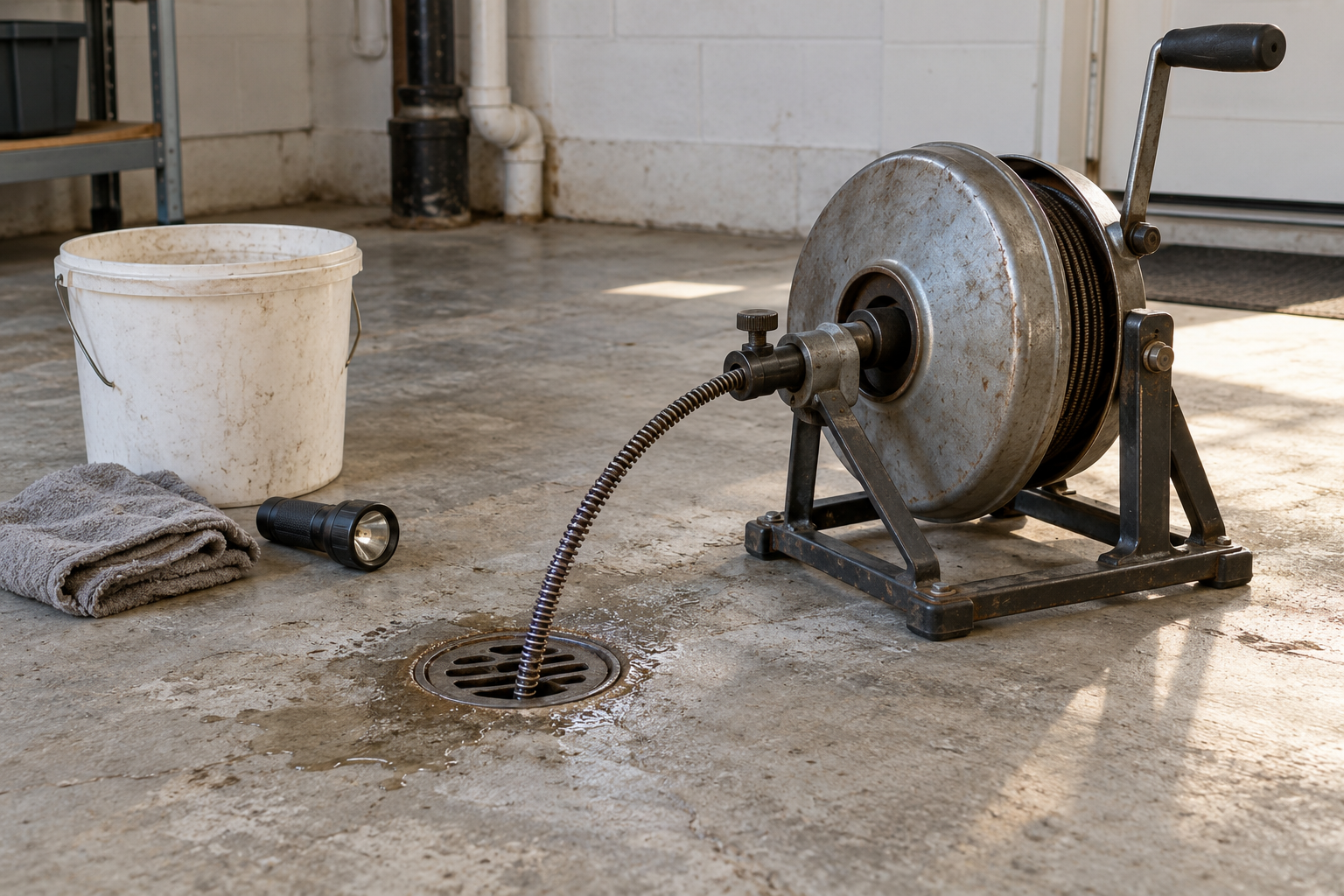
Release the machine’s feed control or switch off and unplug a powered snake before touching the cable or drum. Do not let a rotating cable whip outside the pipe; it can catch gloves, clothing, hair, or nearby objects. For a hand snake, keep one hand on the drum or handle so stored tension does not unwind unexpectedly. Clear people and pets from the area and improve lighting before diagnosing the problem.
If water is rising, stop using the affected fixture and any connected fixtures. Close a sink or tub faucet and avoid flushing nearby toilets until you know whether they share the blocked branch. Place towels and a bucket around the opening, but keep powered equipment and extension connections off wet floors. Wear eye protection and drain-cleaning gloves over intact waterproof gloves because cable coils can hold contaminated water and sharp debris.
Work Out Why the Snake Is Stuck
A cable that stops advancing but still retracts is not necessarily trapped; it may simply be meeting an elbow or obstruction. A cable that rotates but will not move in either direction may be bored into roots, wipes, grease, or fibrous material. If the drum turns while the exposed cable twists into loops, the cable may have doubled back in an oversized pipe or kinked near the entry point.
Pay attention to depth. A snag within the first few inches may be a crossbar, trap bend, or unsuitable access angle. Resistance at the same measured distance every time can correspond to an elbow or junction. A sudden catch followed by scraping or metallic impact raises concern about a broken component. These clues are not proof, but they help you avoid treating every stop as a clog that needs more torque.
Relieve Tension Before Trying to Reverse
For a manual drum snake, stop feeding and rotate the drum slowly in the reverse direction recommended by its manufacturer while applying only light backward pressure. Then move the cable forward a fraction and back again. This small in-and-out motion can release a head that has corkscrewed into soft material. Keep the cable as straight as practical between the drum and drain opening to reduce buckling.
For a powered machine, follow its operating instructions rather than improvising. Many machines use forward motor rotation for both advancing and retrieval, while a reverse switch is intended only to free a bound cable briefly. Running continuously in reverse can loosen couplings or damage the cable. If you do not know the machine, unplug it and stop. Rental-store equipment deserves the same caution as professional machinery; higher torque increases injury and pipe-damage risks.
Use a Controlled Retrieval Sequence
Begin with the least forceful approach. Lock the cable according to the tool design, rotate slowly, and pull back only an inch or two. If it moves, pause to wipe the exposed section with a rag held safely away from rotating parts, then repeat. Do not wrap cable around your hand or brace it against your body. Maintain a short exposed span so the cable cannot form a dangerous loop.
If the cable does not move, gently advance it a small amount before trying to retrieve it again. That counterintuitive step can unhook a head caught on the downstream side of an elbow. Alternate direction in short cycles, never allowing the drum to build obvious torsion. A second person may observe the drain and control the plug, but only one person should operate the machine. Stop immediately if the pipe shifts, a fitting leaks, or the cable begins to kink.
After retrieval, do not immediately send the same damaged cable back into the line. Clean and inspect it for flattened coils, sharp strands, permanent bends, or a loose head. A compromised cable can break on the next use. If the drain remains blocked, reassess the access point and tool choice rather than repeating the exact maneuver that caused the snag.
Quick Reference for Common Snags
| Symptom | Possible cause | Safer response |
|---|---|---|
| Cable stops but pulls back easily | Normal bend or clog face | Retract, adjust angle, and retry gently |
| Cable rotates but will not retract | Head embedded in debris | Use short forward/back movements without added torque |
| Exposed cable forms loops | Too much cable outside pipe or cable doubled back | Stop rotation, shorten exposed span, retrieve carefully |
| Hard metallic catch at fixed depth | Crossbar, fitting, or damaged pipe | Stop and inspect through another access point |
| Drum turns but cable does not | Loose lock, broken cable, or internal tangle | Unplug and inspect tool; do not keep powering it |
| Water leaks at a joint while working | Pipe or fitting has moved or failed | Stop water use and call a plumber |
Do not diagnose solely by sound. Plastic drain pipe can transmit scraping noise that seems severe, while a quiet cable can still be wrapped around roots or a fixture component. If your observations do not match the tool manual—or if each attempt increases resistance—professional retrieval is more economical than risking a broken cable inside the line.
Access Point Problems That Trap Snakes
Snaking through a sink strainer, garbage disposal, toilet bowl, or sharply angled trap often creates unnecessary bends. When practical, a removable trap or proper cleanout offers a straighter route. However, opening a trap can release wastewater, and opening a main cleanout can release sewage under pressure. Do not remove a cap if you cannot safely contain what may come out.
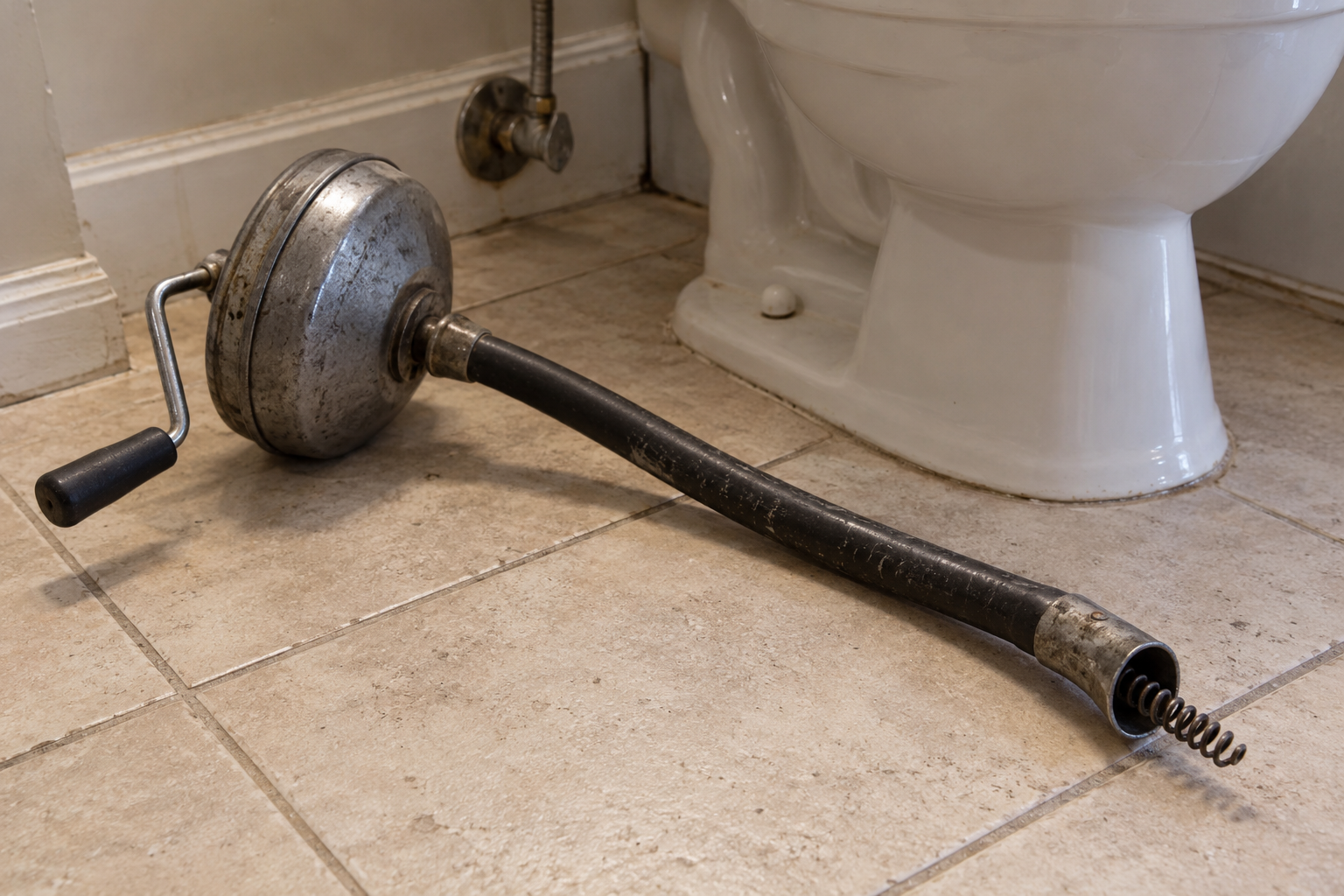
A toilet requires a closet auger with a protected guide, not a general bare cable. A tub overflow can provide a more direct path than the drain opening, where linkage or crossbars may catch the head. For a clogged sink drain, removing and cleaning the trap may solve a local blockage without cable work. If you change access points, first recover the original cable completely and confirm the new route actually leads into the affected drain.
Mistakes That Make a Stuck Cable Worse
Do not attach pliers to the cable and pull with your body weight. Concentrated force can stretch coils, create sharp broken strands, damage a fitting, or pull the machine toward you. Do not use a vehicle, winch, drill, or improvised lever. Never cut a tensioned cable: stored energy can make the ends recoil, and the remaining section may disappear into the drain.
Avoid adding chemical drain cleaner. It rarely releases a mechanically trapped head and creates a splash hazard during retrieval. Do not mix products or pour boiling water into plastic drain systems. If chemicals were already used, tell anyone assisting you and follow the label’s exposure guidance. A cable contaminated with corrosive cleaner requires suitable gloves, eye protection, ventilation, and careful cleanup.
Repeatedly switching a powered machine between forward and reverse is another common error. Reverse is not a universal extraction mode. Excess torque can unwind a sectional cable or loosen a cutter. Likewise, continuing after the cable has kinked risks snapping it. Treat a visible deformation as a tool failure, not a minor inconvenience.
When the Problem May Be the Pipe
A snake can enter a separated joint, a hole in corroded metal, or a break in aging drain pipe instead of following the intended route. It may then snag on soil, reinforcement, roots, or a jagged edge. Recurring clogs, soil on the cable, a fixed snag that feels unlike a bend, or unexplained dampness near the drain route are reasons to suspect pipe damage.
Older galvanized, cast-iron, clay, and thin-walled components can have rough or compromised interiors. Even plastic pipe can be misaligned or crushed. A camera inspection through a suitable cleanout can distinguish a clog from a structural defect and locate a stuck head. If you are dealing with a frequently clogged drain pipe, diagnosis is more useful than progressively larger cutters that may worsen the failure.
Cleaning Up After You Recover the Snake
Place the retrieved cable directly into its drum or a durable container so contaminated coils do not cross the room. Remove debris with tools rather than bare hands; glass, needles, and metal shards can hide in wipes or hair. Clean and disinfect nearby hard surfaces using compatible products, and never mix bleach with acids, ammonia, or drain chemicals. Wash hands thoroughly after removing gloves.
Test the drain with a limited amount of water, not a full sink or repeated toilet flushes. Watch nearby fixtures for gurgling or backup. If flow remains slow, the blockage may be only perforated rather than removed. Store the cleaned, dried, and lightly maintained cable according to its manual; putting a wet steel cable away encourages corrosion and future breakage.
When to Call a Drain Professional
Call promptly if a powered cable is bound, the cable has kinked or broken, a cutter may be loose, or the pipe begins leaking. Professional machines can still be hazardous, but trained operators have retrieval techniques, alternative access points, cable locators, and cameras. They can also determine whether pipe excavation or fixture removal is necessary without blindly applying more torque.
Stop DIY work when multiple fixtures back up, sewage rises at the lowest drain, or the blockage appears to be in a main sewer. Keep everyone away from contaminated water and avoid electrical equipment in wet areas. A stuck snake combined with a main-line backup is not merely a tool problem; it can become a sanitation and property-damage emergency.
Frequently Asked Questions
Should I run a drain snake in reverse to free it?
Only as the manufacturer directs. Some powered machines permit brief reverse operation to release a bound head, while others can be damaged or uncoupled by extended reverse rotation. Unplug an unfamiliar machine and consult its manual.
Can I pull a stuck snake out with pliers?
Pliers can damage the cable and encourage excessive force. Use the tool’s locking and retrieval mechanism with short, controlled movements. If moderate effort fails, stop and call a professional rather than creating a sharp or broken cable.
What if the snake is stuck in a toilet?
Stop pulling if a general cable has become trapped in the toilet trap. Do not scrape it across porcelain. A plumber may need to remove the toilet and work from its outlet; this is often safer than forcing the cable through the bowl.
Why did the snake come back twisted?
The cable may have met too much resistance, been operated with too much exposed length, or doubled back in a larger pipe. A permanently kinked or flattened cable should be retired because it is more likely to bind or break.
Can a plumber retrieve a broken cable from a drain?
Often, yes, using a camera, retrieval head, magnet where applicable, locator, or access from another cleanout. Success depends on pipe layout and cable position. Avoid running more equipment into the line until the broken section is located.
When a drain snake gets stuck, patience is a practical safety tool. Stabilize the equipment, relieve tension, try small controlled movements, and recognize when resistance is no longer normal. Stopping before the cable kinks, the pipe leaks, or sewage spreads is not giving up—it is preventing a more expensive repair.
This pattern is common in San Antonio homes, but the repair still must match the pipe and fixture in front of you.
This pattern is common in San Antonio homes, but the repair still must match the pipe and fixture in front of you.
Why This Is Different in San Antonio
Mineral-heavy water can leave cast iron rough inside, but a trapped cable may also signal roots, a broken fitting, or a bad transition. In the limestone belt toward New Braunfels and Boerne, do not assume descaling will free a mechanically hooked head. The depth, entry point, and direction of rotation matter more than brute force.
SAWS customers and private-well owners face different treatment conditions, yet both can see 21 gpg-scale hardness. Freeze repairs after Winter Storm Uri are another clue: a cable that stops at the same measured distance may be reaching a repaired coupling or offset.
What San Antonio Homeowners Pay (2026)
| Retrieval or diagnostic work | Typical homeowner range |
|---|---|
| Standard drain service call | $150–$350 |
| Camera inspection | $200–$400 |
| Cable retrieval with added access | $300–$800 |
| Localized pipe opening/repair | $500–$1,500+ |
Depth, cleanout access, pipe material, and whether the cable has broken control the price. Ask the contractor to explain the retrieval plan before authorizing pipe cutting.
When to Call a San Antonio Plumber
Stop immediately if the cable is kinked outside the drain, the drum bucks, the machine trips a breaker, or the cable has separated. Keep people away from the work area and never grab a rotating cable with a rag or loose glove.
A licensed Bexar County drain professional can use a locator and camera, open a downstream cleanout, or cut a controlled access point. That is safer than pulling hard enough to damage a fitting under the slab.
San Antonio FAQ
Should I reverse the motor continuously?
No. Brief reverse pulses may release some heads, but sustained reverse operation can unthread couplings or worsen a kink. Follow the machine manual.
Can I use a truck or come-along to pull the cable?
Never. Uncontrolled force can break pipe and turn the cable into a whipping hazard.
What information should I give the plumber?
Report the entry fixture, estimated cable length, head type, rotation used, and any chemicals in the line. Those details help the technician plan safe retrieval.