> San Antonio Local Insight: San Antonio's hard water from the Edwards Aquifer affects every plumbing system in your home. With 357 mg/L mineral content (21 grains per gallon), our water causes faster corrosion, heavier scale buildup, and more frequent repairs than most US cities. Understanding this local factor helps you make better decisions about maintenance, repair, and prevention.
Start With the Pressure Pattern, Not the Softener Cabinet
A softener can restrict flow, but the timing of the pressure loss tells you where to look. If every fixture slowed immediately after a service visit, begin with the bypass position and control valve. If pressure faded over months, suspect a loaded sediment prefilter, fouled resin, or scale at a downstream aerator. If only the upstairs shower is weak, the restriction may be elsewhere in the house.
That distinction matters in the Medical Center area, where many 1970s and 1980s homes combine older shutoffs with later remodel plumbing. Edwards Aquifer water at about 357 mg/L, or 21 gpg, leaves scale wherever flow narrows. Before buying parts, record static pressure, compare one fixture with several fixtures running, and note whether bypassing the unit restores flow. A basic diagnostic visit commonly starts around $125-$250; valve or resin work can move the total into the hundreds.
Summer irrigation demand can expose an undersized unit, while a freeze event such as Winter Storm Uri can reveal a damaged bypass or supply line. SAWS customers should also check for a neighborhood service notice before opening equipment. Keep the work DIY-first—inspect settings, filters, and accessible valves—but stop if a brittle fitting, active leak, or electrical fault appears.
A homeowner in Medical Center area should be especially careful because 1970s and 1980s builds often have aging valves, supply lines, and remodel-era plumbing mixes. If you are comparing advice from national repair guides, shorten the maintenance interval and inspect for white scale, crusted fittings, stiff shutoff valves, and early corrosion before assuming the part simply “got old.”
For budgeting, use local pricing instead of national averages: licensed plumber labor commonly runs $85-$150 per hour, with emergency visits costing more. If the issue appears after a summer high-use period or after a rare freeze like Winter Storm Uri, treat it as a local risk signal and document what you see before calling a licensed plumber in Bexar County.
A water softener can cause low water pressure, but the softener itself is not always the underlying problem. A clogged resin bed, restricted control valve, partly closed bypass, undersized unit, or failing prefilter can all reduce flow. The useful clue is where and when pressure drops: throughout the house, only while several fixtures run, or only after the softener regenerates.
Start with observations that do not require opening plumbing. Compare hot and cold flow, check whether an outdoor faucet upstream of the softener performs normally, and inspect the bypass position. If bypassing the softener restores strong flow, the restriction is probably in the softener, its filter, or the nearby piping. If nothing changes, look farther upstream or downstream.
Pressure and flow are related, but not identical
Homeowners often use “pressure” to describe a weak shower or a faucet that fills slowly. Static pressure is the force in the plumbing when no water is moving. Flow rate is how much water can pass through the system while fixtures are open. A restriction can leave static pressure looking normal on a gauge yet cause a severe flow drop when a shower, washer, and faucet run together.
A softener adds resistance because water must travel through a control valve and a bed of resin beads. A correctly sized, clean unit should keep that loss modest. Problems appear when the passage narrows or household demand exceeds the unit’s service-flow capacity. This distinction matters: raising supply pressure will not cure a clogged valve or compacted resin bed and may stress older piping, hoses, and fixtures.
Quick checks before blaming the softener
Test several fixtures and write down the pattern. Remove and rinse one faucet aerator, because sediment released during plumbing work can clog screens. Compare a cold faucet with a hot faucet; weak hot flow alone may point toward the water heater or its valves. If you see moisture around the heater while checking, follow safe guidance for a water heater leaking from the top rather than treating it as a softener problem.
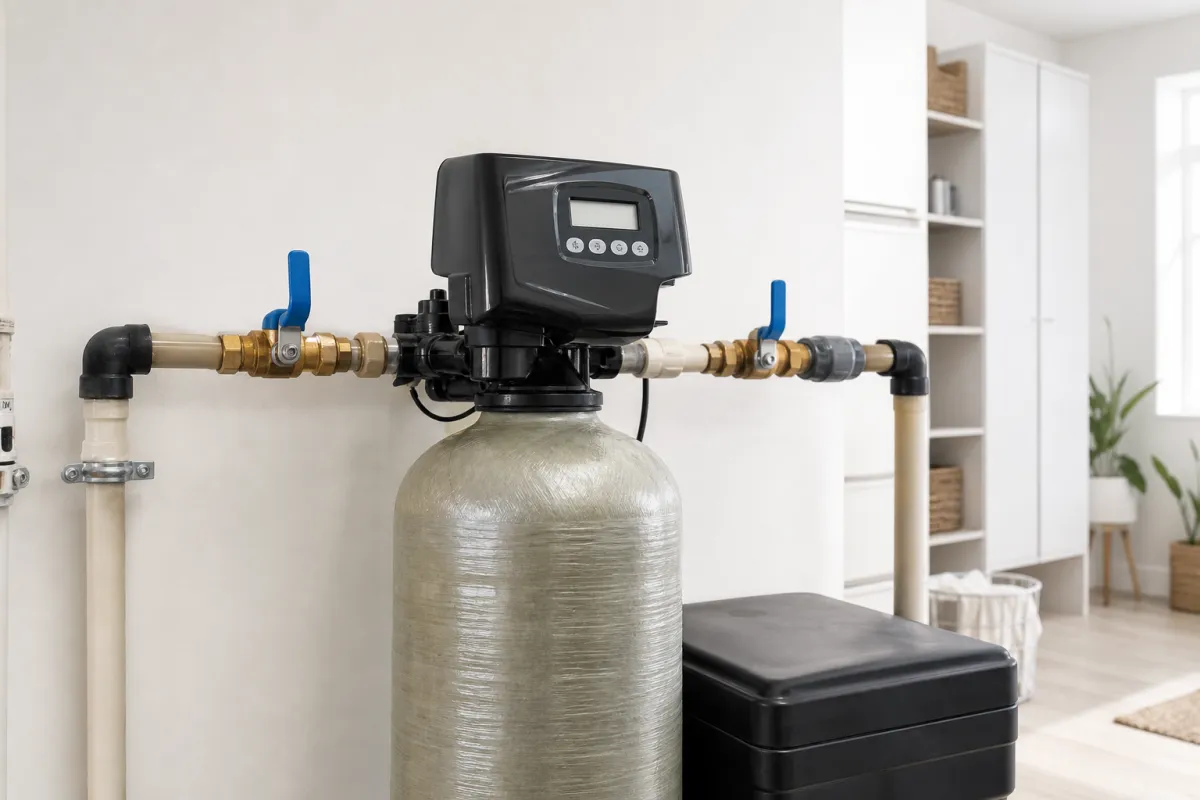
Next, locate the main shutoff, softener inlet and outlet, bypass assembly, and any cartridge prefilter. Confirm that lever-style valves are fully parallel with their pipes and multiport bypass controls are firmly in the service position. Do not force a seized valve. Check whether the issue began after maintenance, a municipal outage, a regeneration cycle, or a sudden increase in household use. Timing often identifies the likely restriction faster than disassembly.
| Observation | Likely area to investigate | Safe first action |
|---|---|---|
| Upstream faucet is strong; softened fixtures are weak | Softener, prefilter, or nearby valves | Test bypass briefly |
| Flow is poor only during peak use | Unit sizing or service-flow limit | Compare demand with specifications |
| Hot water alone is weak | Heater valve, sediment, or hot piping | Inspect without opening the tank |
| Flow worsened after regeneration | Control valve, drain cycle, or resin | Check cycle status and bypass |
| One fixture is weak | Aerator, cartridge, or local stop valve | Clean screen and inspect fixture |
A clogged prefilter is a common restriction
Many softeners have a sediment or carbon cartridge installed ahead of them. As the cartridge captures rust, sand, or fine debris, pressure loss increases. The softener may be blamed simply because both devices are in the same treatment area. A dark-looking cartridge is suggestive, but elapsed time and flow performance are better guides because some media naturally changes color.
Follow the filter manufacturer’s replacement procedure. Shut off water, relieve pressure through a nearby faucet, protect electrical equipment from splashes, and use the correct housing wrench. Never loosen a pressurized housing. Inspect the O-ring, clean its groove, and use only an approved lubricant if specified. If a fresh cartridge immediately restores flow, document the replacement date; unusually rapid clogging may justify a larger filter, a washable sediment stage, or investigation of the well or municipal supply.
Resin beds can foul, swell, or become compacted
Resin beads exchange hardness minerals for sodium or potassium ions. Over time, iron, manganese, sediment, organic material, or chlorine damage can reduce performance and restrict passages through the bed. A failed distributor screen can also allow resin beads into household plumbing, where they may collect in aerators and valve cartridges. Tiny amber or golden beads at fixtures are a reason to bypass the unit and call for service.
Not every old resin bed causes low flow. Healthy resin can remain usable for years when feed-water chemistry is suitable and regeneration is correct. Diagnosis should consider water analysis, unit age, pressure loss across the tank, and whether cleaning is approved for that resin. Do not pour unapproved acids, bleach, or household cleaners into the brine tank. Mixing chemicals or using the wrong concentration can damage components and contaminate drinking-water plumbing.
The control valve or bypass may be restricting flow
The control head contains narrow ports, seals, spacers, a piston or rotor, and often a turbine meter. Sediment, wear, or a motor that stops between cycle positions can leave the water path partly blocked. A bypass valve can also look nearly correct while remaining between service and bypass. This is especially likely when symptoms start immediately after maintenance.
Check the display for an error code and confirm whether the unit is regenerating. During regeneration, some systems provide reduced or unsoftened water; others significantly restrict service. Do not dismantle a pressurized control head. If a brief, manufacturer-approved bypass test restores flow, leave the system in the safest usable position and arrange service. Remember that bypassed water is untreated, which may matter for scale-sensitive appliances and households with other treatment needs.
An undersized softener can feel fine until demand rises
Softener capacity is often advertised in grains, but grain capacity does not tell you how much water can move through the valve without an objectionable pressure drop. Service flow rate is the important specification for simultaneous showers, tubs, laundry, and high-flow fixtures. A unit selected only by regeneration capacity may be too restrictive for a large household or larger supply line.
Estimate peak demand realistically rather than adding every fixture in the house. Note which fixtures commonly run together and compare that demand with the manufacturer’s continuous and peak service-flow ratings. Also examine the connector size. Reducing a large main line through small flex connectors or an unnecessarily complex valve arrangement can create a bottleneck. When piping changes are needed, compare materials and installation considerations such as PEX versus copper for a repipe, but have work comply with local codes.
Use the bypass test carefully
A bypass comparison is the most useful noninvasive test when the system is designed for homeowner operation. First make sure no regeneration is underway. Turn off water-using appliances, then move the bypass slowly according to its labeling or manual. Open a cold faucet and compare flow under similar conditions. Avoid rapid valve movements that can create water hammer or dislodge sediment.
If flow improves substantially in bypass, the treatment train is restricting it. That result does not distinguish among a prefilter, control head, resin tank, or undersized connector, so isolate only components with proper valves and instructions. If flow does not improve, return the valve to its original position and investigate the main shutoff, pressure regulator, well equipment, leaks, and local fixture restrictions. Never leave a leaking or damaged bypass under pressure.
Rule out problems elsewhere in the plumbing
A failing pressure-reducing valve can cause low dynamic pressure throughout a house. A well system may have a clogged filter, weak pump, incorrect pressure-switch operation, or waterlogged pressure tank. Municipal work can introduce debris or temporarily lower supply pressure. Hidden leaks also consume available flow; unexplained meter movement with all fixtures off needs prompt attention.
Old galvanized piping can narrow internally with corrosion. Even a new softener cannot overcome a severely restricted main. If low pressure began after unrelated plumbing work, look for a partly reopened main valve, kinked connector, solder debris, or reversed check valve. Do not attempt to “fix” a restriction by turning a regulator beyond its rated setting. Excess pressure can damage fixture hoses and expose weak joints.
Mistakes that make diagnosis harder
Do not start by repeatedly regenerating the softener. Extra cycles waste salt and water and will not repair a blocked valve or failed distributor. Avoid assuming that adding more salt improves flow; bridging in the brine tank affects regeneration, not the size of the service-water passage. Likewise, plumbing tape is a thread sealant, not a cure for a restriction or cracked fitting—understand where plumbing tape can and cannot stop leaks.
Another mistake is judging pressure from one clogged showerhead. Test multiple fixtures and remove easy local restrictions first. Finally, do not disassemble tanks, pressurized housings, or electrical control heads without shutdown instructions. Water near receptacles or damaged cords is a stop-work condition: isolate power only if it is safe to do so, keep the area dry, and call qualified help.
When to call a water-treatment or plumbing professional
Call a water-treatment technician when bypass clearly restores flow, resin appears at fixtures, the control valve reports faults, or iron and sediment repeatedly foul the unit. A technician can measure pressure before and after the system at controlled flow, inspect internal valve parts, test water chemistry, and determine whether cleaning, rebedding, valve rebuilding, or replacement is economical.
Call a licensed plumber when pressure remains poor in bypass, the main valve or pressure regulator is suspect, piping is corroded, or leaks appear. Urgent help is appropriate for a rapidly leaking tank, water approaching electrical equipment, unexplained loss of well pressure, or contaminated-looking water. Shut off the main if a leak is causing damage and the valve is safely accessible; do not enter flooded areas where electrical hazards may exist.
Frequently asked questions
Can a water softener suddenly reduce pressure?
Yes. A cartridge can load with sediment, a control valve can stop between positions, or debris can shift during regeneration. A sudden change deserves a check of cycle status, bypass position, filters, and upstream flow rather than an immediate resin replacement.
Is some pressure drop across a softener normal?
Yes. Every valve and media bed creates resistance while water flows. The drop should remain within the manufacturer’s specifications at normal household demand. A large difference under controlled flow suggests restriction or improper sizing.
Will regenerating restore water pressure?
It may help if the issue is a reversible media condition covered by the manufacturer’s procedure, but it will not fix broken parts, clogged cartridges, undersized plumbing, or damaged resin. Repeated regeneration is not a diagnostic substitute.
Can I leave the softener in bypass?
Usually for a short diagnostic period, provided the bypass is not leaking and the manual permits it. The house will receive untreated water, so hardness, iron, or other water-quality concerns return. Arrange repair rather than treating bypass as a permanent solution.
Should I replace the whole unit if flow improves in bypass?
Not automatically. A filter cartridge, seal kit, connector, or resin bed may be serviceable. Compare the unit’s age, parts availability, water chemistry, repair cost, and service-flow rating before deciding.
Why This Is Different in San Antonio
San Antonio's Edwards Aquifer supplies some of the hardest municipal water in the United States: about 357 mg/L, or 21 grains per gallon. That limestone-filtered groundwater carries calcium carbonate and magnesium into our fixtures, valves, drains, heaters, and supply lines. For can a water softener cause low water pressure, that matters because mineral scale changes the maintenance schedule, failure signs, and realistic repair costs for local homeowners.
- Scale buildup makes small restrictions worse, especially at cartridges, aerators, shutoff valves, drains, and heater connections.
- Fixtures, pipes, and appliances in our area can wear out 30-50% faster than in soft-water cities when maintenance is delayed.
- SAWS publishes annual water quality reports, but the practical homeowner takeaway is simple: maintenance intervals here should be shorter than national advice suggests.
Homes in Medical Center area are particularly affected because 1970s-80s builds can have aging supply lines and occasional polybutylene concerns. Unlike cities with naturally soft water, local homeowners should treat hard-water maintenance as normal prevention, not an upsell.
> "In my 20 years working in San Antonio, I would say most surprise plumbing failures I see start with homeowners following soft-water maintenance advice in a hard-water city." — Licensed local plumber
What San Antonio Homeowners Pay (2026)
| Service | Typical Cost in San Antonio |
|---|---|
| Emergency plumber call | $150–$350; after hours $250–$500 |
| Plumber hourly rate | $85–$150/hr |
| Water softener installation | $1,500–$4,000 |
Prices are based on local metro area ranges for 2026. Costs may vary by neighborhood, access, pipe material, after-hours timing, and whether the plumber finds hard-water damage beyond the visible problem.
When to Call a San Antonio Plumber
Call a licensed local plumber if the problem involves active leaking, a shutoff valve that will not close, sewer smell, recurring clogs, water near electrical components, a water heater leak, or any pipe inside a wall, ceiling, or slab. Locally, expect many licensed plumbers to charge roughly $85-$150 per hour, with emergency visits commonly around $150-$350 and after-hours calls closer to $250-$500.
When you call, ask three local questions:
1. Are you licensed and insured for work in Bexar County or the surrounding local metro?
2. Have you dealt with Edwards Aquifer hard-water scale on this type of repair?
3. Should I also check the water heater, shutoff valves, or water softener while you are there?
local plumbers see hard-water issues every week, so a good pro should be able to explain whether the failure is normal wear, mineral damage, freeze damage from a cold snap like Winter Storm Uri, or a sign of a larger plumbing system problem.
San Antonio FAQ
Is San Antonio water hard?
Yes. San Antonio water is very hard at about 357 mg/L, or 21 grains per gallon, because much of it comes from the Edwards Aquifer and passes through limestone. That mineral content is why scale shows up quickly on faucets, showerheads, valves, drains, and water heaters.
Do local homes need a water softener?
A water softener is recommended for many local homes, especially if you see white scale, repeated faucet or valve problems, short water-heater life, or cloudy spots on dishes. A typical whole-home water softener installation in San Antonio runs about $1,500-$4,000.