> San Antonio Local Insight: San Antonio's hard water from the Edwards Aquifer affects every plumbing system in your home. With 357 mg/L mineral content (21 grains per gallon), our water causes faster corrosion, heavier scale buildup, and more frequent repairs than most US cities. Understanding this local factor helps you make better decisions about maintenance, repair, and prevention.
Confirm the Unit Is Truly Skipping Salt
Mark the salt level with painter’s tape and compare it after a scheduled regeneration; looking at an uneven pile is unreliable. In King William, start with the clock, bypass position, meter display, salt bridge, and brine level before opening anything. A hardness-test kit costs about $10–$25 and distinguishes appliance failure from old scale flushing out of historic plumbing.
Use only blunt, gentle pressure to break a bridge, and keep cleaners out unless the manufacturer approves them. Unplug the unit before inspecting external tubing and never loosen a fitting under pressure. Edwards Aquifer water at about 357 mg/L (21 gpg) requires substantial capacity, so a low hardness setting or failed flow meter can leave the salt untouched while hard water passes through.
If the salt level in your water softener never seems to change, the appliance may not be regenerating, may be regenerating too infrequently, or may be unable to draw brine from the tank. A salt bridge, salt mush, blocked injector, kinked brine line, failed motor, incorrect programming, or bypassed valve can all produce the same symptom. Low household water use can also make normal salt consumption surprisingly slow.
Do not add more salt until you know what is happening. An overfilled brine tank makes diagnosis harder and can create a solid mass that must be removed. Start by confirming whether the home's water has actually become hard, note the display and water level, and check when the unit last regenerated. Those observations separate a real malfunction from a system that simply has not needed much salt.
Confirm That Salt Consumption Is Actually Abnormal
Mark the salt level with removable tape on the outside of the tank and record the date. Salt use depends on water hardness, household consumption, resin capacity, and regeneration settings, so there is no single normal number of bags per month. A one-person household with efficient demand-initiated regeneration may see little change for weeks. A timer-based unit should follow its programmed schedule even when water use is low.
Check for practical signs of hard water: soap that rinses poorly, fresh scale on faucets or shower glass, spots on dishes, or a slippery feel that has disappeared. The most useful confirmation is a hardness test on cold water from a softened fixture. Compare it with untreated water at an outdoor tap or a sample taken while the unit is bypassed. Test strips provide a rough indication; a service technician can perform a more precise test and confirm whether the softener is providing capacity between regenerations.
Check the Bypass Valve and Basic Settings
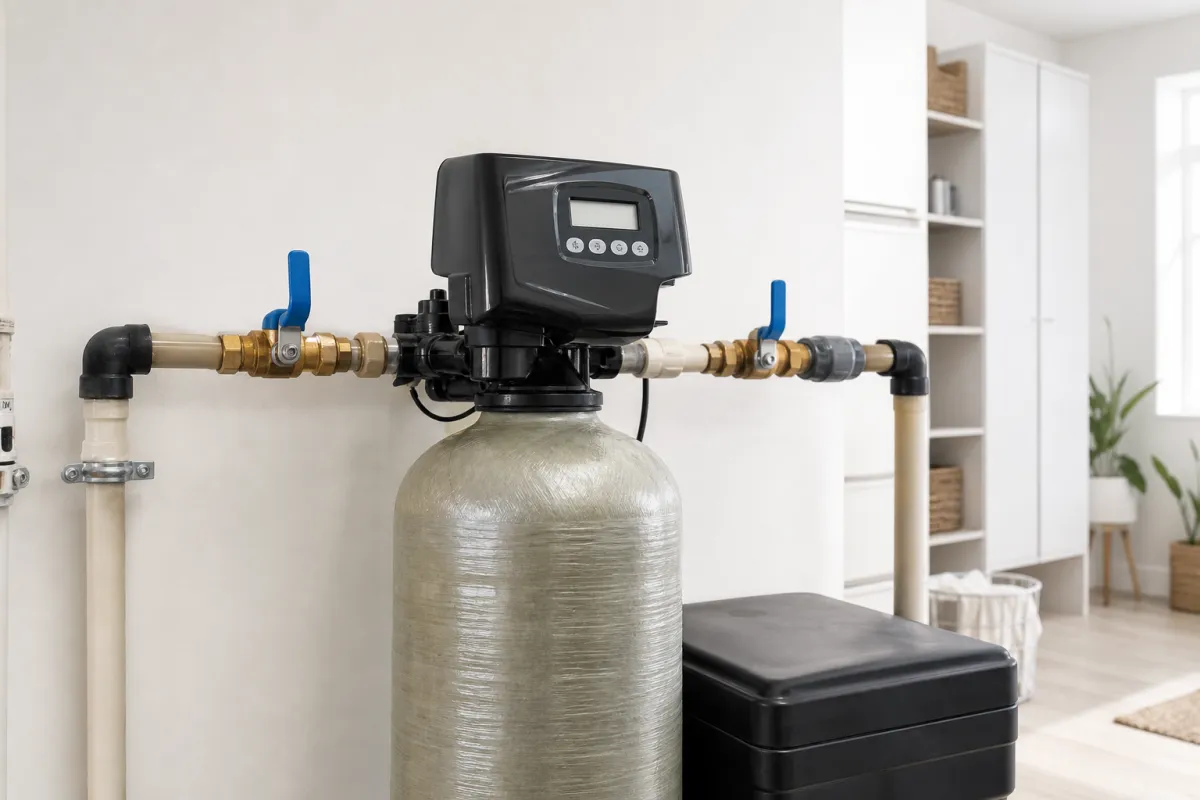
A softener left in bypass does not treat water and may not move water through the meter that triggers regeneration. Inspect the bypass position using the labels on the valve or the owner's manual; designs vary, and some use push-pull plungers while others use rotating handles. Do not force a stuck plastic valve. Look for a service icon or flow indicator on the display while a cold-water faucet is running.
Verify the clock, regeneration time, hardness setting, capacity, and household-use assumptions after any outage or control-board reset. Enter the actual hardness supplied by your utility or a water test, including any model-specific adjustment for iron. Do not inflate the setting as a guess because that wastes salt and water. Confirm that the transformer is plugged into a working, dry outlet and that the display is not showing an error. If water is near the outlet or cord, avoid contact and address the electrical hazard first.
| Observation | What it may mean | First safe action |
|---|---|---|
| Display is blank | No power, failed transformer, or control fault | Check a dry outlet and circuit; do not open energized controls |
| Flow indicator never moves | Bypass position, meter fault, or installation issue | Confirm valve position and request service if unchanged |
| Salt forms a hard roof | Salt bridge | Break it carefully without striking the tank |
| Water is high in brine tank | Brine draw, injector, drain, or float problem | Bypass and arrange diagnosis |
| Manual cycle runs but salt stays dry | Blocked brine path or air leak | Inspect accessible tube connections |
| Soft water and low usage | Possibly normal operation | Mark level and monitor |
Look for a Salt Bridge
A salt bridge is a hardened crust that spans the brine tank while an empty space develops beneath it. From above, the tank looks full, but water cannot reach enough salt to make brine. Bridges are more likely with high humidity, certain salt forms, or a tank kept packed to the top. Gently press the salt surface with a broom handle or another blunt wooden tool reserved for this purpose. A hollow feel or sudden drop can reveal the void.
Work carefully so you do not puncture the tank, damage the brine well, or hit the float assembly. Do not use a hammer, metal bar, drill, or boiling water. Break the crust into manageable pieces and remove any large solid slabs. Keep the salt level moderate afterward and follow the manufacturer’s approved salt type. If the entire mass is immovable or the tank wall flexes under force, stop and have the tank emptied by a technician.
Recognize Salt Mush and Contaminated Brine
Salt mush is a dense paste at the bottom of the tank. Unlike a bridge, it may be hidden under apparently loose pellets. It can restrict water movement around the brine pickup and prevent proper brine concentration. Dirt, insoluble material, or repeated topping-up without periodic inspection can worsen the condition. A strong unusual odor, dark sludge, or evidence of contamination calls for more than simply stirring the tank.
Cleaning procedures vary. Many units must be bypassed, unplugged, drained, and have their salt removed before the brine tank is washed with an approved mild solution and rinsed. Follow the exact manual because float and tubing arrangements differ. Never mix cleaning chemicals, and do not pour brine onto soil, storm drains, or septic components without checking local rules. If the tank is very heavy, avoid trying to move it while full; salt and water can make a plastic cabinet difficult to control and easy to crack.
Observe a Manual Regeneration Without Taking the Valve Apart
A controlled manual regeneration can show whether the motor advances, drain flow starts, brine is drawn, and refill occurs. Read the model instructions first, make sure the drain hose is secure and unobstructed, and remain nearby for the whole test. Keep the area dry, and know how to place the unit in bypass. Do not begin a cycle if the brine tank is already near overflowing or the drain has backed up before.
During the brine-draw stage, the water level in the brine tank should generally fall, although the change may be slow and partly hidden by salt. During refill, water returns according to the programmed dose. A unit that stalls, makes repeated motor noises, continuously drains, or raises the brine level without later drawing it down needs service. Do not repeatedly force cycles: that can waste large amounts of water, increase flood risk, and still leave the resin exhausted.
Inspect the Brine Line, Float, Injector, and Drain
The small tube between the control valve and brine tank must be connected, unkinked, and airtight during brine draw. A loose fitting or hairline crack can admit air instead of lifting brine. Check only accessible external parts with the unit bypassed and depressurized as directed. Reconnect tubing with manufacturer-approved ferrules and inserts; general-purpose tape is not a substitute on a compression or push-fit connection. The same principle applies elsewhere in plumbing, as explained in does plumbing tape stop leaks.
The injector or venturi creates suction, and small debris or mineral buildup can block its narrow passage. The safety float can also stick, while a restricted drain can prevent the pressure conditions needed for brine draw. Some manuals describe safe cleaning of removable screens and injector parts, but orientation and sizing matter. If you cannot positively identify the components, leave the control head intact. A water-treatment technician can test suction, drain rate, and valve sequencing without damaging precision parts.
Determine Whether the Unit Is Metering Water
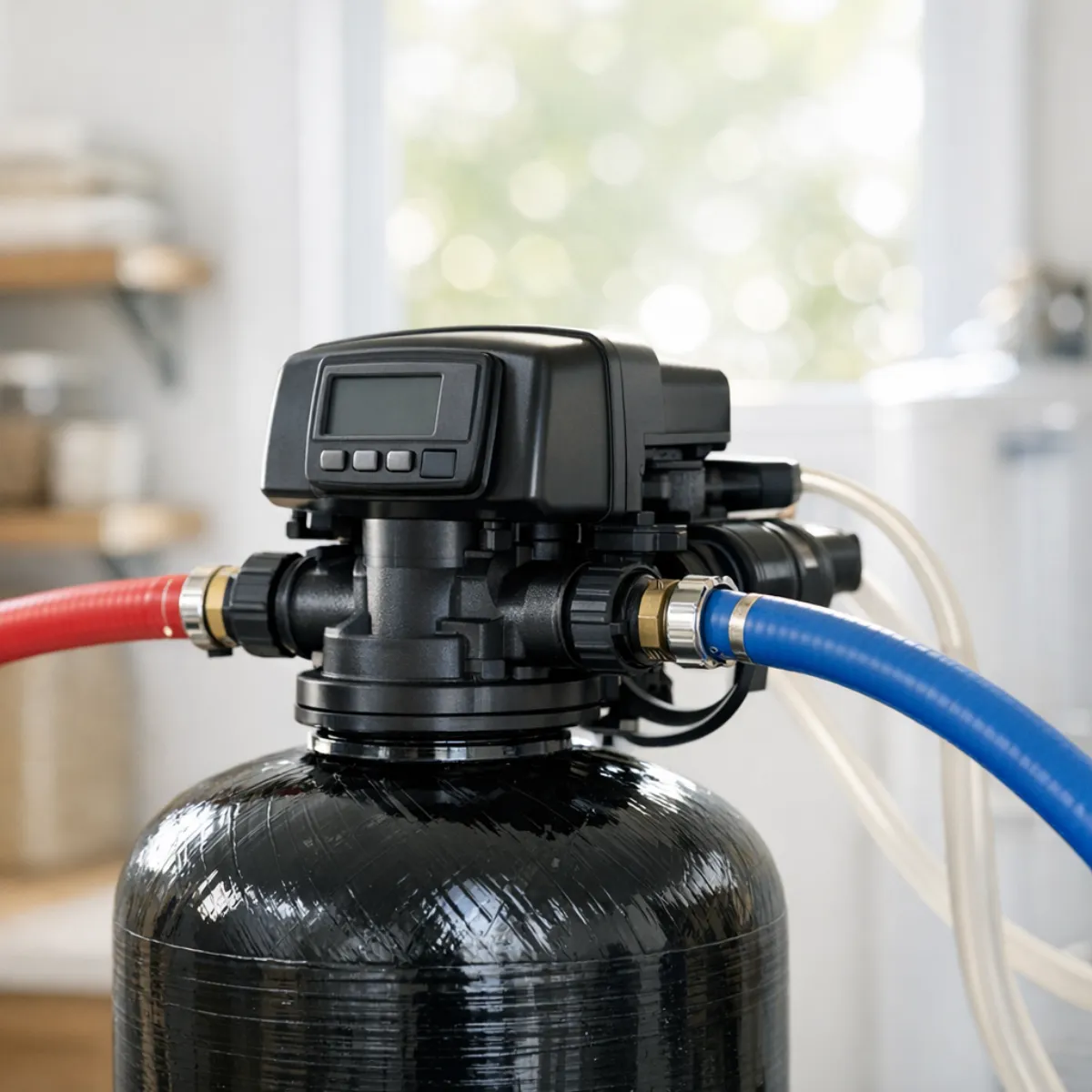
Demand-initiated softeners depend on a turbine, paddle wheel, cable, or electronic sensor to count water use. Run a fixture and watch for a flow icon or changing gallon count. If the display does not register flow even though the bypass is in service, the meter may be jammed, disconnected, installed backward, or failed. A control board may also have lost its capacity settings.
Meter diagnosis often requires depressurizing and separating the valve from plumbing, which is not a casual repair. Plastic connectors and O-rings can crack or leak if assembled incorrectly. If recent plumbing work preceded the problem, check that inlet and outlet were not reversed and that valves are fully open. Broader pipe replacement choices, such as PEX versus copper, are usually unrelated to salt draw, but rigid or poorly supported connections can place harmful stress on the softener’s bypass assembly.
Match the Salt Setting to Water Conditions
A softener should be programmed using measured hardness, resin capacity, and a reasonable reserve—not merely the maximum number available on the display. A setting that is too low allows hardness breakthrough while using little salt. A setting that is too high regenerates too often and wastes resources. Well water containing iron or manganese may require pretreatment or a model-specific compensated setting; ordinary softening salt cannot fix every water-quality issue.
If the household size or water source changed, review the programming with the manual or an experienced dealer. Also confirm whether the appliance uses standard sodium chloride, potassium chloride, blocks, crystals, or pellets. Do not assume products are interchangeable. Some specialty cleaners are intended only for periodic use at precise doses. Never put household bleach, drain cleaner, detergent, or unapproved chemicals into the brine tank, and protect salt bags from moisture and contaminants.
Know When the Resin or Control Valve May Be Failing
A unit can complete cycles and consume little salt because a valve seal, piston, motor, cam, or control board is not moving through the stages correctly. Conversely, it can consume salt but still deliver hard water if resin is exhausted, fouled, or undersized for current demand. Resin condition depends on water chemistry, disinfectant exposure, iron, flow rates, and operating history; age alone does not prove failure.
Professional testing should include untreated and treated hardness, meter response, brine suction, drain flow, cycle timing, and valve leakage. Ask for the failed component and repair options rather than accepting salt use as the only diagnosis. If replacement is recommended, include installation modifications, warranty, drain compliance, and any pretreatment in the comparison. Nearby aging equipment may affect the project budget, but costs such as water heater replacement should be evaluated separately rather than bundled without explanation.
Avoid Common Troubleshooting Mistakes
Do not keep pouring bags into a tank whose level never falls. Do not stab a salt bridge with sharp tools, bypass an air gap, clamp a leaking pressure fitting, or disassemble an energized control head. Repeated manual regenerations are also a poor diagnostic shortcut. They consume water and may overflow a tank when the true issue is a blocked drain or failed brine draw.
Another mistake is replacing parts before testing the incoming and outgoing water. Hard-water symptoms can come from a bypassed mixing valve, an untreated cold line, depleted hot-water storage, or scale left from an earlier fault. After restoring softening, a conventional water heater may take time to exchange its stored hard water. Document each setting and observation, make one change at a time, and restore all covers and clips exactly as designed.
Frequently Asked Questions
How quickly should the salt level go down?
It depends on hardness, water use, capacity, and dose. Efficient units may regenerate only after many days or weeks. Mark the level and verify softened-water hardness rather than judging by a short period alone.
Should there be water in the salt tank?
Usually there is some water, and it may sit below the salt surface. The expected level varies by design and cycle stage. Water near the overflow, a continuously rising level, or no draw during regeneration indicates a problem.
Can I use hot water to dissolve a salt bridge?
Do not pour boiling water into the plastic tank. Carefully break a bridge with a blunt tool according to the manual. If the mass is extensive, empty and clean the tank rather than risking damage.
Why is my water hard even though the tank is full of salt?
The salt may be bridged, the unit may be bypassed or unpowered, the meter may not trigger regeneration, or the brine path may be blocked. The resin or control valve may also need service. Test treated water and observe a cycle.
When should I call a professional?
Call when the tank overfills, the drain backs up, the valve leaks, the motor stalls, electrical components get wet, or model-specific parts must be opened. A technician should also evaluate recurring hard water after correct programming and a confirmed brine draw.
Why This Is Different in San Antonio
With Edwards Aquifer water around 357 mg/L (21 gpg), a correctly sized softener should use salt regularly. No movement can indicate a salt bridge, failed brine draw, bypassed valve, meter fault, or excessive programmed capacity—not “efficient operation” by itself. Historic King William houses add old galvanized lines and tight retrofit drains to the equation. Compare untreated and treated hardness, then verify actual gallons on the controller. SAWS supply information provides context; the appliance’s own cycle evidence identifies the fault.
What San Antonio Homeowners Pay (2026)
| Salt-use diagnosis or repair | Typical local range |
|---|---|
| Test and diagnostic visit | $95–$185 |
| Salt-bridge cleanup/injector service | $150–$400 |
| Meter or valve rebuild | $400–$950 |
| New whole-home softener | $1,500–$4,000 |
Drain access, resin disposal, and plumbing correction can change a Bexar County estimate. In San Antonio, ask the technician to show brine draw and post-service hardness.
When to Call a San Antonio Plumber
Escalate when the unit cannot draw brine, the meter does not register flow, water runs continuously to drain, the tank overfills, or the bypass is seized. Do not dismantle the pressurized valve or pour unapproved chemicals into the resin. A qualified technician should test before replacing parts.
San Antonio FAQ
How much salt should a household use?
It depends on water use, measured hardness, resin capacity, and efficiency settings. Track pounds per month and regeneration gallons rather than relying on a universal number.
Can seasonal use change salt consumption?
Yes. Guests, summer demand, leaks, and irrigation plumbing can change metered flow. A sudden zero-use pattern still warrants a bridge and brine-draw check.