> San Antonio Local Insight: Drain and sink clogs in San Antonio are different from other cities. Edwards Aquifer hard water (357 mg/L) deposits white calcium scale inside pipes that traps hair, grease, and soap more aggressively. Standard drain cleaners often fail because they dissolve organic matter but not mineral buildup. local homes need descaling-specific methods.
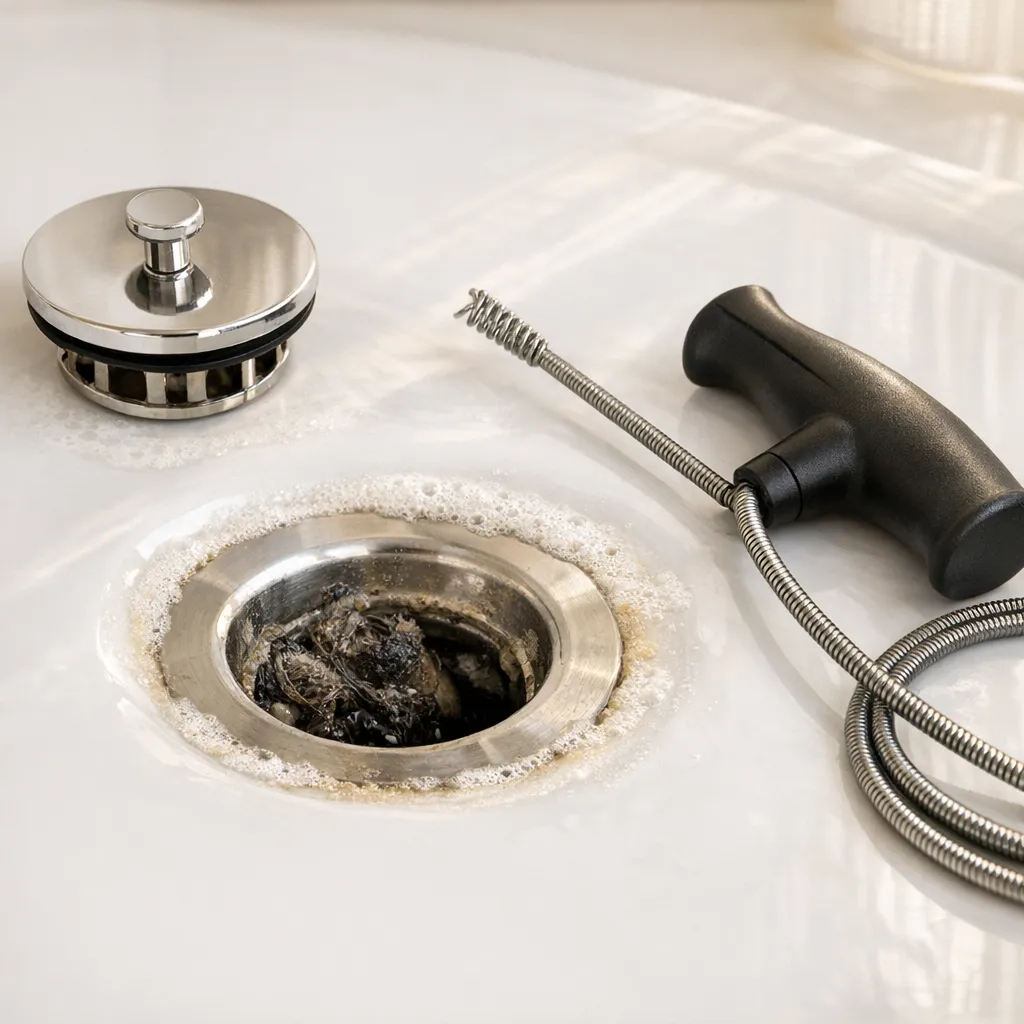
A slow sink that still drains is usually partially restricted, not clear. Around San Antonio, Edwards Aquifer water at roughly 357 mg/L, or 21 gpg, leaves calcium scale that roughens the pipe wall. Grease, starch, and food fines then cling to that surface. A small snake may punch a path through the center without cleaning the coating, which explains why flow can improve briefly and then slow again.
The same pattern is familiar in New Braunfels and Boerne, where Hill Country water is also hard. Start with the strainer and P-trap, keep caustic chemicals out of the line, and note whether both bowls or other fixtures are affected. A simple local drain cleaning commonly runs $150–$350; a camera inspection is often $200–$400 when the restriction returns or older pipe condition is uncertain.
A homeowner in New Braunfels and Boerne should be especially careful because nearby Hill Country systems have similar hard-water pressure on heaters and fixtures. If you are comparing advice from national repair guides, shorten the maintenance interval and inspect for white scale, crusted fittings, stiff shutoff valves, and early corrosion before assuming the part simply “got old.”
For budgeting, use local pricing instead of national averages: drain cleaning usually runs $150-$350, and a sewer camera inspection is commonly $200-$400. If the issue appears after a summer high-use period or after a rare freeze like Winter Storm Uri, treat it as a local risk signal and document what you see before calling a licensed plumber in Bexar County.
A kitchen sink can drain slowly even when there is no solid plug blocking the pipe. The usual explanation is partial restriction: grease coats the pipe walls, food residue narrows the P-trap, a garbage disposal holds debris, or poor venting prevents water from moving freely. The sink still empties, but the pathway for water or air is smaller than it should be.
Start with simple observations rather than immediately pouring a chemical cleaner down the drain. Note whether one bowl or both bowls drain slowly, whether running the disposal changes the flow, and whether you hear gurgling. Those details help separate a local buildup from a deeper drain or vent problem. Most early-stage restrictions are manageable, but recurring backups, sewage odors, leaks, or several slow fixtures justify professional diagnosis.
Why a Drain Can Be Slow Without Being Fully Clogged
“Clogged” is often treated as an all-or-nothing condition, but drain problems usually develop gradually. Cooking grease, starch, soap residue, and fine food particles can adhere to the inside of a pipe. Each layer reduces the pipe’s usable diameter and creates a rough surface that catches more debris. Water continues to pass through the remaining opening, so the sink never appears completely blocked. A partial restriction may be most noticeable when you release a full basin of water rather than when the faucet runs at a light trickle.
Airflow also matters. Drainage relies on plumbing vents to admit air and balance pressure as wastewater moves through the system. A venting problem can make a clear pipe behave like a restricted one, often with gurgling or fluctuating water levels. Pipe slope, an aging corroded line, or a poorly arranged under-sink connection can also slow flow. The key is to diagnose the pattern before choosing a fix; a product meant to dissolve residue will not correct a blocked vent or badly pitched pipe.
What to Check Before Taking Anything Apart
Begin by removing dishes and standing water, then inspect the visible drain opening with a flashlight. Lift out the basket strainer and remove loose scraps with a paper towel or a small nonmetallic brush. If the sink has two bowls, fill each with a few inches of water and release them separately. One slow bowl suggests a restriction near that bowl’s strainer or branch connection. Both bowls slowing together points toward the shared trap, disposal outlet, or drain farther downstream.
Next, run the faucet at a moderate rate and watch how quickly water begins to pool. Listen for gurgling and check the cabinet for drips, dampness, or a swollen cabinet base. If there is a garbage disposal, switch it off before looking into the opening; never put a hand inside it. Test the disposal only with water running and only if it sounds normal. A humming, jammed, leaking, or electrically intermittent unit needs separate attention. These checks cost nothing and keep you from dismantling clean parts while overlooking the actual trouble spot.
Common Causes and the Clues They Leave
The most common cause is a greasy film mixed with food residue. It often produces a drain that works reasonably well with cold trickles but falls behind when a basin is emptied. Starchy foods such as rice, pasta, flour, and potato residue can create a paste-like coating, while coffee grounds and finely chopped scraps settle in low points. If a disposal is present, insufficient water during grinding may leave material in its chamber or outlet elbow. A dirty strainer can also hide a surprisingly restrictive layer just below the visible basket.
Mechanical or installation issues leave different clues. Gurgling may indicate inadequate venting or a downstream restriction drawing air through the trap. A flexible accordion-style drain tube can collect debris in its ridges and sag, while an improperly sloped horizontal arm holds residue instead of carrying it away. Older galvanized or cast-iron piping can narrow internally from corrosion and scale. If the problem began after under-sink plumbing was changed, suspect alignment, slope, or an incorrectly installed trap before assuming years of buildup appeared overnight.
| What you notice | Likely area to investigate | Sensible first response |
|---|---|---|
| Only one bowl drains slowly | Strainer or that bowl’s branch tube | Clean the opening and removable branch parts |
| Both bowls drain slowly | Shared P-trap or downstream line | Clean the trap, then use a hand auger if appropriate |
| Flow improves when disposal runs | Disposal chamber or outlet elbow | Flush while operating normally; inspect safely if needed |
| Gurgling accompanies drainage | Partial downstream restriction or vent issue | Stop repeated product use and diagnose the system |
| Several fixtures are slow | Branch drain, main drain, or venting | Call a plumber rather than treating only the sink |
| Cabinet is damp or smells musty | Loose joint, cracked part, or hidden leak | Stop using the sink heavily and locate the leak |
Safe Cleaning Steps to Try First
Start with the least invasive method. Remove and wash the basket strainer, then flush the drain with hot tap water and a small amount of dish detergent. Use hot tap water rather than a kettle of boiling water, especially with PVC piping or uncertain joints. The detergent may help lift light grease, but it is not a cure for a thick deposit. Run enough water to carry loosened residue beyond the trap instead of merely moving it a few inches downstream.
A sink plunger can help if the restriction is close. Block the second bowl with a stopper or wet cloth, add enough water to cover the plunger cup, and use controlled strokes. On a dishwasher-connected setup, be alert for water movement through connected hoses. If plunging does not improve the drain after a short attempt, stop rather than applying greater force. Baking soda and vinegar may deodorize and agitate light residue, but their foaming reaction is not a reliable way to remove grease-packed or mechanically lodged material. Treat it as mild cleaning, not a substitute for physical removal.
How to Clean the P-Trap Without Making a Bigger Problem
The P-trap is the curved section below the sink that holds water to block sewer gases. Before removing it, turn off the faucet, clear the cabinet, place a bucket underneath, and take a photo of the existing assembly. If the disposal or nearby wiring could be disturbed, switch off the disposal circuit at the breaker and verify that the unit will not start. Loosen slip nuts by hand or with gentle pressure from pliers; old metal fittings may be fragile and should not be forced.
Lower the trap carefully because it will contain dirty water. Clean it with a bottle brush, then inspect the short pipes leading into and out of it. Do not push debris blindly into the wall pipe. Reassemble the washers in their original orientation, tighten the nuts hand-snug, and test first with a small amount of water. Dry each joint and check for fresh droplets, then fill and release the basin while watching again. If a fitting is corroded, cracked, glued in place, or will not reseal, stop and replace the correct parts or call a plumber. A small drain issue should not be traded for cabinet water damage.
When a Hand Auger Is the Better Next Step
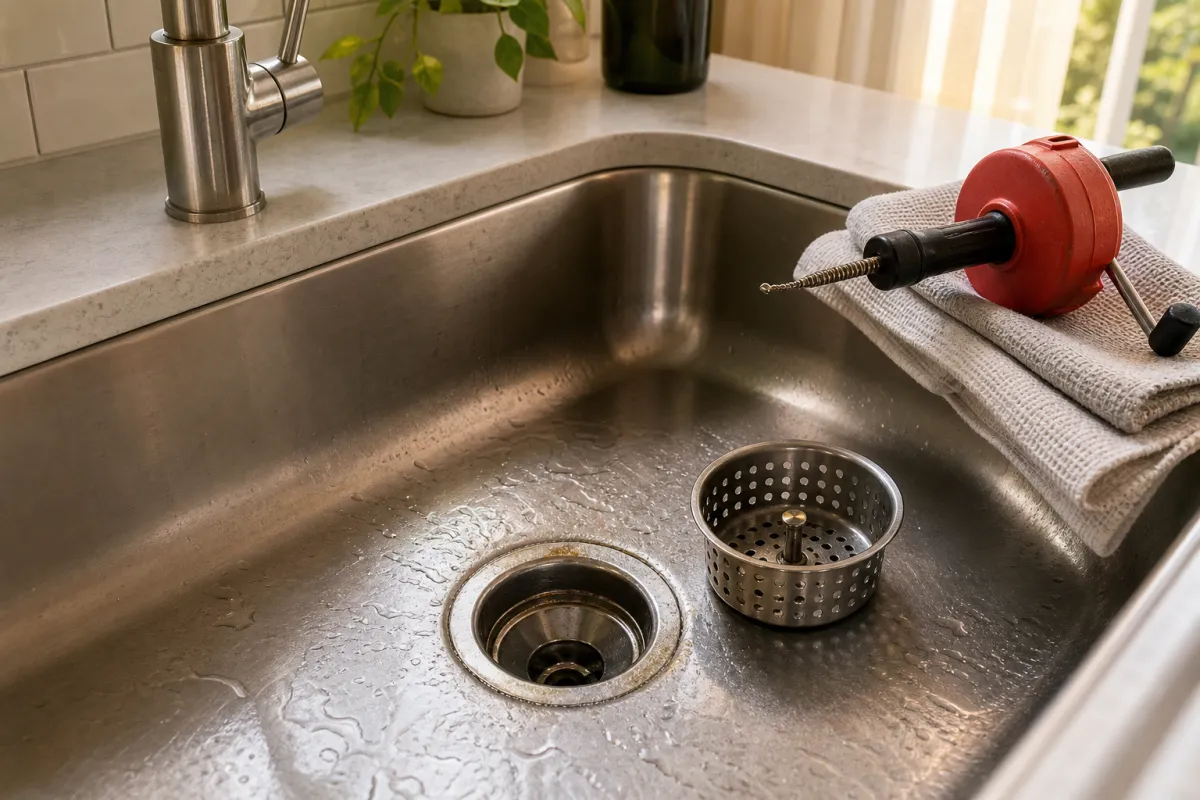
If the trap is clean but the sink remains slow, the restriction may be inside the wall branch. With the trap removed and a bucket in place, a homeowner can sometimes use a small manual drain auger intended for sink lines. Feed the cable gradually, rotate it according to the tool’s directions, and avoid aggressive force at resistance. The goal is to retrieve or break through soft buildup without damaging fittings or trapping the cable. Wear eye protection and gloves because the cable can bring back contaminated residue.
An auger is not appropriate for every system. Do not run one through a garbage disposal, force it into an unknown fitting, or use powered drain equipment without training. Stop if the cable repeatedly binds, the wall connection moves, or wastewater backs out under pressure. After retrieval, reassemble the trap, leak-test it, and flush the line with hot tap water. A basic hand auger is inexpensive compared with a service call, but professional drain cleaning becomes better value when access is poor, the line is old, or the same restriction returns soon after cleaning.
Garbage Disposal and Dishwasher Connections
A garbage disposal can spin normally while its chamber, rubber baffle, or discharge elbow remains coated with residue. Turn off its breaker before cleaning around the opening or removing connected parts, and confirm the switch cannot start it. Never reach into the chamber, even when power is off; use tongs for visible loose objects and follow the manufacturer’s instructions for any jam-clearing tool. If the unit hums, trips the reset repeatedly, leaks from its body, or has a damaged cord, stop using it and address the appliance or electrical fault.
Dishwasher discharge can complicate the symptoms. Water may enter the disposal or drain branch faster than a restricted line can accept it, causing temporary sink pooling. Check that the dishwasher hose is not kinked and that its high loop or air-gap arrangement matches local requirements. If the slow drainage started after a new disposal or dishwasher installation, the connection may have been assembled incorrectly. Do not disconnect a dishwasher mid-cycle, and do not treat water near electrical connections casually. Shut off power and water as needed before inspection, or have an appliance technician or plumber evaluate the setup.
Drain-Cleaning Mistakes That Often Make Things Worse
Avoid repeatedly using caustic chemical drain cleaners. They can remain trapped in a slow line, creating splash and burn hazards when someone later opens the trap or uses an auger. They may also damage some finishes, seals, disposals, or weakened piping. Never mix drain cleaner with bleach, ammonia, vinegar, or another cleaner. If a chemical product has already been used, tell anyone working on the drain exactly what and when, ventilate the area, and follow the label’s safety directions.
Other mistakes are less dramatic but still costly. Do not pour boiling water into unknown plastic plumbing, overtighten slip nuts, or assume a leak will seal itself. Do not use the disposal as a substitute for scraping plates, and avoid sending grease, coffee grounds, eggshells, flour, rice, pasta, or fibrous scraps down the drain. Most importantly, do not keep treating the sink locally when multiple fixtures are slow. That pattern may involve a larger branch or main drainage problem, where continued water use can cause an unsanitary backup.
When Slow Drainage Points to a Bigger Plumbing Problem
Call a plumber when the sink backs up repeatedly after the trap has been cleaned, when several fixtures drain slowly, or when running one fixture causes another to gurgle or rise. Sewage odors that persist after confirming the trap contains water also deserve attention. Stop using affected fixtures if wastewater appears in the sink, a floor drain rises, or contaminated water leaks into a cabinet. Keep people away from the area, avoid skin contact, and do not use chemical cleaners in an active sewage backup.
Professional help is also sensible for old corroded pipes, inaccessible branch lines, suspected vent obstructions, or under-sink plumbing that lacks proper slope. A plumber may use a cable machine, inspection camera, or targeted pipe replacement after evaluating the layout. The total depends on access, pipe material, and whether the problem is a simple branch cleaning or a damaged line, so request a written scope before approving extensive work. If opening a wall or replacing pipe is proposed, ask what evidence supports that recommendation and whether camera findings or removed material can be documented.
How to Keep the Kitchen Sink Flowing Freely
Prevention is mostly about keeping problematic material out of the drain. Scrape plates into trash or compost, wipe greasy pans with a paper towel before washing, and use a basket strainer that catches fine scraps. Collect cooking oil and fat in a container rather than pouring it down the sink. When using a disposal, run cold water, feed small amounts gradually, and continue the water briefly after grinding, following the appliance manufacturer’s guidance.
Pay attention to changes instead of waiting for standing water. A sink that drains more slowly week by week is easier to address before the line closes completely. Clean the strainer regularly, inspect under-sink joints for moisture, and correct sagging or accordion-style piping when practical. If buildup returns despite careful use, the underlying issue may be pipe condition, slope, or venting rather than household habits. Repeatedly cleaning the same section is not preventive maintenance if a structural defect keeps creating the same collection point.
Frequently Asked Questions
Can a kitchen sink be slow even if a snake finds no clog?
Yes. A small snake may pass through the center of a greasy or scaled pipe without removing the coating from its walls. It may also miss a vent issue, a poorly sloped section, or buildup in a disposal elbow. If the cable returns clean and flow remains slow, inspect the trap and configuration, then consider professional diagnosis rather than repeatedly forcing a larger tool.
Will baking soda and vinegar fix a slow kitchen sink?
They may loosen light residue and reduce odor, but the foaming action is unlikely to clear thick grease, compacted food, corrosion, or a venting problem. Use them only as a mild cleaning option, never after a commercial chemical cleaner. Physical cleaning of the strainer and trap is usually more informative because it lets you see what was actually restricting flow.
Why does my sink drain better when the garbage disposal is running?
The spinning impellers and moving water may temporarily push residue through a coated disposal chamber or outlet. That points toward buildup near the disposal, but it does not prove the downstream line is clear. If the improvement is temporary, safely inspect the baffle and discharge components with power disconnected, or have the unit serviced if it leaks, hums, or trips.
Does gurgling mean the plumbing vent is blocked?
It can, but gurgling also occurs when a partial drain restriction pulls air through the P-trap. Because the symptoms overlap, do not climb onto a roof or insert tools into a vent without proper access and fall protection. First rule out accessible sink components; persistent gurgling or effects at multiple fixtures are good reasons to call a plumber.
How do I know whether the problem is beyond the kitchen sink?
Check nearby fixtures without running large volumes of water. If a dishwasher discharge makes the sink rise, another drain gurgles, or several fixtures are slow, the restriction may be in a shared branch or main line. Stop testing if wastewater begins to back up. A broader pattern calls for professional drain evaluation rather than another dose of sink cleaner.
Why This Is Different in San Antonio
The local issue is the combination of very hard Edwards Aquifer water, long cooling seasons, and plumbing that ranges from historic metal pipe to newer PEX installations. At 357 mg/L (21 gpg), mineral scale accumulates quickly on continuously wet surfaces. SAWS water-quality reporting is useful context, but scale does not prove that every failure was caused by water chemistry; diagnose the actual leak, restriction, or electrical symptom.
Season also matters. Summer cooking and heavy household use load kitchen drains, while a freeze event like Winter Storm Uri can expose already stressed fittings in an unconditioned cabinet or exterior wall. Bexar County homeowners should inspect after a hard freeze, but never energize a wet disposal or force a brittle connection.
What San Antonio Homeowners Pay (2026)
| Service | Typical local range |
|---|---|
| Kitchen drain cleaning | $150–$350 |
| Camera inspection | $200–$400 |
| Trap or under-sink correction | $150–$325 |
| After-hours backup response | $250–$500 |
These are planning ranges, not quotes. Access, disposal model, corroded fittings, outlet condition, after-hours timing, and cabinet damage determine the final total. Ask for an itemized scope before approving work.
When to Call a San Antonio Plumber
Call a licensed plumber for a recurring slow kitchen drain, wastewater backup, a shutoff that will not close, or work that requires changing the flange, trap, or wall connection. Stop immediately and use a licensed electrician when water reaches wiring, a breaker trips repeatedly, the receptacle is scorched, or the unit is improperly hardwired. DIY cleaning is reasonable only while power is isolated and the work stays within the manufacturer’s instructions.
When booking service, describe when the symptom occurs, whether the dishwasher is involved, and what you already tested. Ask whether the technician regularly works with hard-water scale and older Bexar County plumbing. That information produces a more useful diagnosis than requesting a generic “tune-up.”
San Antonio FAQ
Does 21 gpg hard water automatically ruin a garbage disposal?
No. The minerals mainly create scale on wet surfaces and contribute to residue retention and corrosion around connected plumbing. Correct use, a dry cabinet, and prompt attention to slow drainage or leaks matter more than aggressive chemical treatment.
Should I install a water softener for this problem alone?
Not solely for one disposal symptom. A softener may make sense when the household also has repeated scale at faucets, valves, showers, and the water heater. Evaluate the full plumbing system and ongoing salt and maintenance costs; a typical whole-home installation can run about $1,500–$4,000.
Who should handle permits or code questions?
For altered plumbing or electrical work, use licensed trades who can confirm the current requirements that apply to the address. That is especially important when a direct appliance swap turns into drain relocation, receptacle work, or repair inside a wall.